Artificial-intelligence spending is still accelerating, but the stock market is increasingly asking whether the profits are arriving fast enough to justify the prices.
AI Stocks Face Rate Pressure as Yields Rise

That tension is driving the latest pullback in AI bellwethers even as companies such as Snowflake and Broadcom keep reporting strong demand. Nvidia rose to $228.45 on Sept. 3, but after a volatile summer it remains well below its May peak of $235.47, while Microsoft has also been trading more than $30 below its June high as investors rotate in and out of the sector. The broader S&P 500, meanwhile, continues to sit near record levels, showing that the weakness is concentrated in the most crowded AI names rather than the market as a whole.
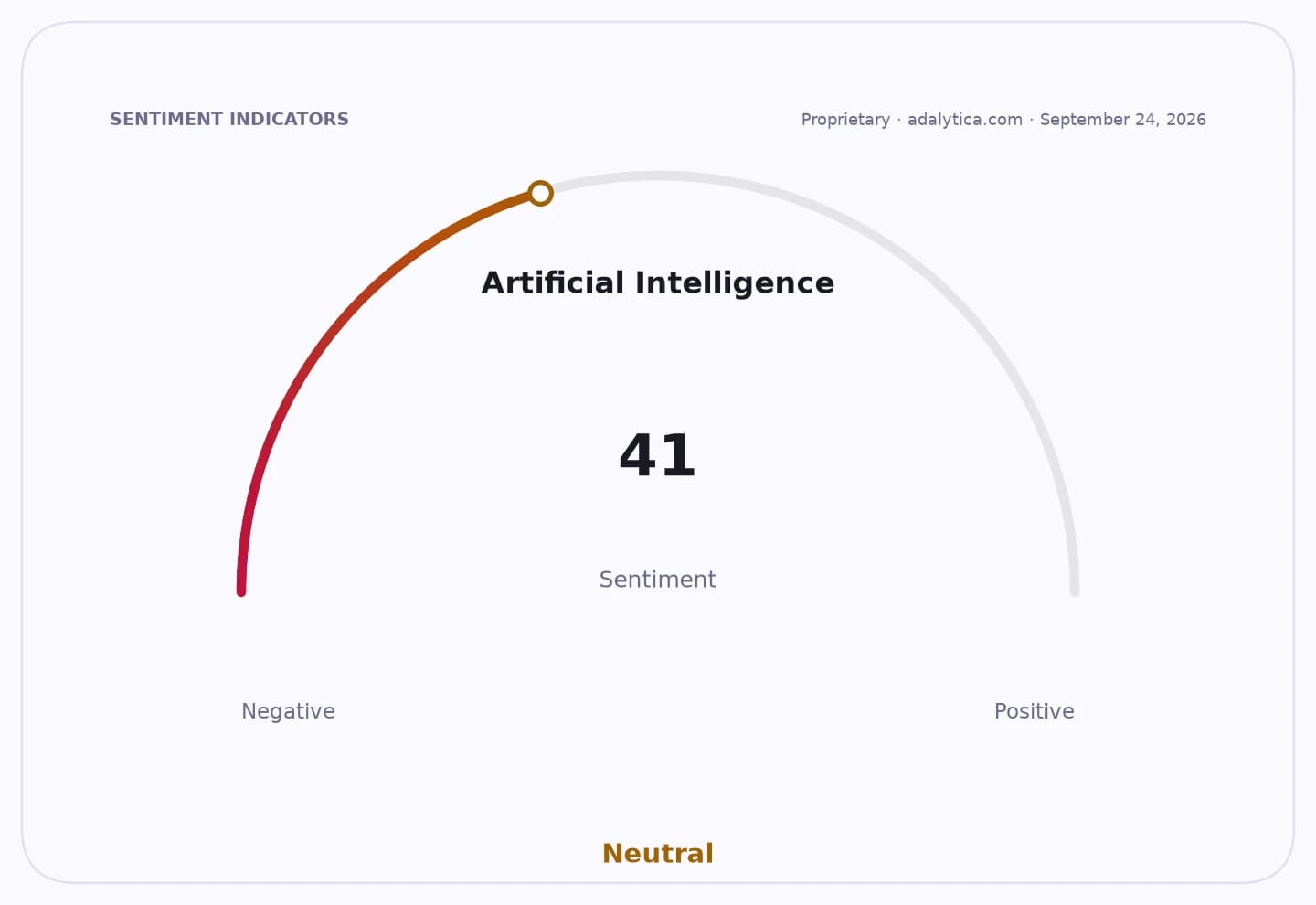
Sentiment IndicatorsⓘProprietary · adalytica.com · September 3, 2026
This is a snapshot — live sentiment, awareness and momentum for 130+ markets update continuously in the dashboard.Open AlphaPulse
The main macro pressure point is the bond market. The yield on the 10-year Treasury has climbed to 4.79%, with the latest forecast pointing to 4.84%, as traders scale back expectations for near-term Fed easing. Markets are now pricing about a 61% chance of another rate increase, even after Federal Reserve Governor Christopher Waller signaled opposition to a September hike. Higher long-term yields matter because they compress the present value of distant cash flows — exactly the valuation model that has underpinned much of the AI trade.
That makes the market’s reaction to strong company results more telling than the results themselves. Snowflake said revenue grew 35% and raised its full-year outlook, with Morgan Stanley lifting its price target to $470 from $300 and saying growth has accelerated for a third straight quarter. Yet Broadcom also fell despite an impressive quarter and raised guidance. The message for investors is that AI strength is no longer enough on its own; earnings have to beat lofty expectations by enough to offset discount-rate pressure and a higher bar for growth.
DGS10 vs FEDFUNDS — macro contextadalytica.com
Explore this data interactively — full history, time series and cross-market comparisons.Open AlphaPulse

The sentiment backdrop is turning more defensive as well. Adalytica’s AI sentiment gauge sits at 7, or “Extreme Fear,” after dropping 75% over the past week, while the S&P 500 trade-signal snapshot also shows “Extreme Fear.” That does not mean the AI theme is broken. It does suggest the trade is becoming more selective, with capital favoring firms that can show immediate monetization, margin expansion and credible guidance rather than those merely tied to the theme.
For investors, the key divide is no longer between AI winners and losers in the abstract, but between businesses with revenue already compounding from AI and those priced for earnings that may still be years away. Nvidia’s 50-day moving average at $209.87 is still below the current price, and the stock remains above its 200-day average of $196.31, but momentum has cooled. Microsoft’s 50-day average of $440.61 is far below the stock’s $510.12 close on Sept. 3, showing the name has recovered sharply, yet it too remains vulnerable if Treasury yields stay elevated and the market keeps demanding more proof of return on AI capital spending.
The next catalyst is the macro data. Weekly jobless claims and the ISM services index will help determine whether the economy is slowing enough to revive rate-cut hopes, while next week’s consumer-price report could either ease pressure on long-duration tech or deepen the current selloff. Until then, AI remains a powerful earnings story — but one that is increasingly being traded like a rates-sensitive asset class.
| Entity | Gains | Losses |
|---|---|---|
| Snowflake, Broadcom | ▲AI monetization premium | ▼Higher valuation skepticism |
| Nvidia, Microsoft | ▲Long-term AI demand | ▼Multiple compression from yields |
| Treasury bears | ▲Higher yield income | ▼Growth-stock valuations |
| S&P 500 broad market | ▲Diversification beyond AI | ▼Crowded AI leadership trade |