US stocks are being pulled higher by a shrinking group of artificial intelligence winners, and that concentration is now the market’s most important risk and opportunity.
AI stocks lead S&P 500 gains as breadth narrows
The latest trading pattern suggests investors are no longer buying the broad market so much as a narrow AI infrastructure trade centered on Nvidia, Microsoft and a handful of chip and software names. Nvidia rose to $227.38, leaving it well above its 200-day moving average of $198.25, while Microsoft finished at $501.61, also comfortably above its 200-day average of $430.15. Both stocks remain in long-term uptrends even after sharp swings, underscoring how much of the market’s advance is being carried by companies tied directly to AI capex and deployment.
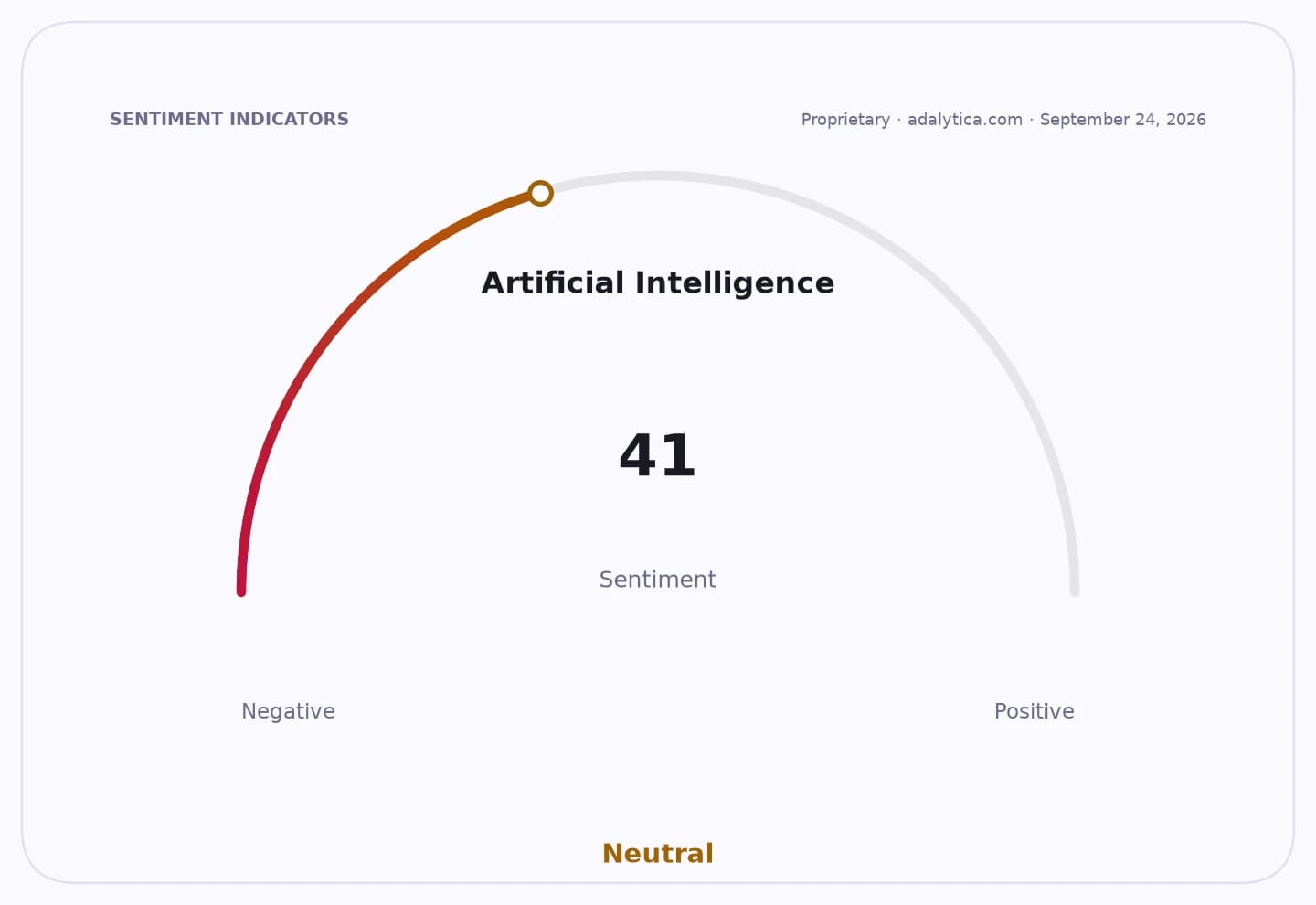
Sentiment IndicatorsⓘProprietary · adalytica.com · September 22, 2026
This is a snapshot — live sentiment, awareness and momentum for 130+ markets update continuously in the dashboard.Open AlphaPulse

That matters because concentration changes the market’s economics. When a few mega-cap AI stocks do the heavy lifting, index gains become less about a healthy earnings recovery across sectors and more about whether spending on compute, data centers and model development keeps accelerating. The S&P 500 can hold up even as the rest of the market looks ordinary, but that leaves investors exposed if AI spending growth cools, margins compress or sentiment turns. In practical terms, the market is increasingly pricing one secular theme as if it can do the work of several old cycles at once.
The price action in Nvidia captures the tension. The stock has climbed from $177.65 in January to $227.38 now, and its 50-day moving average at $214.40 remains below the current price, a sign the longer trend is still intact. Yet the shares have also been volatile enough to remind traders that leadership in AI does not mean straight-line gains. Microsoft shows the same dynamic: a strong recovery from a spring selloff, but still trading in a zone where investors are demanding proof that AI monetization can justify the capital being poured into the ecosystem.

The broader market is reinforcing the same message. AI-linked names such as Advanced Micro Devices, Arm and Intel have also been bid up as investors continue to chase the infrastructure layer of the buildout. That is where the asymmetric opportunity remains, in our view. The market keeps treating AI as a story about a few headline stocks, when the more durable trade is the toll-road model behind them: semiconductors, networking, power, cooling, cloud capacity and software that gets embedded into enterprise workflows.
At the same time, the risk is that enthusiasm outruns breadth. If the AI rally becomes too concentrated, investors in the index are effectively making a leveraged bet that a small cluster of companies can keep compounding faster than the rest of corporate America. That is powerful when it works, but fragile when leadership narrows too far. The current setup also explains why quality industrial and financial stocks can look cheaper on a relative basis even as the Nasdaq complex stays elevated.
For investors, the message is straightforward: don’t mistake index strength for market health, and don’t mistake AI enthusiasm for a short-term trade. The real opportunity is not simply owning the biggest names, but owning the ecosystem that monetizes the buildout over years. If AI spending keeps compounding, the beneficiaries are likely to remain the chips, servers, cloud platforms and infrastructure providers. If it slows, the market’s concentration problem becomes the story everyone notices all at once.
| Entity | Gains | Losses |
|---|---|---|
| Nvidia and Microsoft | ▲AI leadership premium | ▼Broad-market diversification |
| AI infrastructure suppliers | ▲Capex tailwind | ▼Non-AI cyclicals |
| S&P 500 bulls | ▲Index support | ▼Market breadth |
| Short sellers in megacap tech | ▲Higher volatility risk | ▼Contrarian value names |