Alibaba’s chief executive Eddie Wu is putting artificial intelligence at the center of the company’s next act, a move that matters because the market is no longer valuing Chinese internet groups on commerce alone. For Alibaba, the question is whether AI can turn a slowing core business into a new earnings engine, and whether investors are willing to underwrite that transition before the payoff is visible in financial results.
Alibaba AI Focus After Share Price Weakness
The stakes are high. Alibaba’s shares have been under pressure, with the stock closing at $108.76 in the latest available data, well below its 50-day moving average of $117.68 and its 200-day average of $131.09. Technical readings show the stock is no longer in the oversold extremes seen earlier in the year, but it remains in a weak trend, with RSI at 41.8 and MACD still negative. That leaves the market searching for a catalyst, and AI is increasingly the one management is offering.
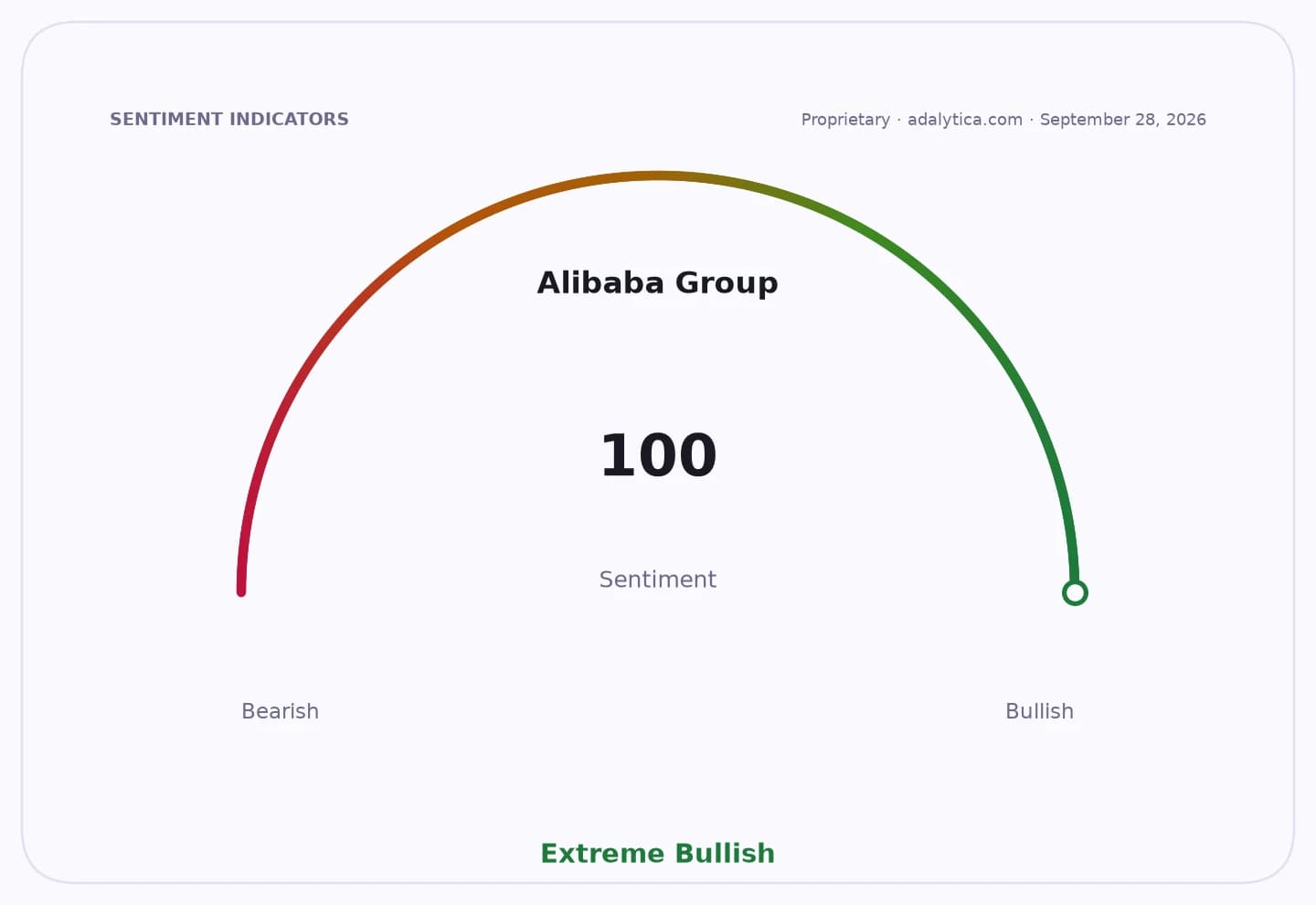
Sentiment IndicatorsⓘProprietary · adalytica.com · September 29, 2026
This is a snapshot — live sentiment, awareness and momentum for 130+ markets update continuously in the dashboard.Open AlphaPulse
The broader context helps explain why Wu’s message is resonating. The latest Adalytica earnings snapshot shows “Extreme Greed” sentiment on Alibaba, with sentiment at 100 and awareness at 71 after a sharp 92-point rise over 30 days. That kind of swing suggests investors have quickly shifted from skepticism to anticipation, even as the stock itself has not yet recovered the losses from earlier this year. In other words, the narrative is improving faster than the share price.
For Alibaba, AI is not just a branding exercise. The company needs to show that cloud computing, model deployment, and AI services can offset the structural maturity of its domestic e-commerce franchise and justify capital spending. The market has already rewarded peers and U.S. competitors with stronger AI monetization stories. Microsoft, for example, trades near $509 and sits above both its 50-day and 200-day moving averages, while Alphabet is holding around $343 with its 50-day average close to the current price. Those comparisons matter because they show what investors are paying for: durable AI revenue rather than AI ambition.
There is also a capital allocation dimension. Alibaba raised HK$80 billion through a share placement in Hong Kong in August, giving it more balance-sheet flexibility to fund growth initiatives, including AI infrastructure. That can be bullish if management deploys the cash into products and cloud capacity that produce higher-margin recurring revenue. The bear case is that the spending cycle arrives before monetization does, pressuring returns on invested capital in a market already sensitive to execution risk and China exposure.
Geopolitics and regulation remain a separate overhang. Chinese technology groups continue to face uncertainty around policy, data rules and broader U.S.-China tensions, which means even strong product progress may not translate cleanly into valuation expansion. Still, Wu’s decision to make AI the headline is telling: it reflects a recognition that Alibaba must compete not only with domestic rivals but also with global hyperscalers that are turning AI into the defining growth narrative of this cycle.
For investors, the immediate question is whether Alibaba can prove that AI will lift cloud growth, improve customer retention and eventually support margins. If management delivers credible traction, the stock’s depressed valuation could rerate quickly. If not, the rally in sentiment risks outrunning the fundamentals.
| Entity | Gains | Losses |
|---|---|---|
| Alibaba | ▲AI-led growth narrative | ▼Core commerce-only valuation |
| Investors bullish on AI | ▲Re-rating potential | ▼Cash without monetization |
| Microsoft and Alphabet | ▲Benchmark for AI returns | ▼Pressure to keep spending |
| Bears on China tech | ▲Short-term caution validated | ▼Missed upside if AI gains traction |