Alibaba Group Holding is warning that Washington’s latest chip export restrictions will crimp one of its most important growth engines, a reminder that the U.S.-China tech fight is now hitting cloud economics as well as semiconductors.
Alibaba Cloud Growth Slows on U.S. Chip Curbs
Alibaba Group
Chief Executive Eddie Wu said on a Thursday earnings call that cloud revenue growth is expected to slow to 30% to 45% in 2027, down from 53% in the third quarter of 2026, as the company reassesses how the curbs and related supply-chain uncertainty will affect next year’s operating plans. For investors, that is the key message: the cloud business that has been central to Alibaba’s valuation recovery is now facing a policy-driven ceiling just as the company was trying to prove that AI demand could accelerate its growth profile.
Sentiment Indicators
The timing matters because cloud is not just another reporting line. It is Alibaba’s cleanest exposure to AI infrastructure, high-value enterprise spending and the broader digitization of China’s economy. Any slowdown in cloud expansion can spill into margin expectations, capital spending and, ultimately, how much the market is willing to pay for the stock. The concern is not only that Alibaba may ship fewer advanced chips; it is that customers and partners may delay deployments if they cannot be sure supply will remain stable.
The earnings update still offered one offset: narrower instant retail losses helped lift quarterly adjusted operating earnings. That suggests Alibaba can still wring more efficiency from its sprawling consumer businesses, even as its most strategic growth engine faces external pressure. But for the market, the trade-off is clear. Cost discipline can support profits in the near term, yet cloud and AI are what determine whether Alibaba becomes a re-rated infrastructure platform or remains a cyclical e-commerce story.
The broader read-through extends beyond Alibaba. New U.S. chip controls are reinforcing a split supply chain in which Chinese internet and cloud companies must either source less capable hardware, redesign workloads, or accept slower rollout of next-generation AI services. That dynamic has already rippled through Asian data-center names and chip suppliers, while adding another layer of uncertainty for semiconductor leaders such as Nvidia and AMD, whose China exposure remains hostage to export policy.
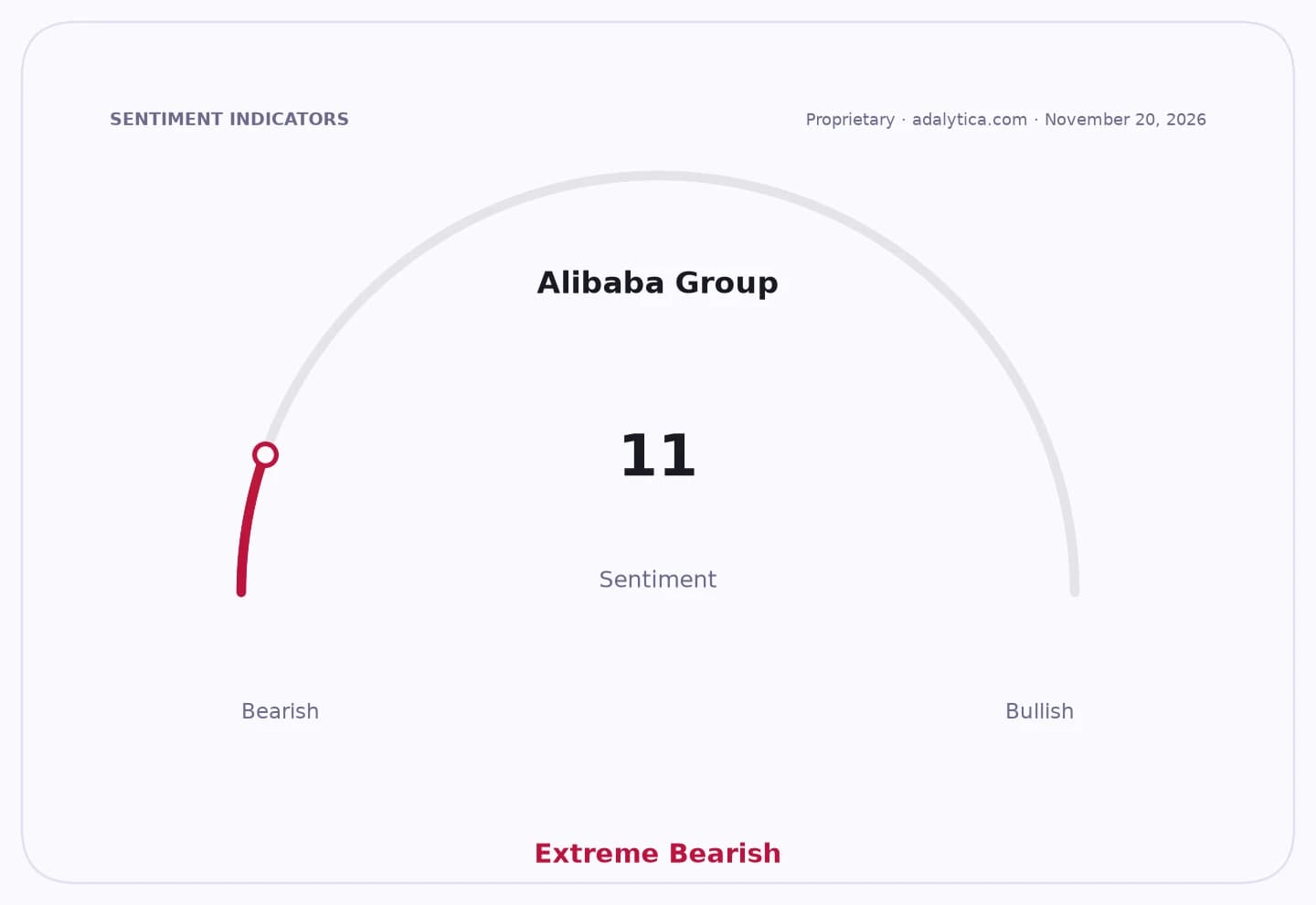
The stock reaction underscores how much of that risk is now in the tape. Alibaba shares have been under pressure, with technical indicators such as the 50-day and 200-day moving averages both above the latest price, while RSI readings have fallen into weak territory. Adalytica.com’s Alibaba earnings sentiment gauge is sitting in extreme fear, reflecting how quickly investors are repricing China AI exposure.
Our view is that this is not a reason to abandon the Alibaba story, but to sharpen it. The market is underestimating how much value will accrue to companies that can control scarce compute, manage capex efficiently and build AI services inside constrained supply chains. Alibaba still has scale, cloud relevance and a large domestic customer base. But until chip access becomes clearer, the upside will depend less on hype around AI and more on whether the company can execute around the constraint. That makes the next few quarters critical for proving whether Alibaba is a cloud winner or another casualty of the U.S.-China technology cold war.
| Entity | Gains | Losses |
|---|---|---|
| Alibaba cloud rivals | ▲Relative share gains | ▼Slower China AI rollout |
| U.S. chipmakers | ▲Policy leverage | ▼Lost China growth |
| Alibaba investors | ▲Profits from retail efficiency | ▼Cloud multiple compression |
| Chinese data centers | ▲Domestic demand tailwind | ▼Advanced chip shortages |