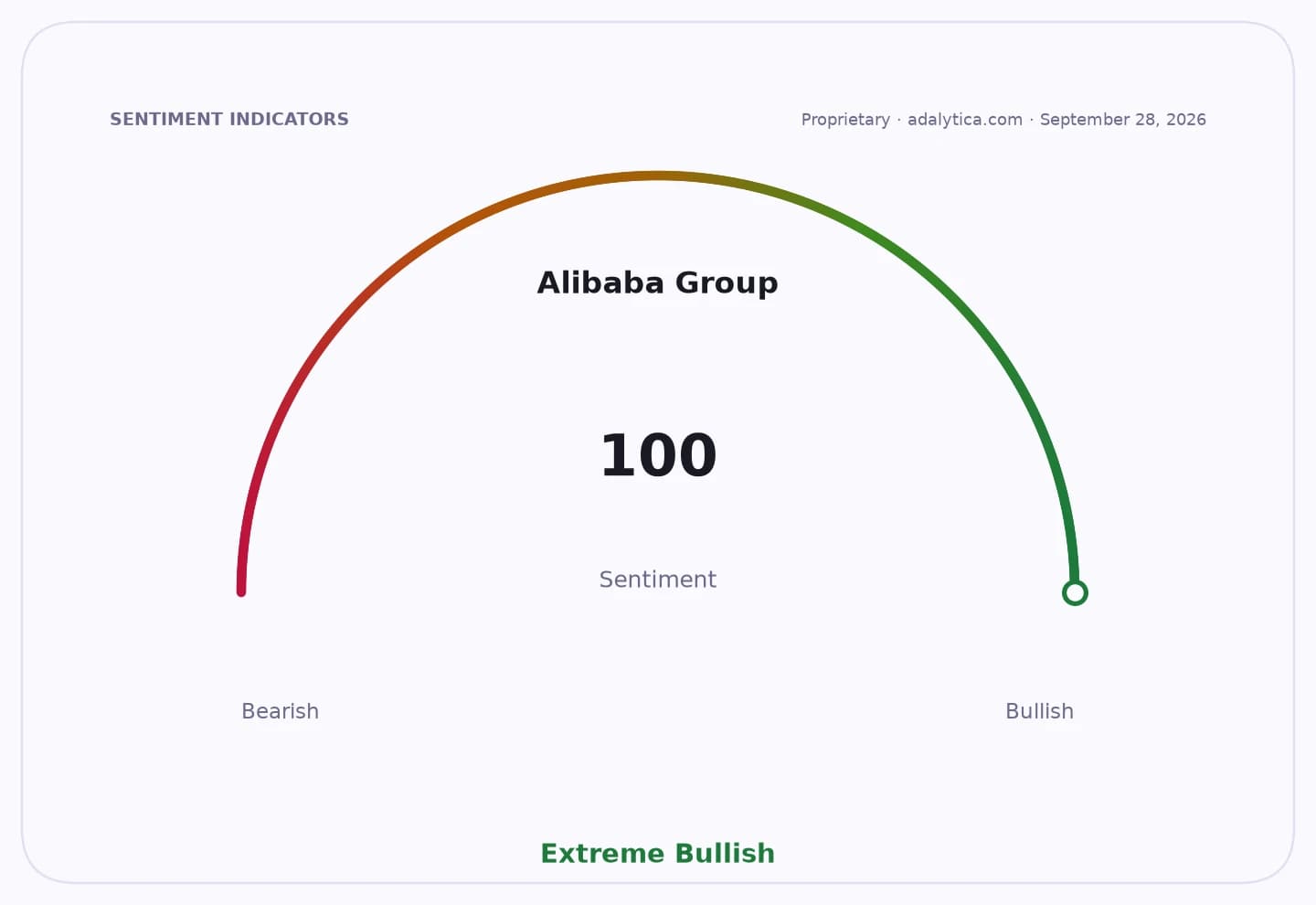
Alibaba shares are trading far below Wall Street’s valuation for the company, even as its cloud and AI business continues to post brisk growth that investors have largely refused to price in.
Alibaba shares lag cloud and AI growth
The stock closed at $110.80 on Oct. 5, after touching as low as $105.85 in recent sessions, versus a consensus 12-month target of about $186, implying roughly 68% to 72% upside depending on the estimate used. The disconnect has turned Alibaba into a high-stakes test of whether China tech can rerate on fundamentals, or whether geopolitical and macro risk will keep compressing valuations.
Sentiment IndicatorsⓘProprietary · adalytica.com · October 6, 2026
This is a snapshot — live sentiment, awareness and momentum for 130+ markets update continuously in the dashboard.Open AlphaPulse
What makes the gap more striking is that Alibaba’s cloud unit is not acting like a mature, slowing business. CEO Eddie Wu said the company’s cloud business posted 45% external revenue growth in its fiscal fourth quarter, with AI-related product revenue extending triple-digit growth for a 12th straight quarter. Alibaba Cloud says its Qwen large language model has 300 million monthly active users, while more than 100,000 Zhenwu PPU chips have been deployed.
That matters because cloud and AI are increasingly the part of the business investors are willing to pay for, while core commerce faces slower growth and China’s broader consumer backdrop remains uneven. Alibaba also holds about 35.8% of China’s AI cloud market, giving it a scale advantage that could support margins if AI demand keeps translating into enterprise spending.
The market, however, is still discounting the stock heavily. Alibaba trades around 16 times forward earnings, according to the data provided, well below the sell-side consensus target and below its own historical earnings multiple. The stock’s technical picture also reflects hesitation: shares recently hovered near their 50-day moving average, and the latest move above $110 suggests buyers are trying to defend the $105 area that traders see as a floor.
Wall Street remains broadly constructive. Among analysts tracked in the data, 38 rate the stock a buy, with just one hold and one sell, and recent target hikes from Barclays and JPMorgan underline the bullish case. Even so, the market has not rewarded the company for the AI narrative the way it has for U.S. peers such as Microsoft and Amazon, whose cloud businesses trade at richer valuations.
For investors, the next catalyst is Alibaba’s earnings report due Nov. 24, which will test whether cloud growth stays above 35% and whether AI monetization can keep offsetting softer commerce trends. If the company delivers another strong cloud print, the gap between price and targets could narrow quickly; if it misses, the market is likely to keep treating the stock as a value trap rather than an AI winner.
| Entity | Gains | Losses |
|---|---|---|
| Alibaba bulls | ▲Re-rating if cloud growth holds | ▼If $105 support breaks |
| Alibaba bears | ▲Lower entry if support fails | ▼Rising risk of a squeeze |
| Wall Street analysts | ▲Validation of higher targets | ▼Credibility if stock lags further |
| U.S. cloud peers | ▲Benchmarking tailwind for AI demand | ▼Less relative upside from AI narrative |