Alphabet’s recent share rebound is less a verdict on its fundamentals than a reset of expectations in a market that had been asking too much of the biggest technology stocks. The broader trade in the so-called Magnificent Seven has become increasingly sensitive to valuation, and for Alphabet in particular, the question now is not whether growth remains strong, but whether it can keep justifying a premium after a long run-up.
Alphabet at $335.76 After July 15 Peak
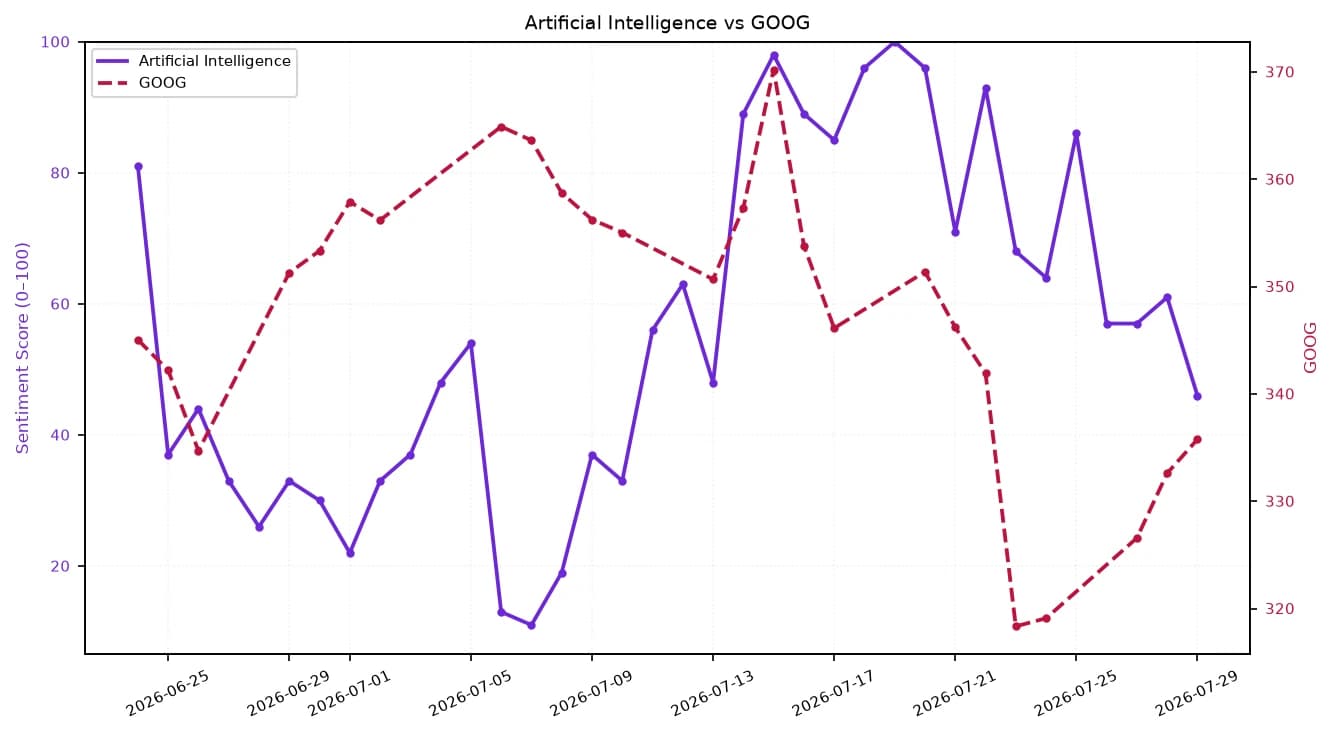
That shift matters because the market’s reaction to megacap tech now has outsized implications for the S&P 500, passive flows and portfolio positioning across growth and value. When expectations are stretched, even solid results can disappoint; when they are lowered, the same results can drive sharp outperformance. Alphabet’s moves in recent sessions suggest investors are beginning to treat it less as an untouchable momentum name and more as a company whose stock now needs to earn its multiple.
Sentiment IndicatorsⓘProprietary · adalytica.com · July 29, 2026
This is a snapshot — live sentiment, awareness and momentum for 130+ markets update continuously in the dashboard.Open AlphaPulse
The price action shows the strain of that recalibration. Alphabet closed at $335.76 on July 29, down from a recent peak near $370.21 on July 15, even though the stock remains well above its 200-day moving average of $324.17. The pullback has cooled some of the overbought conditions that had built earlier in the summer, with the 14-day RSI slipping to 40.2 from readings above 60 two weeks earlier. The MACD remains below its signal line, a sign that near-term momentum is still weak even after a modest rebound.
That is important for investors because the Mag 7 trade has become a contest between earnings power and elevated positioning. Alphabet is still a beneficiary of structural demand in search, cloud and advertising, but its market value is now large enough that incremental disappointment on margin, spending or growth can translate into meaningful share-price volatility. The latest filing also underscores that cost pressures remain embedded in the business, including rising traffic-acquisition costs and heavier other cost of revenues, which can limit how far revenue gains flow through to profits.
The same dynamic is visible across the megacap cohort. Microsoft has also seen a sharp swing in sentiment, with the stock trading at $390.54 on July 29, below its 200-day moving average of $432.77 after a steep mid-year decline and partial recovery. Apple, by contrast, has held up better, closing at $338.19 and staying above both its 50-day and 200-day moving averages. The divergence reflects a market that is no longer rewarding the group as a single trade, but sorting winners from losers based on execution, capital intensity and the sustainability of AI-led spending.
For Alphabet, the bull case is that expectations have finally normalized enough for earnings to matter again. The bear case is that the stock is still vulnerable if investors conclude that AI monetization, while strategically important, will take longer to offset the pressure from rising infrastructure and traffic costs. Either way, the message for the market is the same: in the Mag 7, high expectations are no longer an asset, and that may be the most important thing changing for investors this quarter.
| Entity | Gains | Losses |
|---|---|---|
| Alphabet | ▲valuation reset supports upside | ▼higher bar for earnings beats |
| Mag 7 bulls | ▲lower expectations aid returns | ▼crowded positioning unwinds |
| Value and equal-weight investors | ▲relative rotation potential | ▼underperformance if megacaps rebound |
| Microsoft | ▲partial relief from oversold levels | ▼AI spending scrutiny remains high |