Consumers are still spending, but they are increasingly doing so on higher-ticket items and less price-sensitive purchases, a shift that is favoring Amazon and Walmart while leaving more discretionary retailers to fight for a narrower slice of demand.
Amazon, Walmart Outperform on Premium Consumer Spending

That matters because a premium-heavy basket changes the economics of ecommerce. When shoppers trade up, online leaders with broader assortments, faster delivery and stronger membership or fulfillment ecosystems capture more of the wallet share. It also improves the quality of revenue: premium carts tend to carry better average order values and can offset softer unit volumes, helping large platforms defend margins even if transaction growth is uneven.
Sentiment IndicatorsⓘProprietary · adalytica.com · July 30, 2026
This is a snapshot — live sentiment, awareness and momentum for 130+ markets update continuously in the dashboard.Open AlphaPulse
The stock tape reflects that split. Amazon has recovered from a sharp summer selloff but remains below its 50-day moving average, suggesting investors are waiting for proof that higher-value purchases are durable rather than a short-lived rebound. The shares closed at $226.65 on July 29, down from a recent high near $255, while the relative strength index fell to 27.4, a reading that signals the stock has been oversold. Walmart, by contrast, has continued to outperform, ending at $114.22 and sitting close to its 50-day average after an extended climb that has kept RSI in the mid-50s, a sign of steadier momentum.
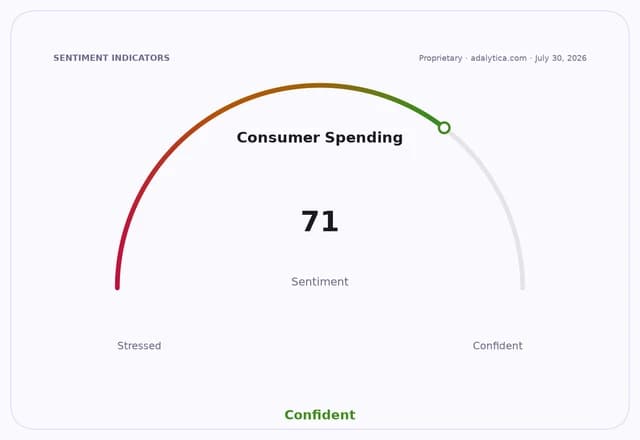
The divergence is important for the broader consumer sector. Adalytica’s Consumer Spending Sentiment gauge showed “Greed” at 71, up 11 points on the day, but the retail-goods spending reading dropped to 36 and remained neutral. That combination suggests households are still willing to spend, but selectively. In practice, that means premium goods, trusted brands and convenience-led purchases are taking priority over bargain-bin volume. For ecommerce, that favors merchants that can monetize intent quickly and absorb lower-frequency, higher-value baskets.
Amazon stands to benefit most if that pattern persists. Its marketplace gives it exposure to both premium branded merchandise and essential goods, while Prime helps lock in repeat purchasing when consumers are choosier. Walmart is also well placed because it captures spending across groceries, household basics and increasingly higher-end general merchandise, making it a natural beneficiary when shoppers consolidate trips and raise basket quality. Target, by contrast, looks more exposed to a pullback in discretionary spending: its shares at $145.90 have surged, but the move has left RSI near 75, which often indicates a stretched near-term setup rather than a clean confirmation of demand strength.
The bull case is that premium carts reflect a consumer willing to keep spending despite slower sentiment in lower-income and mid-tier retail categories. The bear case is that it is a late-cycle trade-up, with shoppers concentrating spend in a few categories while cutting back elsewhere, a pattern that can reverse quickly if employment weakens or credit conditions tighten.
For investors, the key question is not whether ecommerce is growing, but which retailers are capturing the higher-margin end of demand. If premium baskets remain the norm, Amazon and Walmart should continue to take share. If the consumer downshifts again, promotional intensity will rise and the advantage will swing back toward price-led retailers and off-price chains.
| Entity | Gains | Losses |
|---|---|---|
| Amazon | ▲Larger premium baskets | ▼Volume-led rivals |
| Walmart | ▲Trade-up grocery and general merchandise | ▼Mid-tier discounters |
| Target | ▲Less clearly, if demand stays firm | ▼Discretionary-heavy sales |
| Consumers | ▲Better convenience and assortment | ▼Budget-sensitive shoppers |