Anthropic is moving AI agents one step closer to acting as stand-in dealmakers, a shift that could reshape how consumers and companies bargain over jobs, rents, purchases and service disputes.
Anthropic explores AI negotiation agents

The company is consulting law firms to learn how human lawyers negotiate on behalf of clients and to translate those practices into AI systems that can bargain within legal and ethical limits, according to reporting cited by the Financial Times. The effort points to a broader industry push beyond chatbots that answer questions toward agents that can complete tasks and make decisions with limited human intervention.
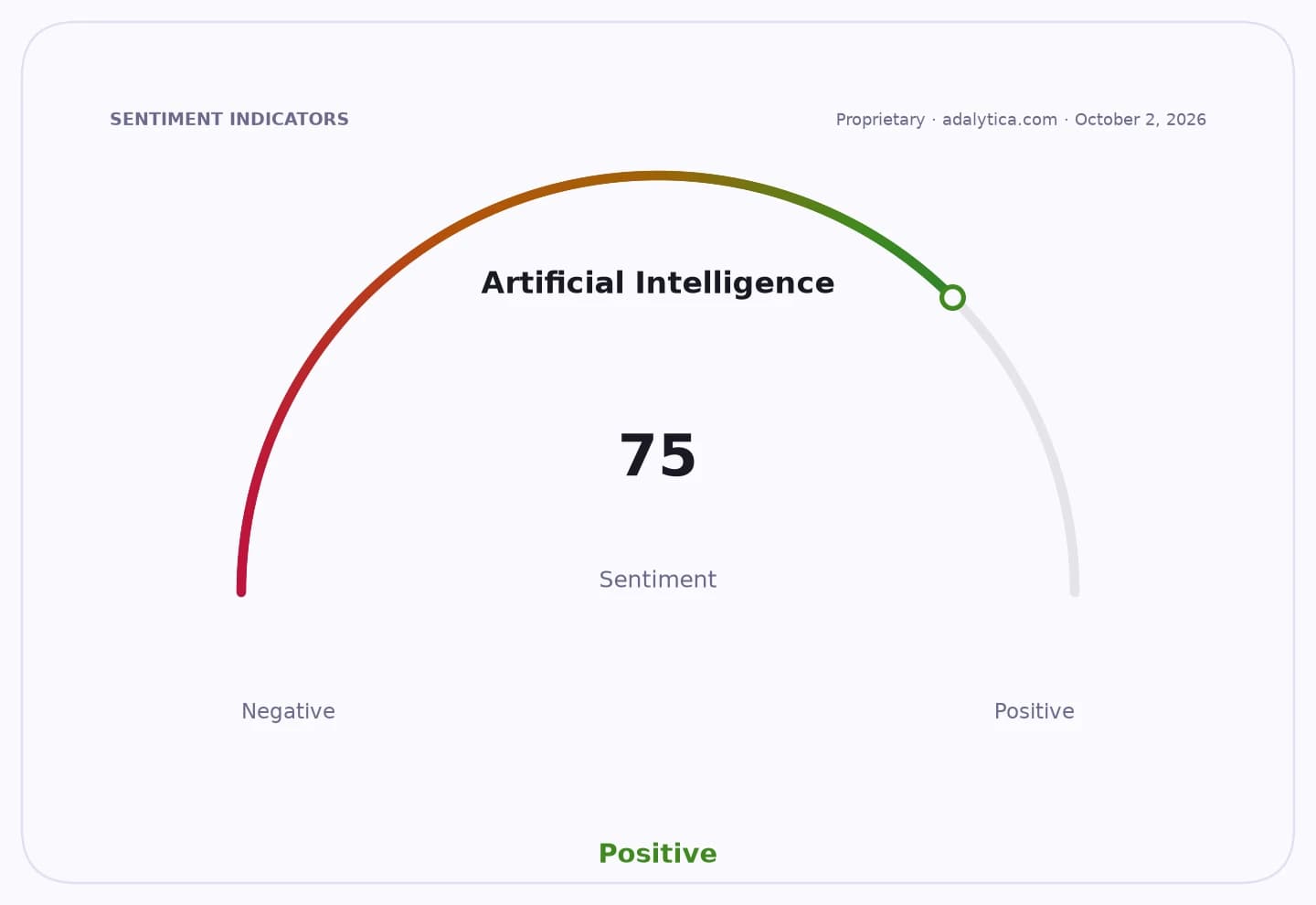
Sentiment IndicatorsⓘProprietary · adalytica.com · October 22, 2026
This is a snapshot — live sentiment, awareness and momentum for 130+ markets update continuously in the dashboard.Open AlphaPulse
That matters economically because negotiation is one of the highest-value applications for agentic AI. If software can reliably secure better prices, settle complaints or improve employment terms, it could lower transaction costs across retail, labor markets and contract services. It could also change who captures that value: consumers and smaller businesses stand to gain from cheaper access to skilled bargaining, while companies that sell products or services may face more price pressure and more automated pushback on fees, renewals and terms.
Anthropic’s interest in legal frameworks also highlights the liability problem that will determine whether agentic AI scales. The company is weighing how to establish what a digital agent is authorized to do, including signed user instructions that define when it can decide independently and when it must seek approval before closing a deal. That is crucial in a market where one agent may represent a buyer trying to minimize price and another a seller seeking to maximize revenue.
The legal and ethical questions are not academic. Research cited in the report suggests AI-to-AI bargaining can be manipulated, including through prompt injection and other techniques that could extract private information from another agent or steer it into unfavorable agreements. Michelle Vaccaro, an assistant professor at Harvard Business School, has run more than 180,000 AI-to-AI negotiations in scenarios involving job offers and leases, underscoring how quickly these systems can be tested at scale — and how quickly they can be gamed.
For investors, the issue is as much about monetization as capability. The companies that can build trustworthy negotiation agents may open a new software category tied to commerce, procurement and customer service, but they will also need to prove they can contain legal risk and data leakage. That makes governance and safety features a commercial differentiator, not just a compliance burden.
The stakes are especially high for the biggest platform vendors, including Microsoft, which has been pushing AI deeper into enterprise workflows while warning in filings that AI systems can create legal, privacy, product liability and regulatory risks. Microsoft shares have recently traded around $532, well above the 200-day moving average near $435, suggesting the market is still rewarding AI exposure even as technical momentum has cooled from recent highs. Nvidia, another core AI beneficiary, has also seen its stock recover sharply from earlier weakness, but its ability to benefit from the next wave of AI spending will depend on whether that spending shifts from training models to deploying agents that can reliably execute high-value tasks.
A successful rollout of negotiation agents would be a milestone for the sector because it moves AI from assistance to agency. But that same shift increases the burden on developers to define authority, verify counterparties and prevent abuse. The winner of the next phase of AI may be the company that can make autonomous bargaining useful enough to save money, but constrained enough to survive regulators, courts and the first wave of failed deals.
| Entity | Gains | Losses |
|---|---|---|
| Anthropic | ▲agentic-AI leadership | ▼legal and liability exposure |
| Consumers and small businesses | ▲better bargaining power | ▼reliance on model quality |
| Sellers and service providers | ▲automated negotiations volume | ▼pricing power and margins |
| Microsoft and Nvidia | ▲broader AI deployment demand | ▼scrutiny over AI risks and governance |