Anthropic’s quiet push for a federal AI safety bill matters because it would help define who gets to police the fastest-moving technology in markets — and it could lock in a regulatory framework that favors the biggest frontier-model developers while raising the cost of entry for everyone else.
Anthropic-backed AI safety bill boosts big tech
The proposed legislation, first reported by Politico, would let Washington block a model only if it poses a foreseeable, imminent risk of more than $1 billion in damages or could kill or seriously injure more than 50 people. The bar is unusually high, but the mechanics are even more important: independent evaluators registered with the Commerce Department would periodically review frontier models, labs could pay those evaluators if compensation is not tied to the result, and any “imminent enumerated risk” would have to be reported within 72 hours. Commerce could seek a judge to suspend a model, but the draft would bar other federal agencies from doing so.
Sentiment IndicatorsⓘProprietary · adalytica.com · October 20, 2026
This is a snapshot — live sentiment, awareness and momentum for 130+ markets update continuously in the dashboard.Open AlphaPulse
That structure is a clue to the real economic story. Anthropic is not just asking for regulation; it is helping draft the rules for a market where trust, compliance and compute scale may matter as much as raw model performance. A regime built around licensed evaluators and federal court oversight would be much easier for large, well-capitalized firms to absorb than for startups trying to ship frontier systems on thin margins. In other words, regulation could become a moat.
For investors, that is the key implication. The market often treats AI safety as a drag on growth, but a formal federal framework could actually reinforce the winner-take-most dynamics already visible in the sector. Publicly traded beneficiaries are likely to be the companies with the capital, legal teams and infrastructure to clear higher compliance hurdles: Microsoft, Nvidia and Alphabet, along with the broader AI infrastructure stack. The more onerous the governance regime, the more value accrues to firms that can spend billions on training, security and oversight without blinking.
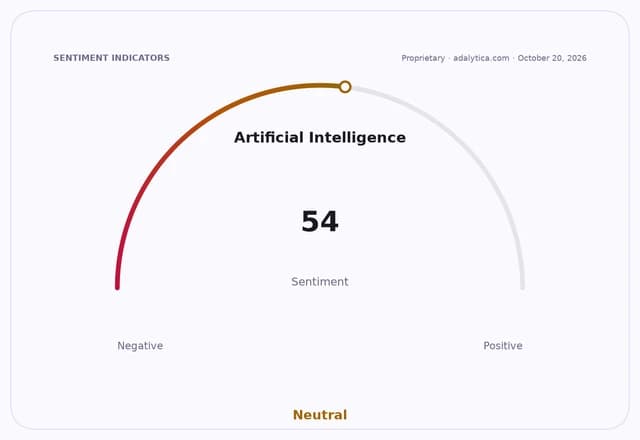
That helps explain why the shares have been resilient even as the policy debate intensifies. Microsoft closed at $533.52 on Oct. 19, well above its 50-day and 200-day moving averages, while Nvidia ended at $217.09 and Alphabet at $344.18, both still tracking near their intermediate trend lines. The conventional technical picture says investors have not abandoned the AI trade; they are waiting to see whether regulation trims demand or simply raises the barriers to competition. Adalytica’s AI sentiment snapshot is neutral, but awareness remains in “Extreme Fear,” a sign that the market is still underestimating how fast governance can become part of the investment case.
The broader narrative is that AI is moving from an open-ended race to a regulated industrial system. That transition tends to reward the picks-and-shovels layer first: chips, cloud, model hosting, cybersecurity and compliance tooling. If Congress takes this seriously, the next phase of AI investing may not be about who builds the smartest model, but who can deploy it safely at scale under a federal rulebook.
Our view is straightforward: investors should position for AI safety to become a structural feature of the market, not a temporary headline. That means staying long the infrastructure names that can thrive under tighter oversight, while being selective on smaller frontier-model players that may face a rising compliance burden before they ever reach scale.
| Entity | Gains | Losses |
|---|---|---|
| Microsoft | ▲Compliance moat | ▼Smaller rivals |
| Nvidia | ▲Infrastructure demand | ▼Unfunded startups |
| Alphabet | ▲Scale advantage | ▼Fast-moving challengers |
| Frontier AI startups | ▲Regulatory clarity | ▼Easier market entry |