Apple’s shares fell to $338.32 on Nov. 2 as investors digested the company’s latest earnings against a backdrop of higher U.S. rates, softer risk appetite and renewed volatility across equities and crypto.
Apple shares fall to 338.32 after earnings

The move matters because Apple remains one of the market’s biggest weighting stocks and a bellwether for consumer demand, hardware spending and broad equity sentiment. With the 10-year Treasury yield at 4.953% in the latest forecast and the federal funds rate at 3.89%, the discount-rate pressure on long-duration growth stocks has not gone away, even as inflation moderates. The latest CPI forecast points to a 0.14% monthly decline in October, suggesting price pressures may be cooling, but not enough to force an immediate repricing of the rates backdrop.
Sentiment Indicators
Apple’s stock had already been easing from recent highs. It closed at $348.91 on Oct. 29 before slipping to $344.63 on Oct. 30 and $338.32 on Nov. 2. The pullback leaves the shares just above the 50-day moving average of $333.62, while the 200-day moving average sits far lower at $296.67, underscoring how much of the year’s rally has already been priced in. The RSI at 46.6 points to a cooling trend rather than outright oversold conditions.
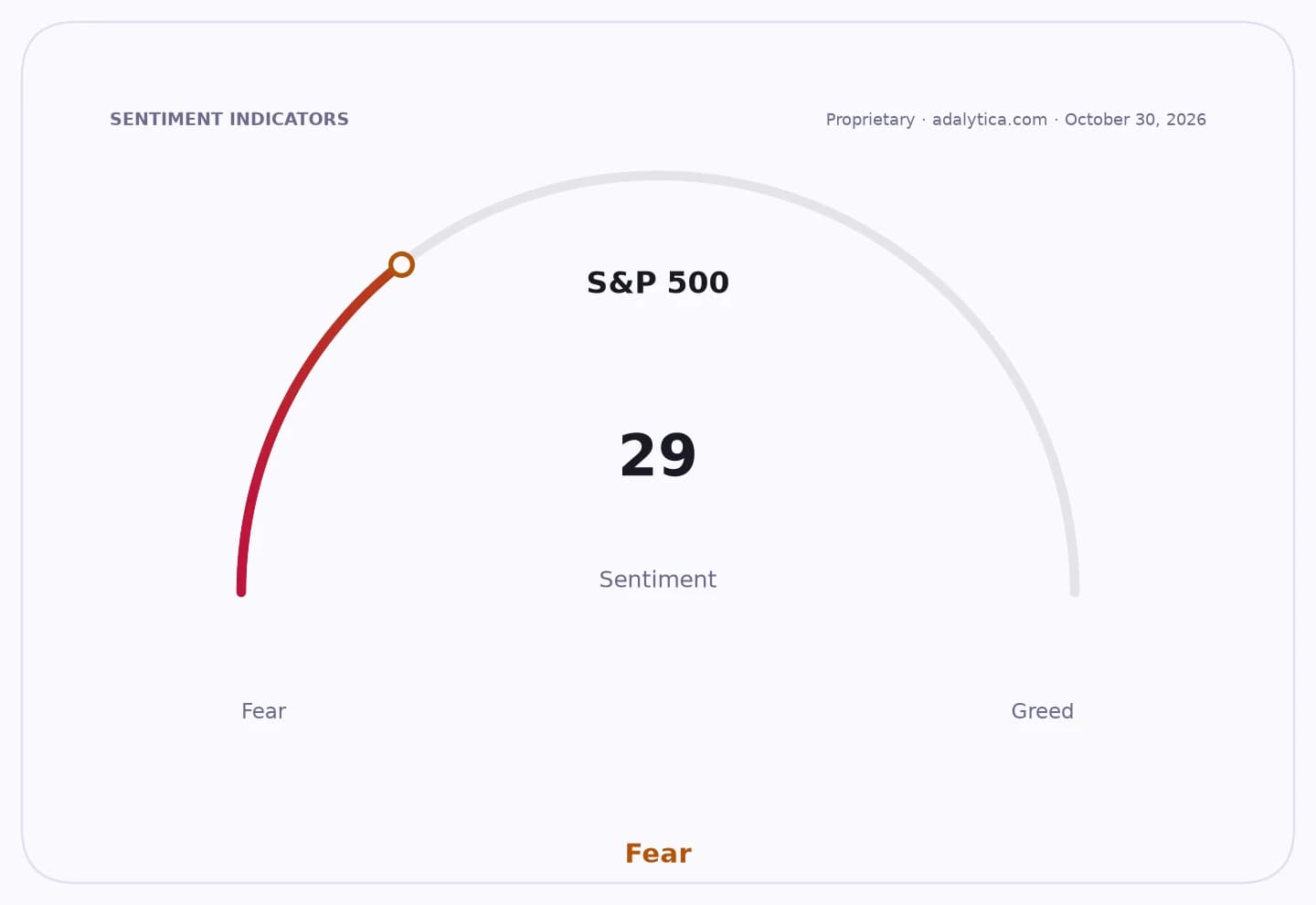
The broader market is not offering much support. SPY ended at 752.1 on Nov. 2, down from 769.36 on Oct. 29, while Adalytica’s S&P 500 Trade Signals showed neutral sentiment but extreme awareness, a sign of elevated market attention and fragile positioning. That kind of backdrop tends to hit mega-cap technology hardest, especially when investors are also watching AI-related capex pressure at peers such as Microsoft and Nvidia.
Bitcoin’s slide to $76,731.24 adds to the risk-off tone. Crypto weakness often feeds into a more cautious read on speculative assets generally, even if Apple itself is not directly tied to the digital-asset trade. A stronger dollar would normally weigh on multinationals, but Adalytica’s dollar gauge shows extreme fear in sentiment and sharply weaker momentum, limiting that channel for now.
For investors, the key question is less whether Apple can defend its franchise and more whether its earnings can justify further multiple expansion in a market where yields remain restrictive and volatility is rising. A constructive read would be that Apple’s balance sheet, services margin profile and installed base can still support durable cash generation. The bear case is that a mature hardware business, slower consumer spending and a higher-rate environment cap upside until growth reaccelerates.
What happens next will depend on whether Apple can turn earnings into fresh estimates upgrades rather than just a relief rally. If rates drift lower and equity volatility cools, the stock could stabilize near current levels. If Treasury yields remain near 5% and broader risk appetite weakens, Apple’s size will keep it at the center of the market’s next rotation.
| Entity | Gains | Losses |
|---|---|---|
| Apple bulls | ▲Stable cash flow case | ▼Higher-rate valuation pressure |
| Bond investors | ▲Higher yield income | ▼Risk assets’ multiple support |
| Risk-off traders | ▲Volatility opportunity | ▼Momentum in mega-cap tech |
| Broad market indexes | ▲Apple resilience if earnings hold | ▼Weight drag from AAPL weakness |