Javier Milei has turned Donald Trump’s hint that Washington could revisit its neutrality on the Falkland Islands into a sharper Argentine push on sovereignty, announcing tougher penalties for companies tied to “unauthorised” activity around the archipelago as he seeks both diplomatic leverage abroad and political traction at home.
Argentina Tightens Falklands Oil Penalties

The move matters because the Falklands dispute is no longer just symbolic rhetoric. By threatening legal and economic measures against firms involved in offshore projects, Buenos Aires is trying to raise the cost of exploration around an area that could hold commercially significant hydrocarbons. That creates a direct overhang for energy investors, while also testing how far Milei can go in aligning himself with Trump without derailing Argentina’s already delicate relations with the UK and Western partners.
Sentiment IndicatorsⓘProprietary · adalytica.com · September 4, 2026
This is a snapshot — live sentiment, awareness and momentum for 130+ markets update continuously in the dashboard.Open AlphaPulse

Trump’s comment that he was not ruling out a review of the US position on the islands gave Milei a rare opening. The Argentine president immediately described it as something “very strong” on what he called the country’s “most sacred cause,” then followed up with a televised pledge to deploy “all the instruments of the state” — diplomatic, economic and judicial — against actors he says undermine Argentine sovereignty.
For investors, the immediate question is less about a sudden change in legal ownership than about risk premium. The United States, like most Western governments, still recognizes Britain’s de facto administration and maintains a neutral stance on the sovereignty claim. But even a small shift in Washington’s language can embolden Buenos Aires, add uncertainty around licensing and financing for projects near the islands, and complicate risk assessments for companies exposed to the North Falklands basin.
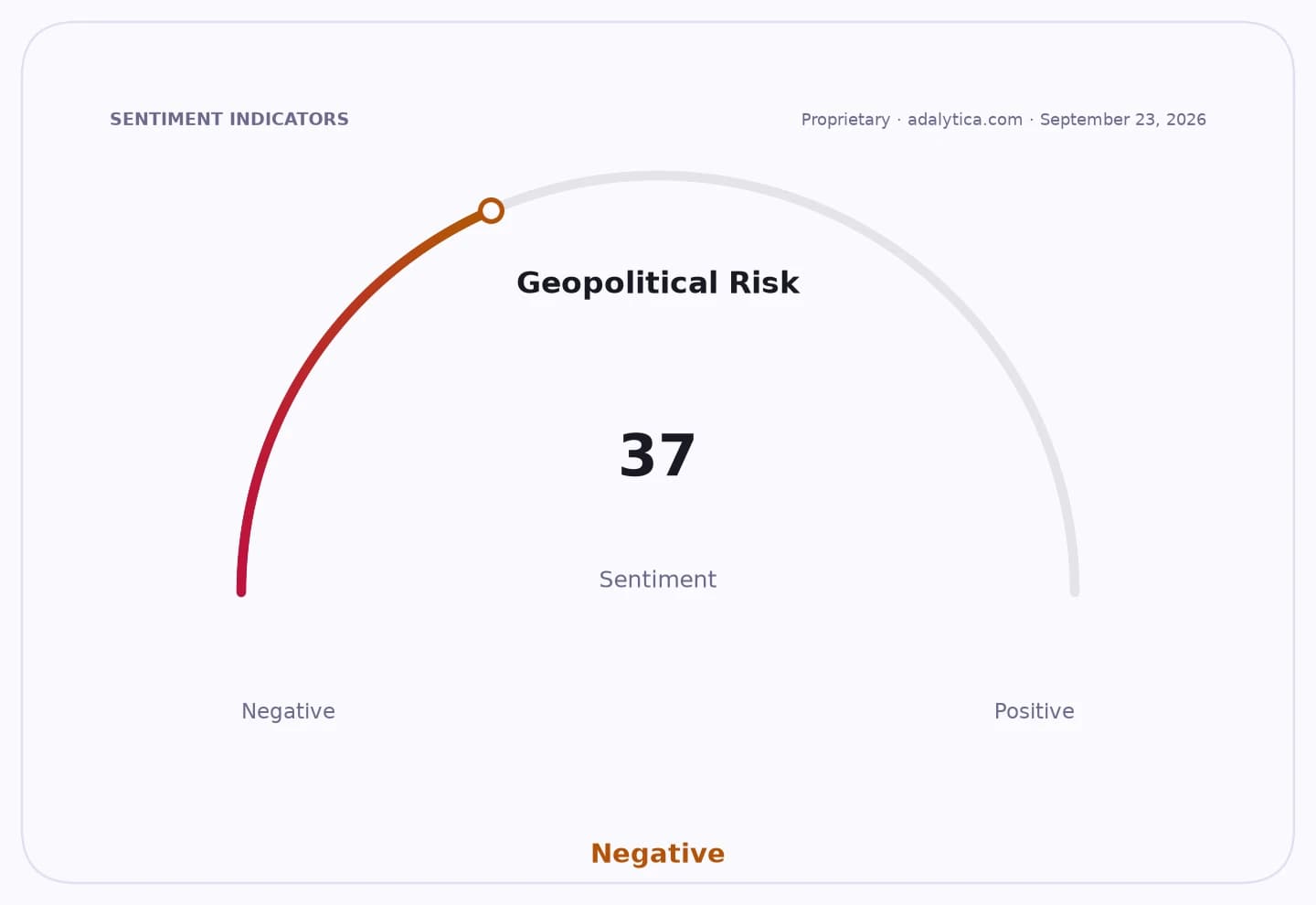
Geopolitical Risk — 30-day sentimentadalytica.com
Explore this data interactively — full history, time series and cross-market comparisons.Open AlphaPulse

That is already visible in the political and legal response. Argentine veterans and environmental groups have sued to block a British-led oil project north of the islands involving Rockhopper and Navitas. Buenos Aires also condemned the venture through its foreign ministry, signalling that the dispute is moving beyond diplomatic protest into a more active attempt to deter investment.
The domestic politics are just as important. Milei has been leaning harder on the Falklands issue at a time when his approval ratings have softened under the strain of austerity. The sovereignty claim has unusually broad support across Argentina, and the president is using it to reinforce nationalist credentials while shifting attention away from economic pain at home. That makes the rhetoric politically useful even if the practical chances of recovering the islands remain remote.
Still, there are limits to how far this can go. The islands are administered by Britain and home to about 3,500 residents, who overwhelmingly favour their current status. Any move to challenge that reality would collide with international law, the 1965 UN resolution that recognizes a dispute but calls for a peaceful settlement, and with the interests of London, which is unlikely to concede anything while energy prospects remain in play.
For markets, the key catalyst is whether Milei’s new bill is translated into enforceable restrictions that affect permits, shipping, insurers or capital providers linked to offshore development. For now, the most likely outcome is heightened political noise rather than an immediate change in project economics. But in a region where sovereignty, energy and great-power signalling are colliding, even rhetoric can move valuations and reshape timelines.
| Entity | Gains | Losses |
|---|---|---|
| Javier Milei | ▲Domestic nationalist support | ▼Diplomatic flexibility |
| Donald Trump | ▲Leverage over UK | ▼Policy clarity |
| UK oil explorers | ▲— | ▼Permitting and financing risk |
| Argentina | ▲Sovereignty narrative | ▼Investor uncertainty |