Argentina’s rising household delinquency has become a macroeconomic risk, not just a banking problem, as millions of borrowers fall behind on loans and credit cards and some are pushed toward informal lenders with far harsher terms.
Argentina Household Delinquency Reaches 12.2% in September
Official data from the central bank show the delinquency rate on household bank credit reached 12.2% in September, down from a peak of 12.9% in July but still far above 7.3% a year earlier. When digital wallets are included, a study by the Centre for Argentina’s Political Economy put the combined rate of irregular debt at 15.4%, affecting 6.07 million people out of 21.4 million debtors.
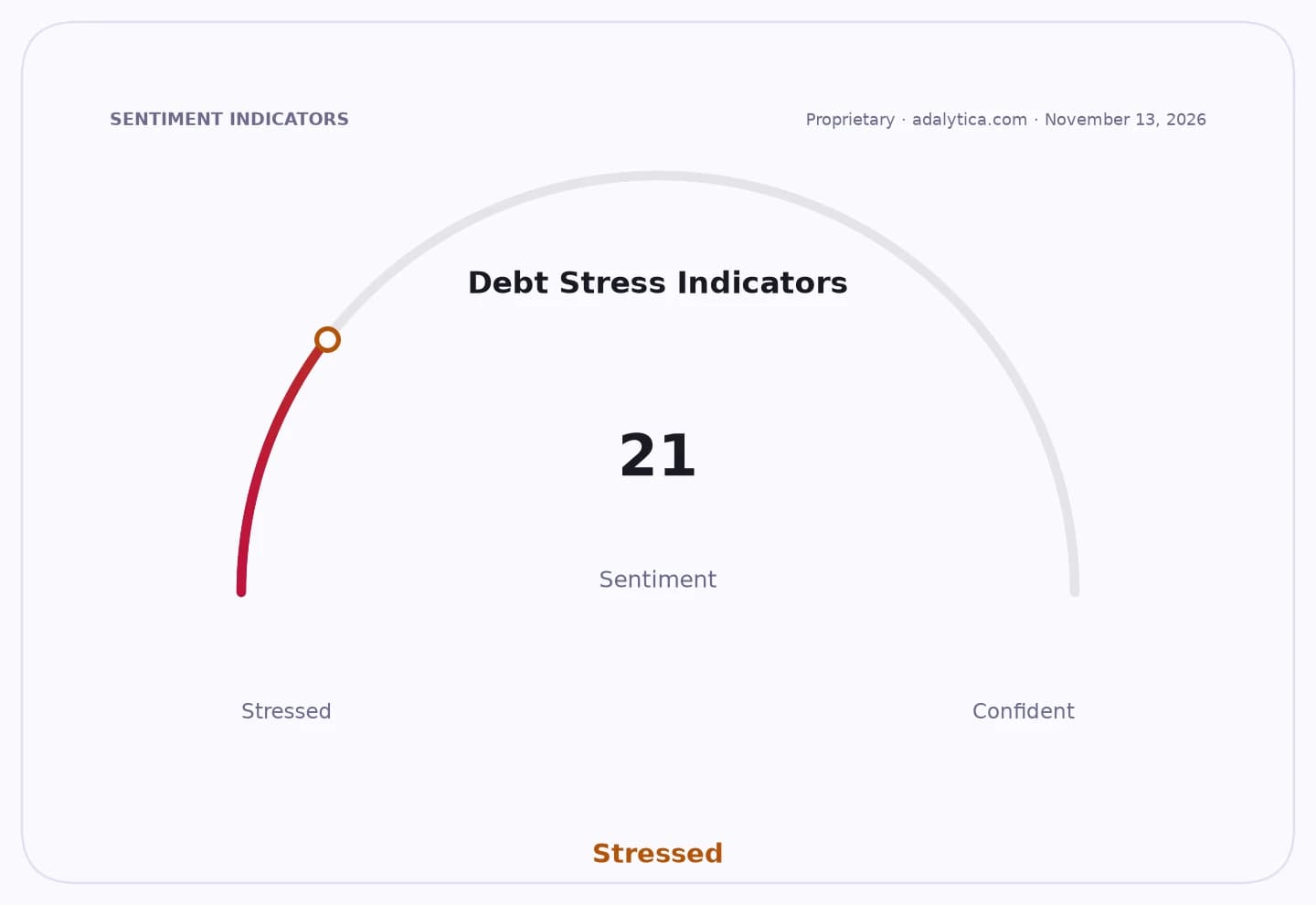
Sentiment Indicators
That scale matters because consumer credit is no longer being used mainly to smooth occasional shocks. For many families, it is now financing food, utilities, rent and medicine. Once debt is being used to cover basic consumption, delinquency becomes self-reinforcing: higher arrears force banks to tighten lending, which pushes borrowers deeper into distress and reduces household spending power across the economy.
The financial system is already absorbing the strain. The recent decline in the official bank delinquency rate does not point to a clean recovery, because some loans were written off and others refinanced. That means the headline improvement masks credit losses still moving through balance sheets. For banks, the issue is not only provisioning and charge-offs, but also weaker growth in a market where consumer credit should normally support transaction volumes and fee income.
For investors, the broader concern is that stressed households can feed back into slower consumption, weaker collections and tighter credit conditions for lenders exposed to retail borrowers. The risk is especially acute in credit cards and personal loans, the segments most exposed to irregular repayment. In an economy already constrained by inflation, low real wages and fragile confidence, elevated delinquency can quickly become a brake on recovery rather than a side effect of it.
The social consequences are potentially more severe. As formal credit becomes harder to obtain, demand can migrate to unregulated lenders in poorer neighborhoods, where reports of punitive rates, intimidation and debt enforcement practices raise the risk of a parallel lending economy. That would widen the economic damage beyond bank losses, turning debt into a channel of coercion and undermining financial inclusion.
The policy response now matters as much as the data. Lawmakers and economic authorities face pressure to consider refinancing schemes and debt relief measures that ease repayment burdens without creating a fresh cycle of overborrowing. The challenge is to stabilize households before delinquency becomes entrenched and before more credit flows out of the regulated system entirely.
| Entity | Gains | Losses |
|---|---|---|
| Indebted households | ▲Short-term access to cash | ▼Rising repayment stress |
| Banks and digital wallets | ▲Some refinancing recovery | ▼Higher losses and tighter credit |
| Informal lenders | ▲More borrower demand | ▼Consumers seeking formal relief |
| Policymakers | ▲Scope to intervene | ▼Credibility if stress deepens |