Argentina’s push to loosen land protections under Javier Milei is intensifying a political and social fight over who controls the country’s water, soils and resource-rich frontier regions, with protesters warning that deregulation is opening the door to deeper foreign ownership and faster evictions.
Argentina land reform battle under Milei
The clash matters economically because land is not just an ideological fault line in Argentina: it sits at the center of mining, forestry, agriculture, hydropower and the infrastructure needed to unlock lithium, Vaca Muerta and other export assets. Milei is betting that a more permissive regime will draw capital into an economy starved of investment, but the backlash underscores the risk that land reform becomes a source of legal uncertainty, social conflict and delay rather than a catalyst for growth.
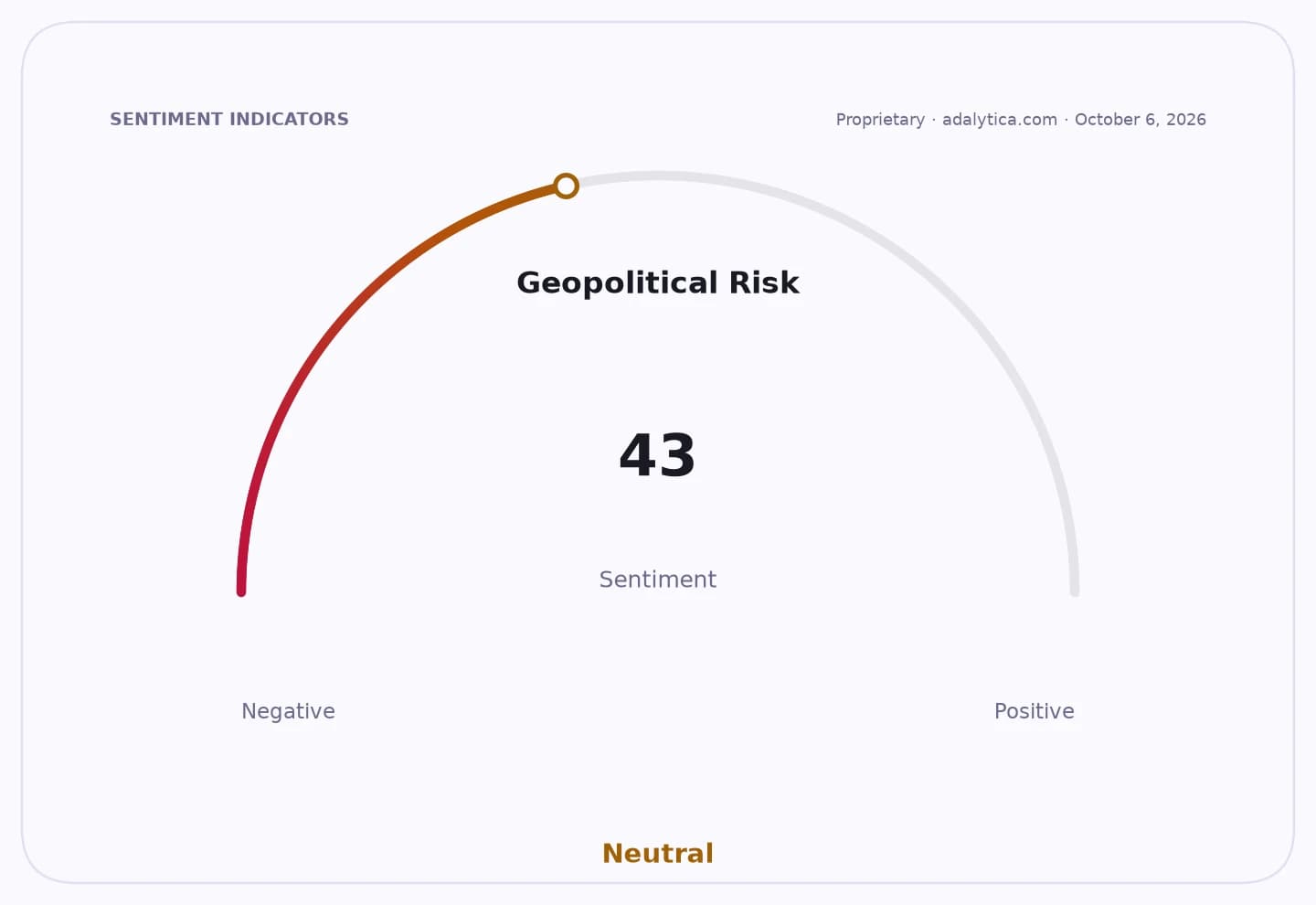
Sentiment IndicatorsⓘProprietary · adalytica.com · October 7, 2026
This is a snapshot — live sentiment, awareness and momentum for 130+ markets update continuously in the dashboard.Open AlphaPulse
Foreigners own about 13 million hectares, or roughly 5% of Argentina’s territory, according to activists, and the controversy has sharpened around Milei’s efforts to roll back the 2011 Land Law, which limits foreign rural holdings to 15% of any department and 30% for any one nationality. In Patagonia’s Lácar department, foreign ownership is said to reach about 54%, with roughly 30% held by US entities. Protesters argue that such concentrations give outside owners practical control over water, forestland and access routes, especially in the Andean cordillera and the Paraná basin.
The government has already taken several steps in that direction. Last week, Argentina’s supreme court cleared the path for Milei’s attempt to repeal the Land Law after an earlier ruling had blocked the move, while the president’s party advanced a pared-back property bill in the Senate that would speed evictions and make expropriations for public works harder. Milei has also signed a reform to the glacier law, widening the scope for mining in previously protected zones, and has framed the broader agenda as a way to attract long-term foreign capital.
Geopolitical Risk vs ARGTadalytica.com
Explore this data interactively — full history, time series and cross-market comparisons.Open AlphaPulse
For investors, the appeal is straightforward: lower barriers, more legal certainty for private owners and a state less willing to interfere in strategic projects. That is the logic behind Milei’s investment incentive regime, or Rigi, which offers tax breaks, freer profit repatriation and 30 years of regulatory stability, and behind a proposed “super Rigi” for capital-intensive projects such as AI data centres and semiconductor plants. The administration is also courting high-profile backers such as Peter Thiel, whose stake in Vista, an oil producer in Vaca Muerta, has become emblematic of the government’s open-door approach.
The bear case is that the reforms may simply transfer risk from the state to the courts and the streets. Indigenous communities in Neuquén, Chubut, Jujuy and Misiones say the loosening of eviction rules and the dismantling of the national registry of Indigenous communities have already accelerated property disputes. Legal title remains murky in many areas, which means investors may still face litigation, local resistance and reputational risk even where the law is made more permissive.
That tension is visible in the economic trade-off Milei has embraced. A more aggressive investment regime could help unlock hard-currency exports and scarce infrastructure spending, but it also risks inflaming local opposition in regions where land is tied to water access, environmental protections and Indigenous rights. CEPA, a local research group, estimates the fiscal cost of Rigi projects at as much as $2.3 billion a year, a reminder that the incentives may not be free even if they succeed in attracting capital.
Markets have largely treated Milei’s reform drive as supportive of Argentine assets, but the political economy behind land reform is more fragile than the government’s message suggests. If the administration can translate deregulation into visible investment in energy, mining and technology, the market will likely reward the policy mix. If not, land could become another source of institutional friction in a country already known for policy reversals, especially as provincial resistance, Indigenous mobilisation and court challenges test the limits of Milei’s mandate.
| Entity | Gains | Losses |
|---|---|---|
| Milei government | ▲Faster investment flows | ▼Social and legal backlash |
| Foreign investors | ▲Easier land access | ▼Higher protest and litigation risk |
| Indigenous communities | ▲Public attention | ▼Evictions and dispossession pressure |
| Argentine state revenue | ▲Potential growth spillovers | ▼Tax breaks and fiscal cost |