Argentina is sharpening its Malvinas strategy with legal pressure on energy companies and a diplomatic push that could affect offshore exploration costs for the oil majors operating in the South Atlantic.
Argentina tightens Malvinas stance on offshore drilling

President Javier Milei said Argentina will not use violence to recover the Falkland/Malvinas Islands, but will keep pressing its sovereignty claim “by right, by history and by geography” and use sanctions against companies that explore for hydrocarbons around the islands without permission. The message matters for investors because it raises the risk premium on any project tied to the disputed basin and signals that Buenos Aires wants to turn its Vaca Muerta shale boom into leverage in a long-running geopolitical dispute.
Sentiment Indicators
Milei said the government will punish firms that drill in Malvinas, South Georgia and the South Sandwich Islands without authorization, arguing that Argentina can make life harder for suppliers and developers by restricting access to domestic opportunities. He framed Vaca Muerta, the country’s main shale asset, as a strategic counterweight that gives Argentina more bargaining power than it had in the past.
The timing is notable because the Tribunal International of the Law of the Sea has set Nov. 10 and 11, 2026, for oral hearings in Argentina’s case against the United Kingdom over hydrocarbon exploitation in the South West Atlantic. Buenos Aires is also pulling back its domestic legislative debate on a sovereignty bill after Washington asked members to wind down the UN decolonization committee, underscoring how the dispute is being shaped by wider diplomatic currents.
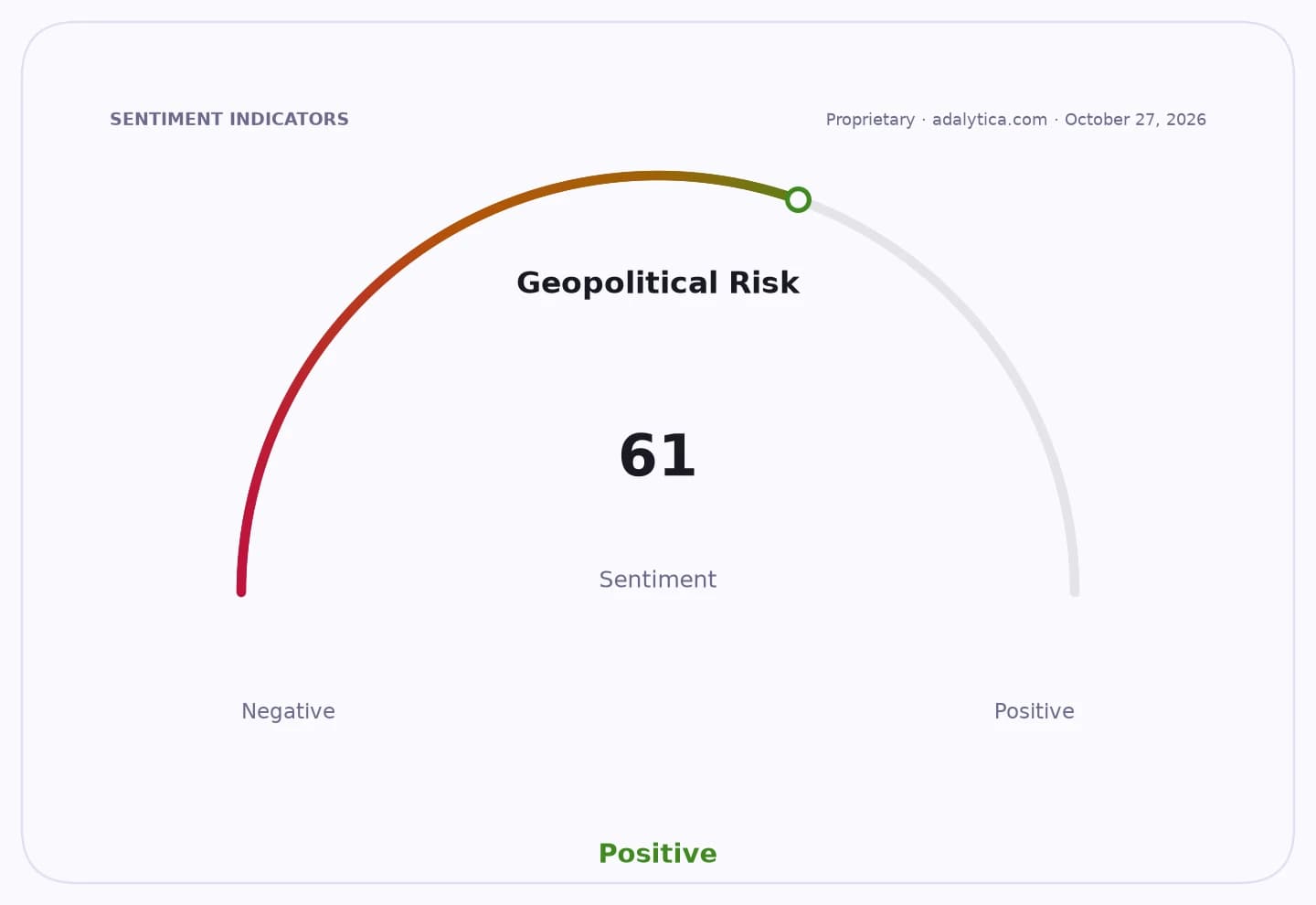
Geopolitical Risk — 30-day sentimentadalytica.com
Explore this data interactively — full history, time series and cross-market comparisons.
For energy investors, the issue is less about an immediate supply disruption than about permitting, financing and partner selection. Exploration around the islands already carries political and legal risk; a tougher Argentine stance could make some service providers, contractors and smaller independent operators even more cautious, while favoring companies with broader portfolio flexibility.
Oil majors have already been operating in a market where geopolitical shocks keep crude elevated and earnings strong. Exxon Mobil shares have climbed to $182.02, well above its 50-day moving average of $166.97, while BP closed at $49.79, also comfortably above its 50-day average of $45.72. The sector’s resilience means the Malvinas dispute is unlikely to move global oil prices by itself, but it can influence project economics in a region where headline risk is already high.
The next catalyst is the tribunal hearing in November, which could give investors a clearer read on whether Argentina’s tougher rhetoric turns into practical constraints on offshore activity or remains mainly a diplomatic pressure campaign.
| Entity | Gains | Losses |
|---|---|---|
| Argentina | ▲Stronger sovereignty posture | ▼Higher diplomatic friction |
| UK-backed operators | ▲None | ▼Greater legal and political risk |
| Vaca Muerta producers | ▲Strategic leverage | ▼Potential policy crossfire |
| Exxon Mobil, BP and peers | ▲Higher oil price backdrop | ▼Offshore exploration uncertainty |