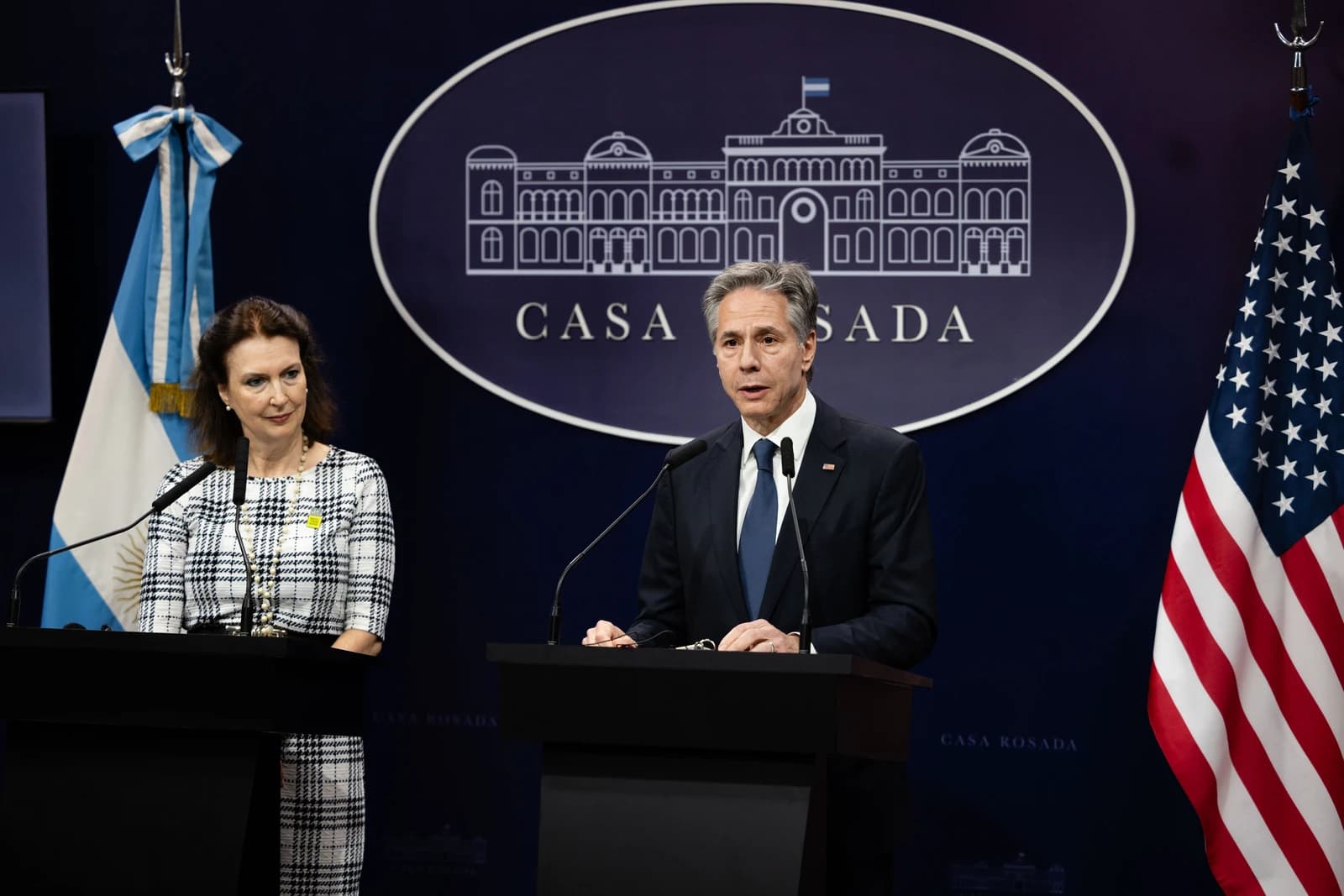
Argentina’s effort to keep its US backing intact now hinges on whether Republicans can hold Congress, because a Democratic surge would not overturn the alliance between Javier Milei and Donald Trump, but could make Washington’s support far more politically exposed.
Argentina backing depends on US Congress control
That matters economically because Argentina’s recent gains in market confidence have rested not just on Milei’s domestic program but on the prospect of sustained US financing, trade access and diplomatic cover at a time when the country still needs outside support to stabilize growth, roll over debt and attract capital. A more hostile Congress would not remove Trump’s authority over foreign policy, but it could raise the cost of backing Buenos Aires and invite investigations into the $20 billion rescue package cited by analysts as a possible target for oversight.
Sentiment Indicators
The midterms renew all 435 House seats, 35 Senate seats and 36 governorships, and the immediate question is whether Republicans can preserve control of at least one chamber. National polling has Democrats ahead by 7 to 12 points, while Trump’s approval has fallen to 37%, the lowest in an Emerson College survey, as voters remain focused on inflation and the cost of living.
For Argentina, the key risk is not a dramatic policy reversal but a reduction in discretion. Experts in the bilateral relationship say a Democratic majority would probably push for more transparency and tougher scrutiny of bilateral deals, as well as a closer look at US initiatives in Latin America. The rescue package, officials and analysts said, could become a politically sensitive subject, particularly if Democrats argue it played a role in strengthening Milei’s allies ahead of Argentina’s own elections.
Even so, the structural logic behind the relationship remains intact. Argentina offers lithium, copper, energy and strategic geography at a time when Washington is trying to limit China’s influence in the region. Trump’s priorities in Latin America still center on migration and organized crime, issues that have limited direct overlap with Argentina, which helps explain why several analysts expect continuity even under divided government.
Michael Shifter, former president of the Inter-American Dialogue, said the personal affinity between Milei and Trump is unprecedented in the bilateral relationship and that it would have been difficult to imagine a $20 billion rescue without it. Benjamín Gedan of the Stimson Center said Argentina’s leverage comes from its resources and the US-China rivalry, but warned that midterm results would likely shrink Buenos Aires’s room for maneuver. Kezia McKeague of McLarty argued that the relationship is driven mainly by the White House, where the executive still has broad authority over trade and foreign policy.
That leaves investors with a narrow but important distinction: a Republican hold would preserve the current policy path with fewer congressional obstacles, while a Democratic victory would likely increase investigation risk, budget friction and headline volatility without necessarily ending US support for Argentina. In market terms, the main consequence is not a collapse in the bilateral relationship, but a higher political discount attached to the rescue architecture that has helped underpin Argentine assets.
For Argentina, the next two years would likely be easier under continued Republican control, especially if Trump retains leverage over Congress and can keep Latin America policy concentrated in the executive branch. If Democrats win one or both chambers, Milei’s government may still keep Washington’s backing, but it would have to navigate a noisier, more skeptical Congress — and investors would have to price in a less predictable path for US support.
| Entity | Gains | Losses |
|---|---|---|
| Argentina / Milei government | ▲Continued US backing | ▼Congressional scrutiny |
| Trump administration | ▲Policy flexibility | ▼Legislative resistance |
| Democrats in Congress | ▲Oversight power | ▼Free hand for Trump |
| Argentine assets | ▲Stable US support scenario | ▼Rescue-package uncertainty |