Donald Trump’s White House has been thrown back into factional warfare, with aides jostling for influence, accusations of financial misconduct surfacing and a string of high-profile exits raising questions about how much control the president’s inner circle can exert just two weeks before crucial midterm elections.
Trump White House factional infighting ahead of midterms
The upheaval matters because the administration’s political operation is the main asset Trump has heading into a fight for Congress, and internal disorder risks blunting the message discipline, staffing stability and rapid decision-making the White House has tried to project since January. For investors, the bigger issue is that personnel chaos can spill into policy execution on immigration, regulation, energy and Venezuela — all areas where Trump’s team has already shown sharp shifts driven by who has the president’s ear.
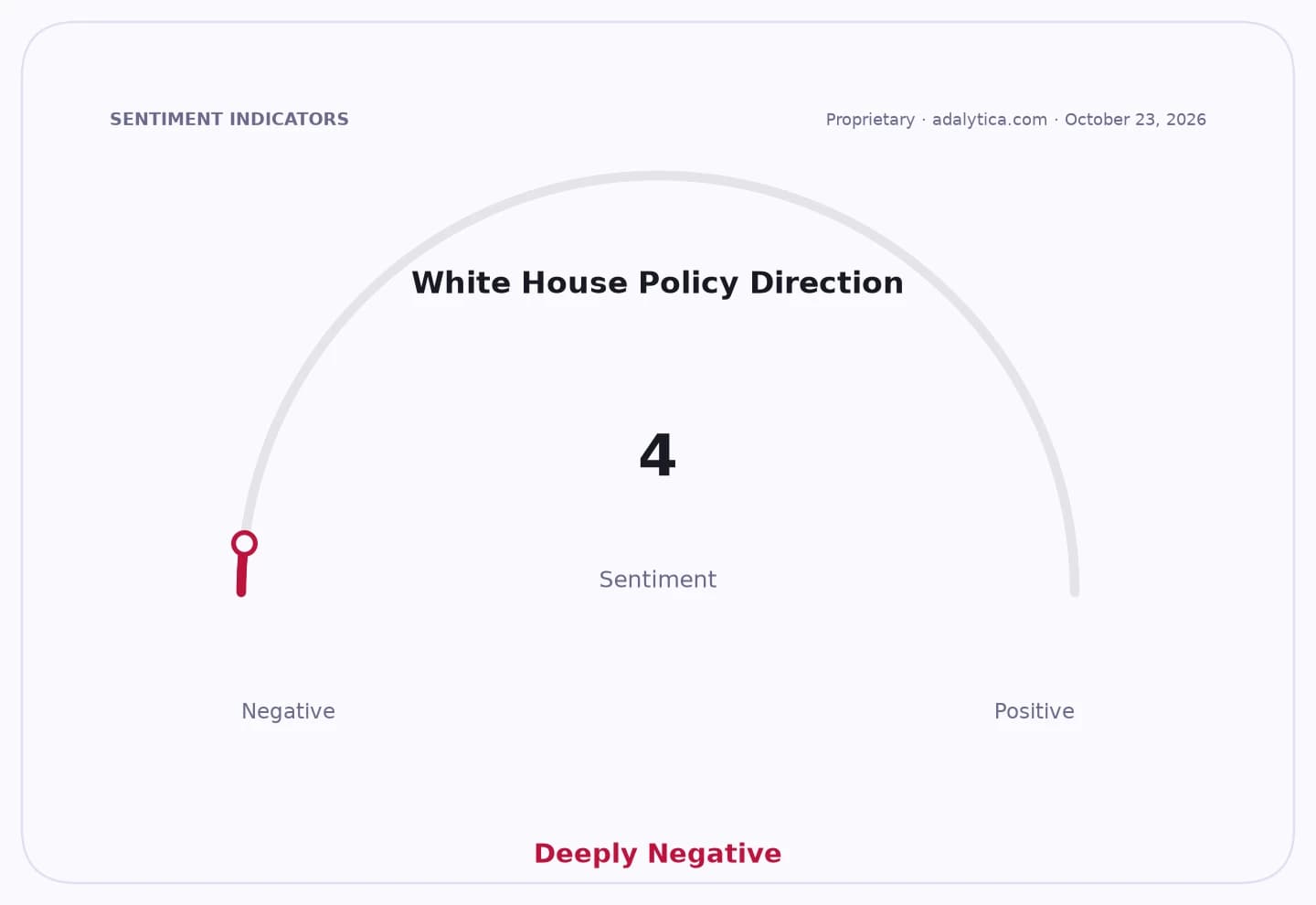
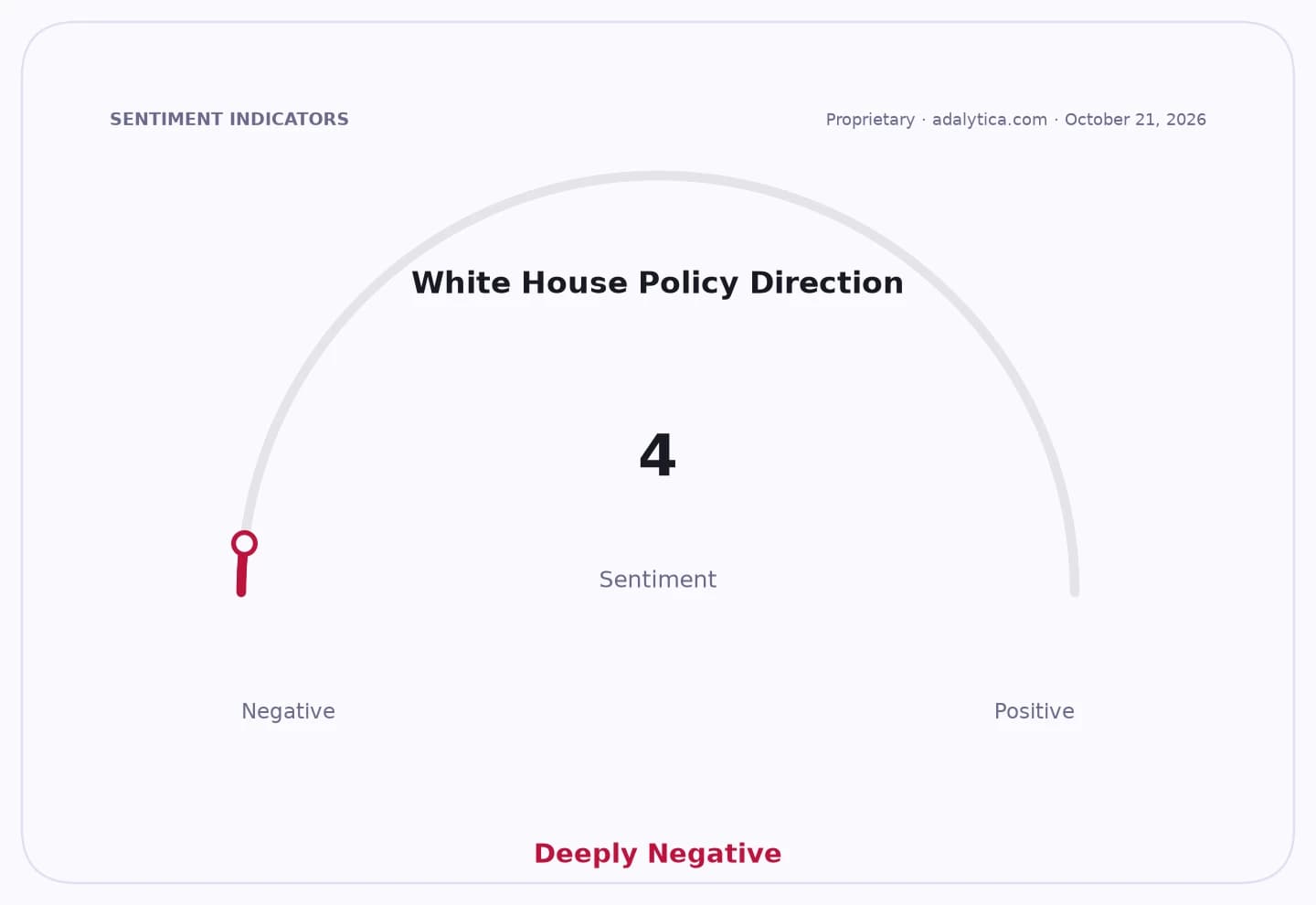
Sentiment IndicatorsⓘProprietary · adalytica.com · October 23, 2026
This is a snapshot — live sentiment, awareness and momentum for 130+ markets update continuously in the dashboard.Open AlphaPulse
Susie Wiles, Trump’s chief of staff and the central figure holding the operation together, is now the target of succession chatter despite public backing from the president. Several allies are positioning for her job, including Stephen Miller, Bill Pulte and Lee Zeldin, underscoring how quickly the battle for access to Trump has reopened after nearly two years of relative discipline.
The cracks became visible when Trump installed Katie Zacharia as a spokesperson without consulting Wiles, a move that was read inside the building as a direct challenge to her authority. Zacharia was then dismissed after only five days, a rapid reversal that reinforced the impression of a staff operation increasingly driven by personal loyalty tests rather than process.
The turmoil widened when the president was drawn into claims that two senior political operatives, James Blair and Chris LaCivita, took paid work in Bosnia’s Republika Srpska while still tied to Republican campaign efforts. Trump publicly distanced himself and said anyone with a conflict of interest would be fired immediately, a sign he wants to contain the damage even as the episode feeds the perception of a cash- and access-driven free-for-all.
The controversy also reached Wiles’ family, after reporting that her daughter’s firm was paid $35,000 a month by the Republika Srpska government. That has handed leverage to internal rivals and revived one of Trump’s recurring vulnerabilities: loyalty politics colliding with business interests, foreign contacts and the appearance of pay-to-play influence.
A separate clash between Alina Habba and Richard Grenell over a disputed $17.6 million Kennedy Center-linked donation has further exposed the extent of the infighting. Trump has ordered White House lawyers to look into the matter, while the dispute also intersects with policy tensions over Venezuela, where Grenell’s more conciliatory line lost ground to Secretary of State Marco Rubio’s tougher stance.
The State Department has not escaped the feud. Paolo Zampolli was removed as special envoy after months of conflict with Christopher Landau, and Kimberly Guilfoyle was pushed out as ambassador to Greece after allegations about her conduct. Taken together, the moves suggest Trump’s team is struggling to impose a single chain of command across diplomacy, domestic policy and political outreach.
For markets, the immediate impact is less about Washington drama than about the risk of erratic policy direction as the administration moves deeper into an election cycle that could reshape congressional control. The more the White House turns inward, the harder it becomes to deliver consistent signals on tariffs, energy, immigration and foreign policy — all key drivers for equities, defense, industrials, energy and Latin America exposure.
The next catalyst is whether Trump can restore discipline before the midterms or whether the latest wave of loyalty fights turns into a broader purge that weakens the administration’s governing capacity heading into 2027.
| Entity | Gains | Losses |
|---|---|---|
| Trump loyalists seeking influence | ▲Higher access to the president | ▼More public factional warfare |
| Susie Wiles | ▲Trump’s public backing | ▼Authority inside the White House |
| Marco Rubio / hardline policy camp | ▲More control over Venezuela policy | ▼Rivals advocating softer lines |
| Investors in policy-sensitive sectors | ▲Clarity if discipline returns | ▼Volatility from erratic decision-making |