Asian equities opened weaker on Tuesday, with technology stocks leading the decline after a sharp overnight selloff in Nvidia and other AI-linked names on Wall Street rattled sentiment across global markets.
Asia stocks fall as Nvidia selloff hits AI trade

The retreat matters because Asia has become tightly tethered to the US-led AI trade, leaving regional benchmarks vulnerable when investors reassess the valuations of the semiconductor and cloud names that powered this year’s rally. The weakness was broad enough to hit Japan, South Korea and Australia, underscoring that this is not just a single-stock correction but a de-risking of a crowded theme.
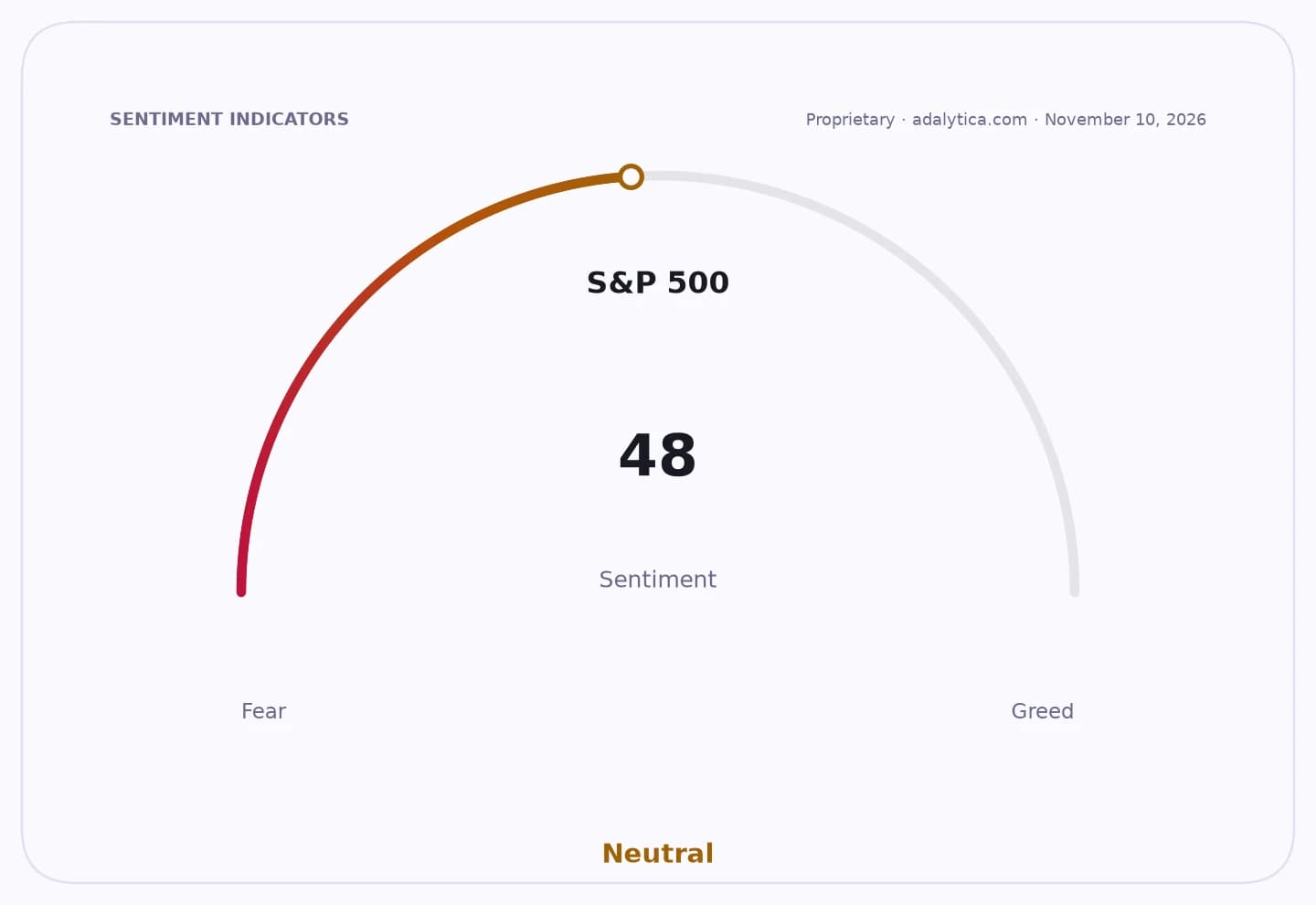
Sentiment Indicators

Japan’s Nikkei 225 fell 0.76% and the Topix lost 1.06% at the open, while South Korea’s Kospi dropped 1.57% and the tech-heavy Kosdaq slipped 0.62%. Australia’s S&P/ASX 200 also opened 1.37% lower. The declines followed Monday’s slide in US markets, where Nvidia fell 4.1% ahead of its quarterly results, dragging lower Advanced Micro Devices, Micron Technology and Sandisk as investors trimmed exposure to AI beneficiaries.
The move reflects a broader question now hanging over the market: whether the earnings growth implied by the AI boom can keep pace with the multiples attached to it. Ben Emons of FedWatch Advisors said the market was becoming more vulnerable as Nvidia’s AI valuation premium kept shrinking and investors started to question the durability of the ecosystem built around the company’s dominance. That dynamic is prompting dispersion trades, where money rotates away from a narrow group of mega-cap winners into a wider set of names, reducing the concentration that has carried the S&P 500 and Nasdaq higher.
For investors, the immediate concern is that a pullback in US technology can quickly translate into pressure on Asian chipmakers, suppliers and indices with heavy semiconductor weightings. Nvidia has fallen almost 24% this month and is on track for its steepest monthly decline since April 2022, while the Nasdaq posted its biggest daily drop since Nov. 5. The scale of the move suggests that positioning in AI-related stocks had become stretched enough that a single earnings event could trigger broader profit-taking.
The selloff also arrives as markets prepare for another test of US growth and inflation assumptions, with retail sales and import price data due later Tuesday. Those releases, along with results from Walt Disney and Home Depot, will help determine whether this is a contained tech correction or the start of a wider recalibration in risk assets.
For now, the narrative is clear: Asia is opening lower not because its own fundamentals have suddenly deteriorated, but because the global AI trade is losing momentum and investors are becoming more selective about how much valuation they are willing to pay for technology leadership.
| Entity | Gains | Losses |
|---|---|---|
| Cash-heavy value stocks | ▲Relative inflows | ▼Momentum reversal risk |
| AI leaders and chipmakers | ▲None in the selloff | ▼Valuation compression |
| Broader Asian indices | ▲Opportunity for rotation | ▼Tech-led drawdown |
| Investors holding hedges | ▲Portfolio protection | ▼Missed upside if dip is brief |