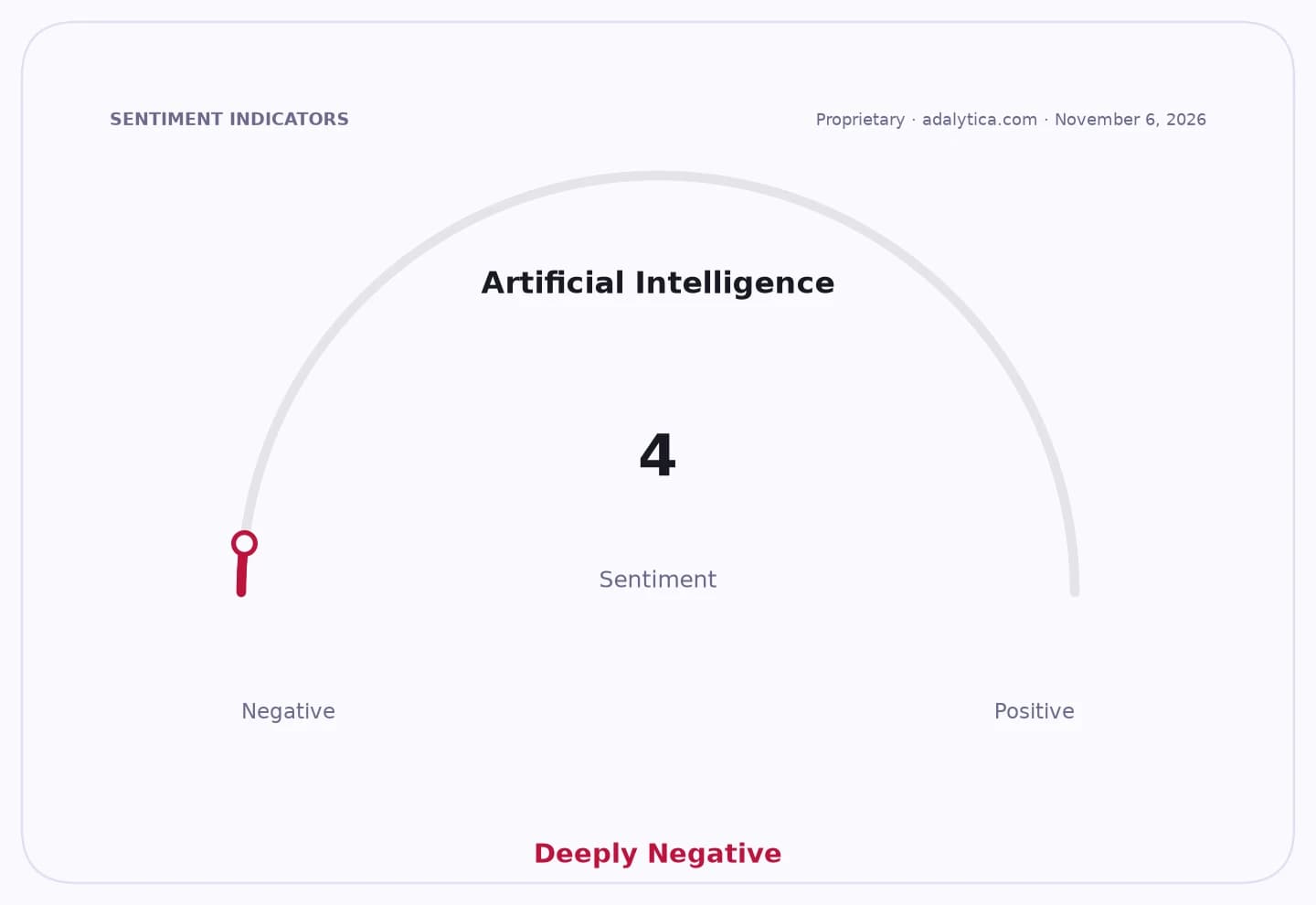
Global investors are punishing technology shares across Asia even as China’s stock market inches higher, a split that says more about where capital is leaving than where it is going. The selloff is being driven by mounting anxiety that the AI spending boom may be getting ahead of itself, with semiconductors and the most expensive growth names taking the hardest hit.
Asia Tech Sells Off as China Shares Rise

That matters because AI has been the main engine of the region’s equity rally and a powerful source of earnings optimism for chipmakers, hardware suppliers and internet platforms. When investors start to question whether that spending can deliver enough profit to justify the outlay, valuations compress fast. The result is a classic late-cycle move: money rotates away from momentum winners and into markets or sectors viewed as less vulnerable to a pullback in risk appetite.
Sentiment Indicators

In Asia, the damage has been broad. The Nikkei fell even as other markets were steadier, South Korean shares dropped nearly 3%, and technology-heavy names were hit especially hard. The weakness echoes the slide seen in SanDisk and other AI-linked stocks, despite strong earnings in some cases, showing that investors are focusing less on recent results and more on whether the AI capital cycle can keep accelerating.
China’s market, by contrast, has managed to rise, suggesting domestic shares are again acting as a relative haven when global tech sentiment turns volatile. That divergence is important for long-term investors because it highlights a widening gap between companies tied to the AI buildout and those tied more directly to China’s internal economy, policy support and cheaper valuations. Alibaba, Tencent and JD.com were mixed to firmer in recent trading, with Alibaba closing at $109.45 and JD at $29.11, while Tencent ended at $53.66.
Economic Growth Targets
The technical picture for some of those Chinese internet names looks constructive enough to keep them on watchlists. Alibaba’s shares have reclaimed their 50-day moving average after a rough summer, while JD has pushed above its 50- and 200-day moving averages. Tencent is still below its longer-term trend lines, but it has stabilized after a deep selloff. That does not make the stocks immune to macro shocks, yet it does suggest investors are beginning to separate durable businesses from the more speculative corners of the AI trade.
The bigger message for investors is that the market is re-pricing growth. AI remains a genuine secular opportunity, but the current selloff is a reminder that even the strongest themes can go through brutal corrections when expectations outrun near-term cash generation. For patient investors, that can create opportunity — but only if they focus on companies with real free cash flow, pricing power and balance-sheet strength, not just exposure to the theme.
What happens next will depend on whether upcoming earnings and guidance show that AI spending is translating into profits rather than just bigger capex bills. If the answer is yes, today’s volatility could prove to be a reset rather than a reversal. If not, the pressure on Asia’s tech leaders may deepen, while China’s more domestically focused stocks could continue to attract capital. For now, this looks like a market telling investors to be selective, stay diversified and think in years, not days.
| Entity | Gains | Losses |
|---|---|---|
| China equities | ▲Relative safety bid | ▼Less exposure to AI crowding |
| Asia tech stocks | ▲— | ▼Valuation compression |
| Chipmakers and AI suppliers | ▲Long-term demand theme | ▼Near-term spending doubts |
| Patient investors | ▲Better entry points | ▼Short-term volatility |