Chinese artificial intelligence shares are coming under renewed pressure as investors question whether the country’s home-grown AI champions can turn heavy spending into profits fast enough to justify their valuations.
Chinese AI Stocks Fall as Valuations Reset

The selloff matters because Beijing has made technological self-reliance a strategic priority, and AI sits at the center of that push. If markets keep punishing the sector, it gets harder for Chinese companies to fund the chips, data centers and model development needed to compete with U.S. rivals.
Sentiment Indicators

Baidu, one of China’s best-known AI names, has fallen to 76.40 yuan from 152.26 yuan in January, cutting its market value roughly in half. The stock is now well below its 50-day moving average of 87.39 and 200-day average of 114.45, while its RSI reading of 24.3 points to deeply oversold conditions.
Alibaba has also slid sharply, closing at 98.04 from 175.57 in late January. That puts the stock below both its 50-day average of 109.67 and 200-day average of 125.59, underscoring how quickly enthusiasm has faded as investors reassess near-term earnings power.
Artificial Intelligence vs BIDUadalytica.com
Explore this data interactively — full history, time series and cross-market comparisons.

The pressure mirrors weakness in U.S. AI names, where Nvidia has dropped to 204.64 from a recent high of 235.20. Its RSI of 31.0 and break below the 50-day average of 221.68 show that even the sector’s bellwether is losing momentum, reinforcing doubts that the AI spending cycle can deliver near-term returns.
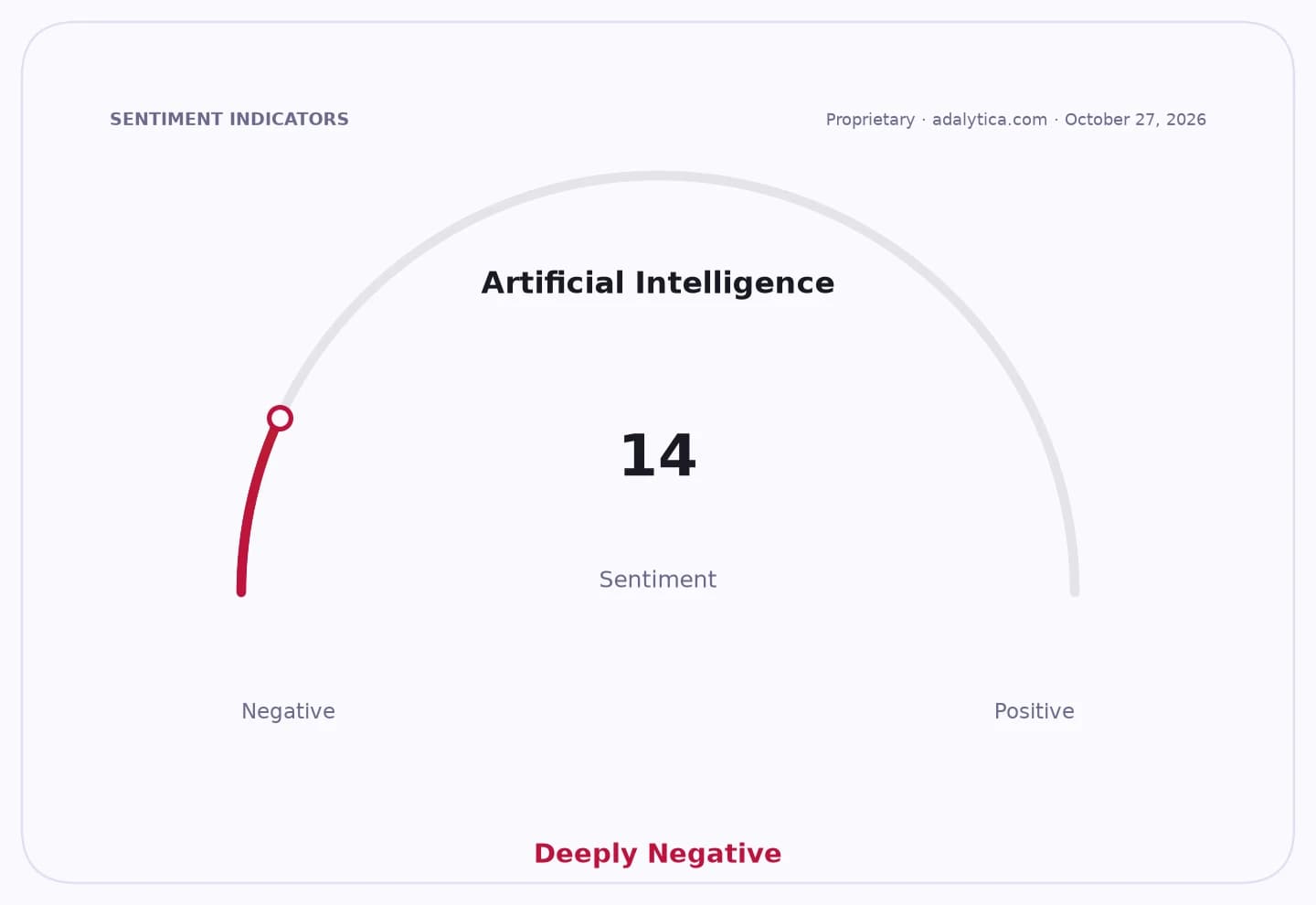
The broader chill is visible in Adalytica’s AI sentiment gauge, which shows “Extreme Fear” with a sentiment reading of 4, down 96 points over 30 days. For investors, that signals a market still trying to separate durable AI infrastructure demand from a speculative rally that ran too far, too fast.
The key question now is whether upcoming earnings can prove that AI investment is translating into revenue growth and margin improvement, or whether the latest pullback marks the start of a longer reset in AI valuations across Asia.
| Entity | Gains | Losses |
|---|---|---|
| Cash-rich value investors | ▲Lower entry prices | ▼Momentum unwinds |
| Chinese AI developers | ▲Policy support focus | ▼Valuation compression |
| U.S. AI peers | ▲Relative benchmark status | ▼Sector-wide sentiment drag |
| Short sellers | ▲Volatility and downside | ▼If earnings surprise higher |