Asian equities opened broadly lower as Wall Street’s overnight slide and a jump in oil prices revived worries that higher energy costs will squeeze growth and keep inflation sticky, a mix that is pressuring risk assets from Tokyo to Hong Kong.
Asian equities fall as oil prices and yields rise

Japan’s Nikkei 225 fell 0.8% at midday, while the broader Topix was down 0.3%. In Hong Kong, the Hang Seng dropped 1.3%, South Korea’s Kospi lost 1.0%, and mainland China’s Shanghai Composite and Shenzhen Component slipped 0.2% and 0.4%, respectively. The declines were modest in size but broad in scope, suggesting investors were trimming exposure across the region rather than rotating within markets.
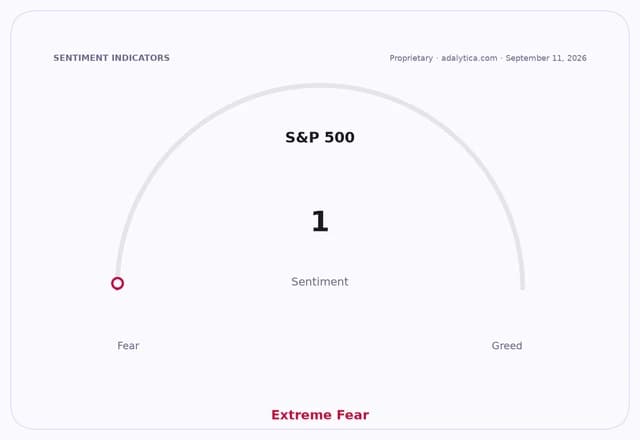
Sentiment IndicatorsⓘProprietary · adalytica.com · September 11, 2026
This is a snapshot — live sentiment, awareness and momentum for 130+ markets update continuously in the dashboard.Open AlphaPulse

The move matters because Asia is facing the same crosscurrents that hit U.S. markets: higher crude prices, softer risk appetite and renewed doubts about the durability of the global expansion. Oil above $100 a barrel in the U.S. market narrative feeds directly into inflation expectations, bond yields and profit margins, especially for sectors that are energy-intensive or sensitive to consumer demand. For export-heavy Asian economies, a sustained rise in energy costs can also erode trade balances and corporate earnings even if local growth remains intact.
The market backdrop remains fragile. The 10-year U.S. Treasury yield has edged up to 4.83%, while the 10-year/2-year spread has narrowed to 0.39 percentage point, a configuration that usually leaves investors wary about growth prospects. Adalytica’s S&P 500 trade signals show “Extreme Fear,” underscoring how quickly sentiment has deteriorated in global equities. In the Asia equity ETFs, the picture is mixed: the iShares China Large-Cap ETF (FXI) and iShares MSCI Emerging Markets ETF (EEM) are still above their 50-day moving averages, but both have rolled over from recent highs, with FXI’s latest RSI reading near 32, a level that often reflects stretched downside momentum.
For investors, the immediate issue is not one day’s decline but whether the market is starting to price a more persistent squeeze on margins and valuations. High oil tends to punish airlines, transportation, consumer discretionary names and import-dependent economies, while supporting energy producers and certain commodity exporters. It also complicates central bank policy by keeping inflation elevated just as growth concerns deepen, leaving fewer policy cushions for equities.
The next catalysts will be crude’s direction, any further move in U.S. yields and whether Wall Street can stabilize after its latest drop. If oil remains elevated, Asia’s defensive bid could widen; if energy prices ease, the region’s selloff may prove to be another short-lived risk-off move rather than the start of a deeper correction.
| Entity | Gains | Losses |
|---|---|---|
| Energy producers | ▲Higher revenue | ▼- |
| Asian exporters | ▲- | ▼Higher input costs |
| Equity bears | ▲Lower valuations | ▼- |
| Long-only stock investors | ▲- | ▼Broader risk-off selling |