ARPA-H has chosen Atman Health to build a voice-first AI system for heart failure care, a bet that could help push patient-facing clinical automation toward regulated use in one of medicine’s biggest and costliest disease areas.
Atman Health Wins ARPA-H Heart Failure AI Award
The award matters because heart failure is both widespread and hard to manage at scale: about 7.7 million Americans live with the condition, and ARPA-H says the disease remains poorly controlled even though it is highly treatable. The agency estimates its ADVOCATE program could ultimately deliver $28 billion in annual savings across the heart failure population if the technology works as intended.
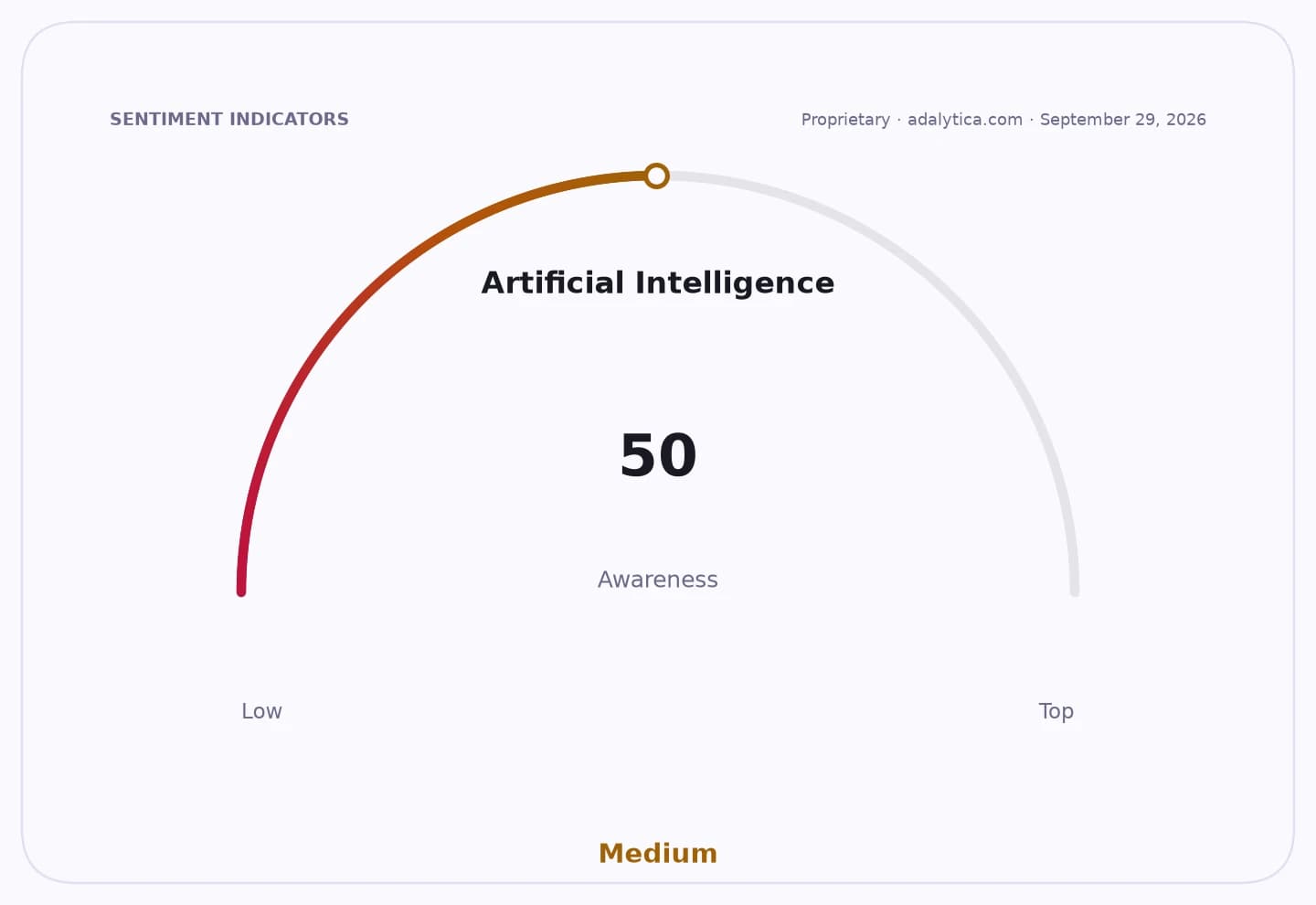
Sentiment IndicatorsⓘProprietary · adalytica.com · September 29, 2026
This is a snapshot — live sentiment, awareness and momentum for 130+ markets update continuously in the dashboard.Open AlphaPulse
Atman’s contract is worth up to $7.7 million, part of ARPA-H’s first-year commitment of up to $33.7 million in a four-year program totaling $62.7 million. The agency is trying to create what it calls the world’s first reliable, FDA-authorized clinical agentic AI system — software that can operate around the clock as part of the care team rather than simply flagging data for clinicians.
That makes the selection economically significant beyond a single grant. Heart failure care is expensive, labor-intensive and fragmented, especially in rural areas and counties without cardiologists. ARPA-H says nearly half of U.S. counties have no cardiologist, a gap that leaves room for tools that can triage symptoms, monitor medications and prompt follow-up without requiring constant specialist time.
Atman is pitching a model designed to lower safety risk by separating language processing from clinical decision-making. Its system uses a large language model for patient conversation by phone or chat, while treatment recommendations are handled by a deterministic rules engine built on more than 9,000 clinical criteria, 9,600 medication pairings and 6,900 titration profiles, according to the company.
That architecture is central to investor interest in healthcare AI. Regulators have been wary of black-box systems in clinical settings, and ARPA-H is explicitly working with the FDA on evaluation standards, interoperability and reimbursement pathways. A successful path to FDA authorization would be a major validation for firms trying to commercialize AI that touches prescribing and treatment changes.
Atman’s program also puts it alongside other performers including Tempus AI, Updoc, Stanford University, Duke University and Kaiser Permanente, underscoring how the government is trying to build both the software and the deployment infrastructure for a new care model. Kaiser’s participation is especially important because it gives the program access to large-scale real-world workflows across more than 260 clinics and 21 medical centers.
The market relevance extends beyond Atman itself. Abbott Laboratories, Teladoc Health and Veeva Systems all sit in the orbit of digital health, diagnostics and healthcare software, where AI-enabled care delivery could eventually alter workflow, reimbursement and competition. For investors, the key question is whether this kind of system becomes an assistive tool or a reimbursable clinical platform that can scale across health systems.
The near-term milestone is regulatory, not commercial. ARPA-H says patient-facing performers must submit a first-of-its-kind FDA authorization package within 24 months, while Atman says it plans pre-submission FDA engagement in year one, an investigational device exemption around month 12 and a De Novo filing within 24 months. The next catalyst is whether the company can prove that its voice-first model is safe enough for real patients and robust enough for broad hospital adoption.
| Entity | Gains | Losses |
|---|---|---|
| Atman Health | ▲ARPA-H award, clinical validation | ▼Higher regulatory scrutiny |
| ARPA-H / FDA | ▲New AI oversight framework | ▼Limited room for failure |
| Heart failure patients | ▲Better access, tighter monitoring | ▼Risk of rollout delays |
| Traditional care delivery | ▲AI workflow support | ▼Manual-only models, specialist bottlenecks |