The most important investment story here is not ideology — it is that the platform power of Big Tech is being weaponized in ways that could keep volatility elevated, reward authoritarian politics and push capital toward defense, energy and infrastructure while raising the discount rate on social-media and advertising assets.
Big Tech Politics Lift Defense and Energy Spending

That matters because the modern attention economy now sits at the center of elections, war messaging and consumer behavior. The article’s core claim is that algorithms, targeted ads and billionaire-owned platforms have become the organizing layer for political mobilization, with far-right movements gaining the edge on social media while traditional parties struggle to compete. For investors, that means the political cycle is no longer a backdrop to tech; it is a direct variable in tech’s revenue model, regulatory risk and valuation multiple.
Sentiment IndicatorsⓘProprietary · adalytica.com · October 17, 2026
This is a snapshot — live sentiment, awareness and momentum for 130+ markets update continuously in the dashboard.Open AlphaPulse
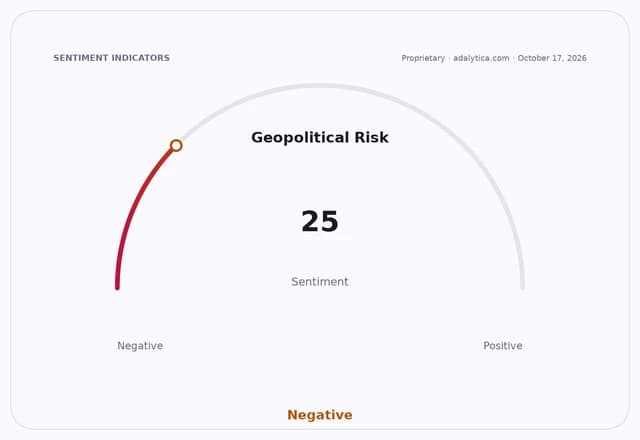
The market is already trading some of that instability. The Nasdaq-100 tracker QQQ closed at 709.8 on Oct. 16, down from 728.95 two days earlier, while its 50-day moving average sat at 726.33 and RSI readings had slipped to 33.4, a sign of weakening momentum. The broader S&P 500 was still holding above its 50-day average at 763.25 versus 767.4, but the tape is less forgiving when policy and geopolitics turn noisy. In Adalytica’s Global Stability Sentiment gauge, fear has jumped to 25 and awareness collapsed to 4, an “Extreme Fear” reading that fits a market increasingly alert to disruption rather than complacent about it.
This is where the investment thesis gets more interesting. If social platforms are becoming political infrastructure, then their business models face a split outcome: engagement may rise, but scrutiny, legal risk and advertiser caution rise too. Meta, Snap and Reddit all flag escalating government and regulatory attention in their filings, and those disclosures should be read as a macro warning, not boilerplate. The platforms that monetize outrage and political microtargeting may still print cash, but the market will increasingly ask whether that cash flow is durable or politically contingent.
The deeper opportunity may not be in the platforms themselves. If the world is moving into a more fractured, security-conscious, information-warfare era, the beneficiaries are the businesses that sell resilience: cloud and compute, cybersecurity, defense electronics, energy infrastructure, grid hardening and satellite communications. The same force that empowers digital populism also accelerates spending on monitoring, moderation, intelligence, secure networks and physical deterrence. That is why I believe the market underestimates the second-order winners from this “doom loop” — not the companies amplifying the noise, but the ones getting paid to contain it.
There is also a capital-allocation angle. A more polarized world tends to favor state power, higher defense budgets, fossil-fuel security and emergency-capex cycles. It is no accident the article links far-right politics to fossil capital and geopolitical conflict around oil routes and fuel depots. That supports a durable bid for energy, defense and industrial names, while pressuring consumer-facing digital ad businesses that depend on a stable regulatory and brand environment.
For investors, the actionable takeaway is clear: don’t chase the narrative layer, position for the infrastructure layer. Own the picks-and-shovels of political disorder — semiconductors, cloud, cybersecurity, defense, grid and energy infrastructure — and treat large-cap platform stocks as higher-beta political assets, not neutral compounders.
| Entity | Gains | Losses |
|---|---|---|
| Defense and cybersecurity firms | ▲Higher security spending | ▼None material |
| Cloud and AI infrastructure providers | ▲More compute demand | ▼Higher regulatory scrutiny on platforms |
| Energy and grid infrastructure stocks | ▲Security and resilience capex | ▼Fossil-fuel volatility risk |
| Meta, X, Snap, Reddit | ▲Engagement from polarization | ▼Regulatory and advertiser risk |