Bitcoin’s drop below $83,000 is forcing investors to confront the trade-off between long-term upside and near-term pain, even as Bernstein sticks with a $1 million target for 2033.
Bitcoin Drops Below $83,000 as Bernstein Keeps $1M Target
The target remains eye-catching, but the path to it is becoming the real story. Bernstein’s latest outlook still sees Bitcoin around $150,000 by mid-2027 and roughly $300,000 at the next cycle peak in 2029 before reaching $1 million by the end of 2033. That implies years of fresh institutional demand, ETF inflows and broader market adoption just to justify a price that would still be roughly 12 times today’s level.
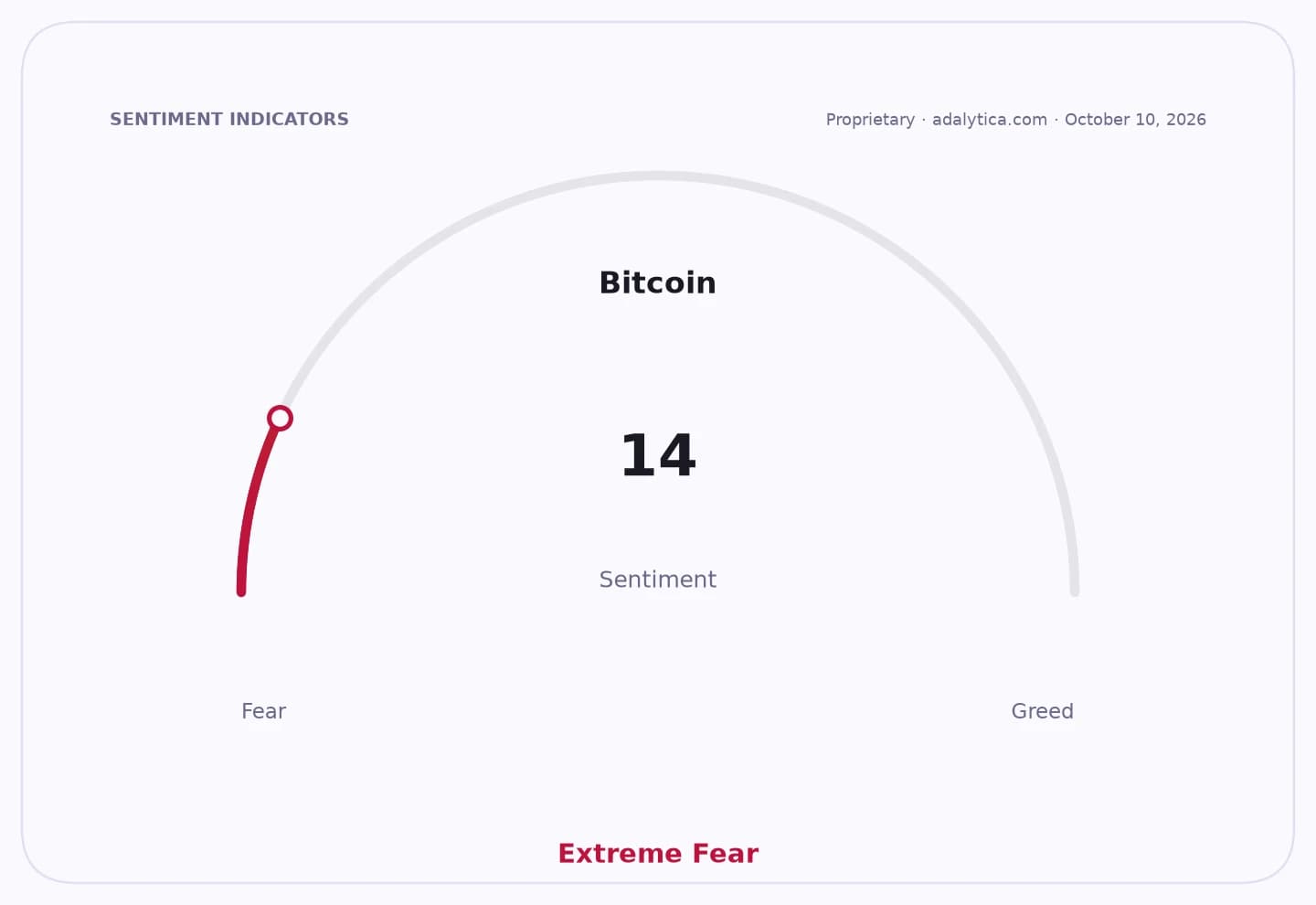
Sentiment IndicatorsⓘProprietary · adalytica.com · October 10, 2026
This is a snapshot — live sentiment, awareness and momentum for 130+ markets update continuously in the dashboard.Open AlphaPulse
For investors, the economic significance is twofold. First, Bitcoin’s valuation has already grown large enough that the next leg higher likely depends on sustained capital inflows rather than retail speculation alone. Second, the latest sell-off highlights how brutally Bitcoin can retrace even inside a longer secular bull thesis. The token’s slide to the low $80,000s has come alongside technically weak readings, with Adalytica’s Bitcoin Fear & Greed Index at 14, or “Extreme Fear,” and the 14-day relative strength index in depressed territory. Bitcoin is also trading below its 50-day moving average, a sign that momentum has deteriorated even after its earlier run above $100,000.
That matters for market structure. When an asset as widely held as Bitcoin is sold off this sharply, it tends to pull in leveraged traders, crypto-related equities and risk appetite across the broader digital-asset complex. The latest data show the pressure extending beyond the token itself. MicroStrategy, one of the most prominent corporate Bitcoin proxies, has swung sharply lower over the past year, while Coinbase has also traded with heavy volatility as crypto activity and investor sentiment whipsaw. For holders of Bitcoin-linked equities, the challenge is that the long-term thesis can be intact while the stock and the underlying asset are still digesting a major drawdown.
Bernstein’s forecast also underlines why some traders are shifting attention toward smaller, earlier-stage tokens and presales in search of bigger percentage gains. The logic is straightforward: Bitcoin can still climb dramatically from here and yet remain a far more mature asset than in its early years, making 100x-type outcomes harder to justify on a public-market basis. In contrast, presale tokens such as AlphaPepe are being marketed to buyers on the premise that they are entering before exchange listing and price discovery, with Stage 21 now live after Stage 20 sold out at a stated presale price of $0.03269. That pitch will appeal to investors chasing asymmetry, though it comes with materially higher execution, liquidity and survival risk than Bitcoin.
The bull case for Bitcoin remains powerful. A $1 million price would still be compatible with a world in which institutions keep buying, ETFs deepen distribution and crypto solidifies as a long-duration macro asset. The bear case is that the market’s next gains may arrive much more slowly than the most aggressive forecasts imply, with repeated drawdowns testing conviction well before 2033.
For now, the market is telling investors that the calendar matters as much as the target. Bitcoin may still be on a path to much higher prices, but the road looks likely to remain volatile, crowded and unforgiving.
| Entity | Gains | Losses |
|---|---|---|
| Long-term Bitcoin holders | ▲Potential upside to $1 million | ▼Years of volatility |
| Short-term Bitcoin traders | ▲Trading opportunities | ▼Whipsaw risk |
| Bitcoin-linked equities | ▲Leverage to any BTC rebound | ▼Deep drawdown exposure |
| Presale token buyers | ▲Early-entry upside narrative | ▼Liquidity and execution risk |