A money-laundering case tied to the so-called “crypto queen” is a reminder that the biggest threat in digital assets is not price volatility, but compliance risk — and that matters for every exchange, broker and corporate treasury now exposed to Bitcoin.
Bitcoin compliance crackdown lifts regulated platforms

The economic significance is straightforward: when regulators and prosecutors move against alleged laundering networks moving billions, the cost of doing business in crypto rises. More compliance spending, tighter onboarding, deeper transaction monitoring and greater scrutiny of cross-border flows all compress margins for intermediaries while raising the bar for legitimate institutions seeking to enter the market. That is exactly why the latest wave of enforcement is more than a criminal headline — it is a re-pricing event for the sector’s risk premium.
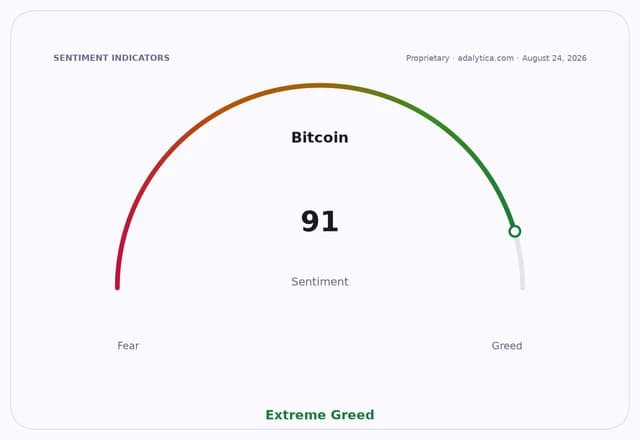
Sentiment IndicatorsⓘProprietary · adalytica.com · August 24, 2026
This is a snapshot — live sentiment, awareness and momentum for 130+ markets update continuously in the dashboard.Open AlphaPulse
Investors should care because the market is already pricing Bitcoin as a mainstream asset, but the plumbing around it is still being policed like an emerging-market payments network. That creates a split outcome. On one side are regulated platforms and balance-sheet holders that can absorb compliance costs and benefit from the flight to credibility. On the other are smaller, lightly supervised players that depend on frictionless growth and opaque flows. When enforcement tightens, the survivors gain market share.
The backdrop is clear in the numbers. Bitcoin has ripped back into the high-$70,000s, with standard technical indicators showing a market that remains stretched and momentum-heavy. Adalytica’s Bitcoin Fear & Greed Index sits in “Extreme Greed,” while awareness is also at the top of the range, underscoring how crowded the trade has become. That is a powerful setup: when enthusiasm is high, any headline that reminds investors crypto is still under the microscope can trigger sharp rotations into the safest operators.

The public companies most exposed are the ones built on volume, trading and retail participation. Coinbase, for example, has already been climbing again, but its earnings power still depends on a regulatory regime that can either broaden institutional adoption or choke off activity through investigations and tighter rules. MicroStrategy, meanwhile, is leveraged to Bitcoin itself — so any crackdown that dents liquidity or sentiment can hit the stock harder than the coin. The real long-term winners are the “picks-and-shovels” names that benefit from a more institutionalized market: compliant custody, surveillance, payments and custody-linked infrastructure.
There is also a broader policy story here. Authorities are not just chasing one alleged fraud; they are trying to prove the crypto economy can coexist with anti-money-laundering rules, sanctions enforcement and banking oversight. That is especially important as crypto-linked ventures seek legitimacy through banking charters and regulated wrappers. The message from regulators is that scale will be allowed, but only if the sector pays for trust.
For investors, the takeaway is to treat laundering crackdowns as a filter, not just a headline risk. I believe the next leg in crypto is not driven by the least regulated platforms, but by the most compliant ones. That means the better asymmetric opportunities sit in the infrastructure that helps institutions participate safely, while the fragile edge of the market remains vulnerable to enforcement shocks. In this environment, own the toll roads, not the shortcuts.
| Entity | Gains | Losses |
|---|---|---|
| Regulated exchanges | ▲More share, more credibility | ▼Higher compliance costs |
| Unregulated platforms | ▲None | ▼Enforcement risk, lost volume |
| Bitcoin infrastructure firms | ▲Greater institutional demand | ▼Short-term volatility |
| Criminal networks | ▲None | ▼Asset seizures, prosecutions |