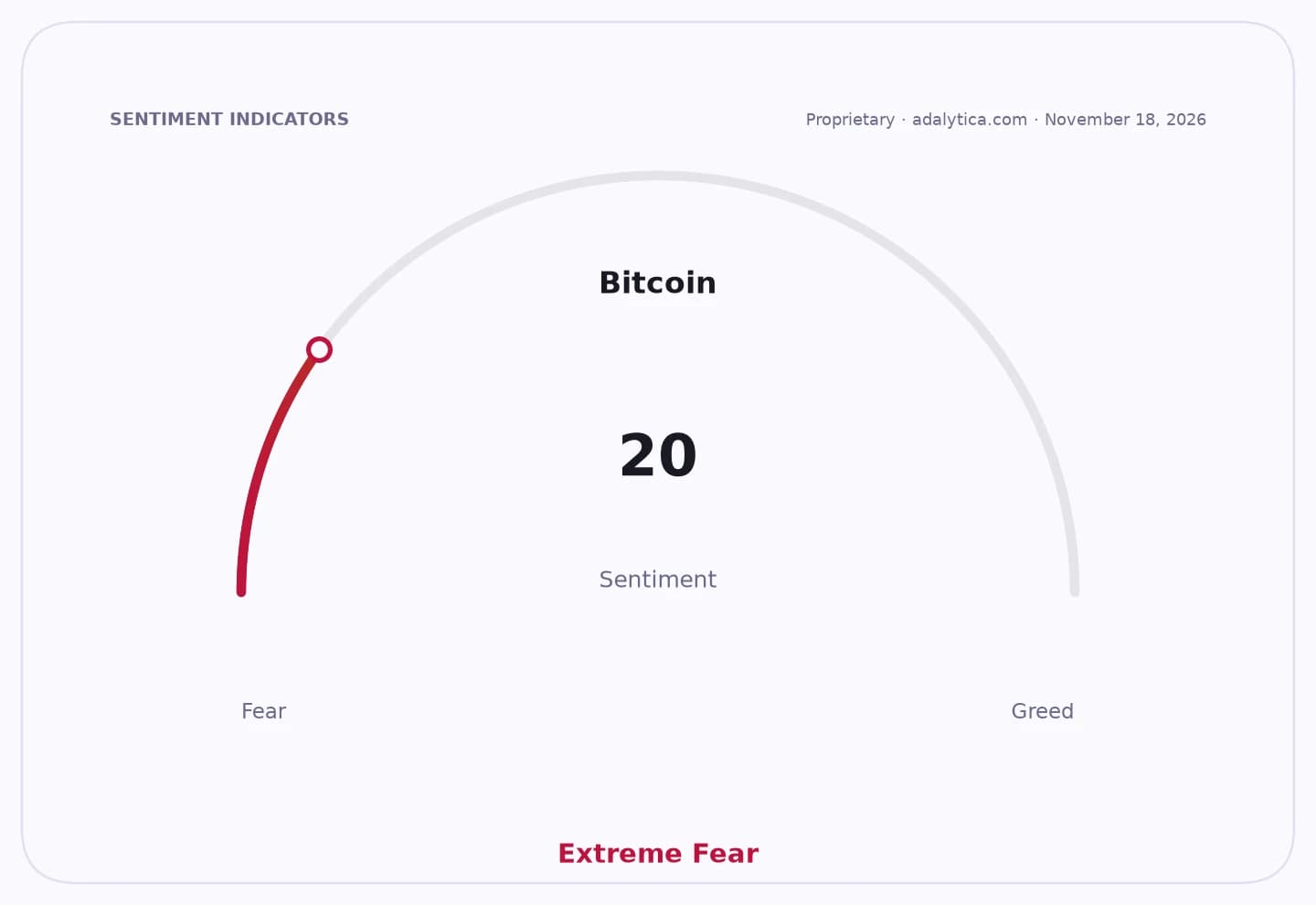
Bitcoin is testing whether institutional demand has merely paused or has started to reverse, after US spot ETFs shed about $2.3 billion so far in November before BlackRock’s flagship fund posted its first net inflow in more than two weeks.
Bitcoin ETF outflows ease as IBIT posts inflow
The turn in BlackRock’s iShares Bitcoin Trust matters because IBIT has been the dominant marginal buyer in the market since launch, and its flows have accounted for the bulk of the November exodus. After 11 straight days of outflows, IBIT drew in $76.5 million on Monday, helping the 12 US spot Bitcoin ETFs ekes out a combined net inflow of $7.9 million. That is still a long way from a durable trend change, but it is the first sign that the fastest institutional selling pressure may be easing.
Sentiment Indicators
The bigger message is that the ETF complex has stopped acting as a tailwind. Since Nov. 2, the funds have bled roughly $2.34 billion, including about $1.28 billion in the first week of the month and another $1.07 billion in the second, according to SoSoValue data cited in the reports. IBIT alone accounted for about 90% of the net November outflows through mid-month. The monthly decline is large in headline terms but modest relative to assets under management: the products still hold about $86 billion, and cumulative inflows since January 2024 remain close to $55 billion. For the market, the issue is less an investor stampede than the disappearance of persistent bid-side demand that helped lift bitcoin through 2024 and 2025.
That matters economically because bitcoin, unlike equities or bonds, offers no yield to cushion investors when real rates are high and Treasury returns are attractive. The 10-year US Treasury yield around 5.12% and near-certainty of a December Fed hike leave digital assets competing with genuinely risk-free income. In that setting, every basis point of policy hawkishness or hot inflation data raises the hurdle for new allocations to bitcoin ETFs. The market has already absorbed that message: bitcoin traded around $64,500, down about 13.7% from a week earlier and almost 49% below its October 2025 peak above $126,000.
Investors should also read the flows as a signal about who is and is not still buying the dip. Recent 13F filings show large holders such as Wells Fargo and JPMorgan had built or maintained meaningful IBIT stakes through Sept. 30, which suggests the product is now embedded in institutional portfolios. But those filings lag the latest price damage and do not show whether those same holders added or cut exposure in October and November. The more immediate indicator is that the marginal buyer appears to be waiting for a friendlier macro backdrop, not abandoning the asset class.
The market linkages go beyond crypto. Bitcoin’s slide has tracked weakness in the Nasdaq 100, underscoring that the token is still being traded as a high-beta risk asset rather than a diversifier. That has hit the listed proxies as well: Coinbase fell more than 6% and Strategy dropped more than 7% on Monday. For Coinbase, softer ETF demand matters because it weakens one of the key structural narratives supporting crypto market activity, while trading revenue has already been under pressure. For Strategy, the concern is even more direct: the company bought just 485 bitcoin last week, and a growing portion of capital is being directed toward supporting its preferred stock rather than adding aggressively to bitcoin holdings.
The near-term test is whether Monday’s inflow can be repeated as investors parse retail sales data, Fed commentary and Nvidia’s results. If ETF flows stay positive through the week, it would strengthen the case that November’s outflows were a deleveraging phase rather than a broader institutional retreat. If they turn red again, the market may be forced to accept that the “pros” are not gone — they are simply waiting for lower rates, lower yields or lower prices before returning in size.
| Entity | Gains | Losses |
|---|---|---|
| BlackRock IBIT | ▲first net inflow since late October | ▼loses momentum in a key growth trade |
| Bitcoin bulls | ▲signs of returning institutional bids | ▼weaker price support and sentiment |
| Treasury yields / cash | ▲stronger relative yield appeal | ▼less capital chasing non-yielding assets |
| Coinbase, Strategy | ▲less immediate ETF-driven scrutiny if flows stabilize | ▼lower trading activity and weaker crypto leverage |