Oil prices are easing while stocks remain resilient, but the deeper message for markets is that Bitcoin is absorbing risk appetite that gold is not.
Bitcoin, gold, oil and yields diverge on risk appetite

West Texas Intermediate was last near $96.72 a barrel in the latest forecast, down from a recent high of $109.76 in May and well below the $123.64 peak seen in March 2022, while the 10-year Treasury yield edged up to 5.29%. That combination — softer crude, firmer yields and a still-firm equity tape — is the backdrop for a relative-rotation trade that investors are watching closely: Bitcoin has climbed to about $85,973, gold is stuck near $4,224 an ounce, and the S&P 500 is holding up even as sentiment remains fragile beneath the surface.
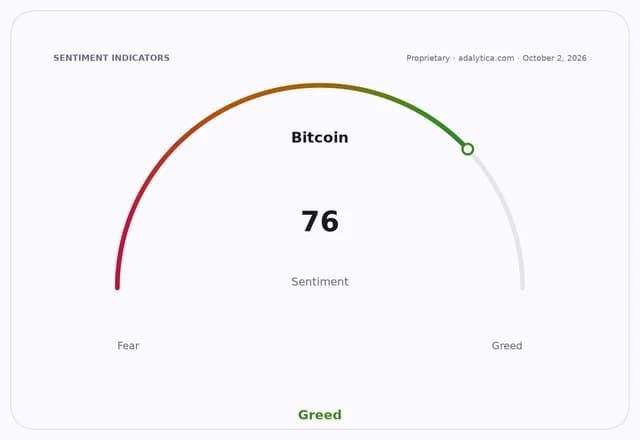
Sentiment IndicatorsⓘProprietary · adalytica.com · October 2, 2026
This is a snapshot — live sentiment, awareness and momentum for 130+ markets update continuously in the dashboard.Open AlphaPulse

The economic significance is straightforward. Lower oil tends to ease inflation pressure, helping support equities by reducing the risk of further policy tightening and softening input costs for consumers and companies. But the move in yields suggests markets are not pricing a clean disinflation story. With the 10-year at 5.29%, the discount rate on future cash flows remains elevated, which usually weighs on long-duration assets. In that setting, gold’s inability to sustain momentum is notable: despite a recent rise in crude that pushed inflation expectations higher, bullion is still trading below its 50-day moving average of around $4,367 and under its 200-day average near $4,554.
Bitcoin, by contrast, is behaving like a high-beta liquidity asset. The cryptocurrency is trading above both its 50-day and 200-day moving averages, with RSI at 78.3 indicating stretched but still strong momentum. Its recent close above $85,000 puts it not far from the upper Bollinger Band near $89,142, suggesting the market is pressing a technical breakout even as overbought readings warn of near-term volatility. The Adalytica Bitcoin Fear & Greed Index is at 76, in “Greed” territory, even though awareness remains low, underscoring how quickly speculative demand can return when macro conditions improve.
DCOILWTICO vs DGS10 — macro contextadalytica.com
Explore this data interactively — full history, time series and cross-market comparisons.Open AlphaPulse
That matters for investors because the current price action is drawing a line between store-of-value trades and risk-on liquidity trades. Gold typically benefits when growth is slowing, real yields fall or investors seek hedges against policy error and geopolitical stress. Bitcoin, increasingly, is being treated as a momentum asset that can outperform when traders believe the macro environment is stabilizing and capital is moving back into risk. The fact that both are holding up while oil softens suggests markets are not fully embracing recession, but are still wary of sticky rates and uneven growth.
The S&P 500’s own signals are mixed. Adalytica’s U.S. equity gauge shows neutral sentiment at 47, but awareness at “Extreme Fear” levels of 14, a sign that the index’s headline strength is not yet matched by broad conviction. That split helps explain why stocks can rise even as underlying caution persists: falling energy prices can support margins, yet high yields and fading confidence can keep leadership narrow.
For now, the key narrative is not simply that oil is down and stocks are up. It is that crude, yields, Bitcoin and gold are sending different messages about inflation, liquidity and risk tolerance. If oil keeps easing and yields stabilize, equities could extend gains and Bitcoin may continue to outperform as a leveraged proxy for improving liquidity. If energy rebounds again, the case for gold as an inflation hedge would improve, but that would also test stock valuations and the durability of the current risk rally.
| Entity | Gains | Losses |
|---|---|---|
| Stocks / S&P 500 | ▲Easier inflation outlook | ▼Margin pressure from higher yields |
| Bitcoin | ▲Risk-on inflows | ▼Store-of-value rivals if rates stay high |
| Gold | ▲Geopolitical hedge demand | ▼Rising real yields and weak momentum |
| Oil producers | ▲Higher-price rebound | ▼Softer crude and narrower spreads |