Bitcoin’s institutional base swelled to a record $29.78 billion in the third quarter as banks, wealth platforms and financial advisers returned to buying spot Bitcoin exchange-traded products after three straight quarters of net selling.
Bitcoin institutional holdings hit record in Q3

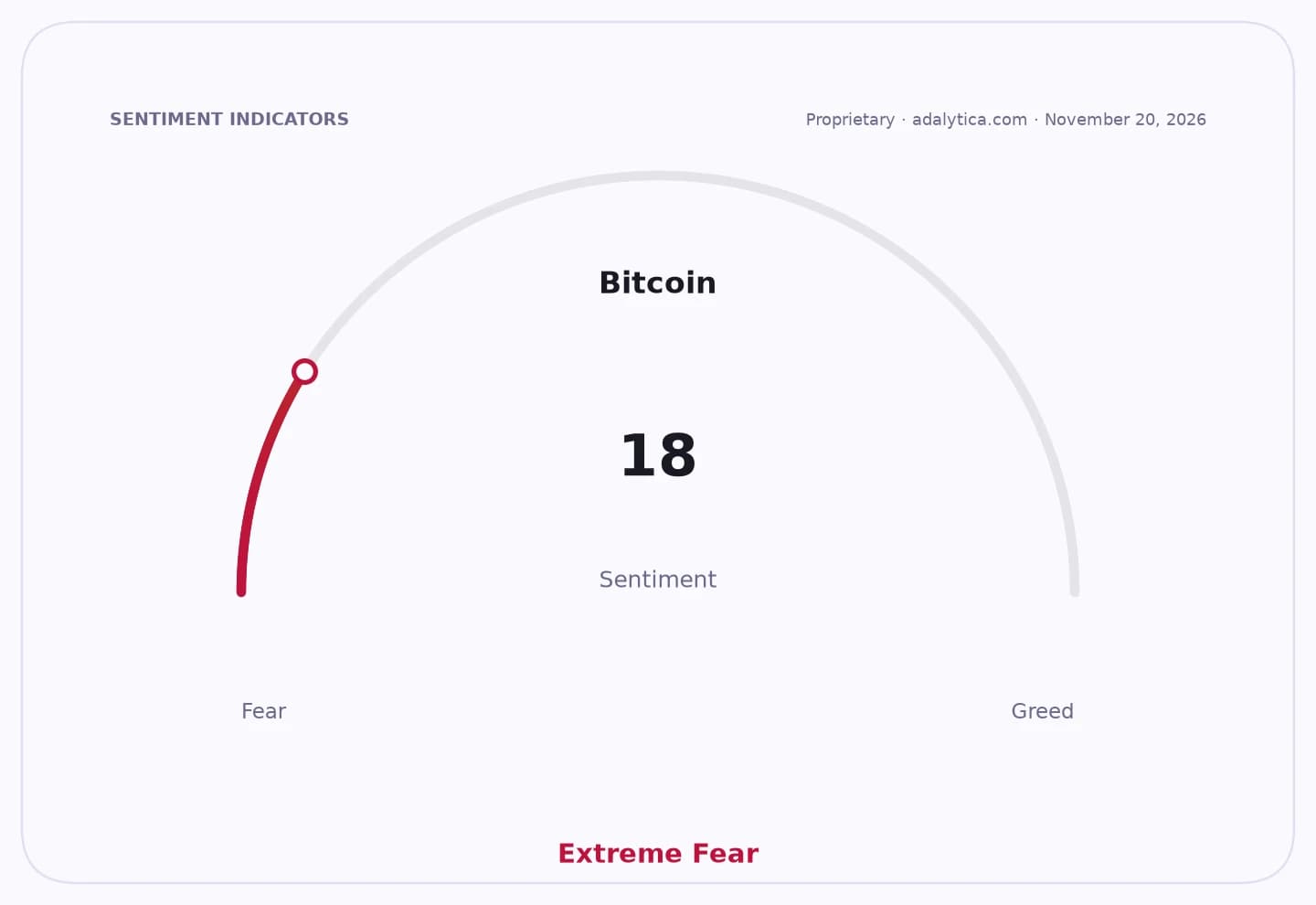
The shift matters because it shows the market’s biggest allocators were willing to add exposure even as Bitcoin later slid below $60,000 and broader crypto sentiment sank into “Extreme Fear.” For investors, that makes Q3 look less like a speculative burst and more like a structural bid from mainstream finance — the kind of demand that can deepen liquidity, support product flows and help determine whether Bitcoin’s rally has institutional legs.
Sentiment Indicators
Galaxy Research said institutional investment managers added about 49,229 BTC-equivalent in the quarter, lifting holdings to 356,491 BTC-equivalent by Sept. 30. That was up to roughly $29.78 billion in value and marked a record for the category.
The composition of ownership changed as much as the level. Financial advisers and wealth management platforms held 144,307 BTC-equivalent at quarter-end, or 40.5% of all Bitcoin ETP holdings reported by institutional managers, and their positions have risen for nine straight quarters. Their exposure is now 3.3 times the level seen in March 2024.
Large banks helped drive the accumulation. Wells Fargo, Bank of America and Morgan Stanley were among the biggest buyers, while Wells Fargo alone added 14,636 BTC-equivalent to reach 30,553 BTC-equivalent, overtaking Jane Street as the largest institutional holder of U.S. spot Bitcoin ETPs.
The mix of holders also underscores how Bitcoin is being absorbed into advisory and brokerage channels rather than concentrated in more tactical hedge fund accounts. Hedge funds’ share of institutional Bitcoin ownership fell to 19% from 50.6% in December 2024, while BlackRock’s IBIT accounted for 65.2% of institutional Bitcoin ETP holdings.
That demand did not hold through the end of the year. Bitcoin ETP holdings fell by 38,531 BTC between Sept. 30 and Nov. 16, while spot Bitcoin ETFs flipped from inflows of $2.65 billion in September and $3.52 billion in August to outflows of $515.03 million in October and $3.47 billion in November.
The price backdrop has been just as weak. Bitcoin was trading near $59,193 on the latest data, far below its earlier 2026 highs, with the 50-day moving average and 200-day moving average both above spot and the RSI deep in oversold territory. Coinbase and MicroStrategy have also been under pressure, reflecting how quickly crypto-linked equities can reprice when ETF demand cools.
For investors, the key question now is whether Q3’s institutional buying was the start of a durable wealth-management allocation trend or just a pause before broader risk aversion took hold. The next read will come from whether spot ETF outflows stabilize and whether banks and advisers keep adding through the volatility.
| Entity | Gains | Losses |
|---|---|---|
| Wealth advisers / platforms | ▲Bigger Bitcoin allocations | ▼Holding through volatility |
| Wells Fargo, BofA, Morgan Stanley | ▲Early institutional exposure gains | ▼Mark-to-market pressure |
| BlackRock IBIT | ▲Dominant share of institutional ETP holdings | ▼Heavy dependence on ETF flows |
| Bitcoin bears / short sellers | ▲Price weakness and outflows | ▼Q3 accumulation narrative |