Bitcoin’s long-running link to M2 money supply is breaking down, and that helps explain why the token has lagged stocks even as liquidity metrics keep rising. The bigger driver, according to crypto analyst Benjamin Cowen, is net global liquidity — a broader measure of central-bank balance sheets and short-term cash drains — and that gauge is still well below the levels that powered previous Bitcoin rallies.
Bitcoin and M2 Link Weakens as Liquidity Stays Tight

Cowen argues that Bitcoin does not simply rise with M2, which includes cash and readily available deposits across the financial system. M2 has hit record highs in years such as 2014, 2018 and 2022, but Bitcoin still suffered sharp declines in those same periods, suggesting the token needs actual liquidity expansion rather than just more money in the system.
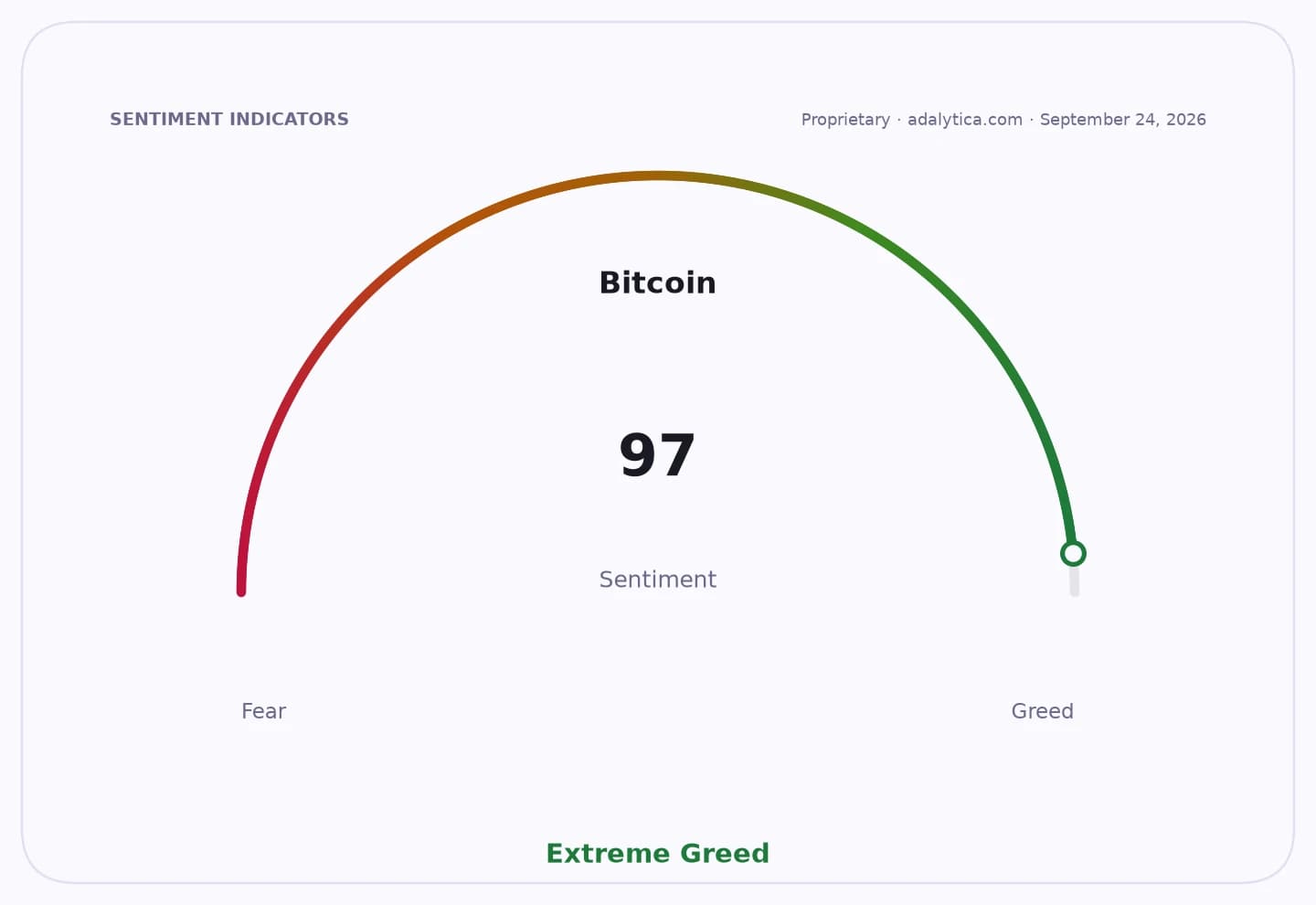
Sentiment IndicatorsⓘProprietary · adalytica.com · September 4, 2026
This is a snapshot — live sentiment, awareness and momentum for 130+ markets update continuously in the dashboard.Open AlphaPulse
That distinction matters for markets because net global liquidity currently sits around $25 trillion, roughly $5 trillion below the $30 trillion peak reached in 2021 and 2022. Cowen says that shortfall helps explain why Bitcoin has underperformed equities despite continued M2 growth, and why the market has lacked the kind of speculative excess seen in earlier crypto cycles.
The setup echoes 2019, when M2 rose, stocks pushed to record highs and Bitcoin still fell because global liquidity did not improve enough to support a broad risk rally. Bitcoin only turned higher when the pandemic forced central banks to flood markets with real liquidity, a backdrop that is absent now as megacap artificial-intelligence stocks keep the S&P 500 elevated and reduce pressure on policymakers to ease.
For investors, that means Bitcoin may remain tied more closely to central-bank balance-sheet policy, Treasury cash management and broader funding conditions than to simple money-supply growth. The token’s relatively mild drawdown in this cycle, compared with prior bear-market losses of 75% to 85%, also suggests the market has not fully unwound, but it has not reached the euphoric phase that usually accompanies a true liquidity boom.
Bitcoin was last trading around $81,200, after rebounding from earlier weakness, while MicroStrategy and Coinbase have also swung with the crypto tape. Adalytica’s Bitcoin Fear & Greed Index shows sentiment at 48, or neutral, with awareness still in fear territory at 18, underscoring a market that is stabilizing but not overheated.
The next catalyst is still liquidity: a move higher in global central-bank balance sheets or a shift in Fed/Treasury funding conditions could revive the Bitcoin-money-supply trade, while persistent tightness would keep the token’s path dependent on risk appetite rather than M2 alone.
| Entity | Gains | Losses |
|---|---|---|
| Central banks adding liquidity | ▲Bitcoin | ▼Bitcoin bears |
| Risk assets with abundant funding | ▲BTC and crypto proxies | ▼Cash-holding investors |
| Megacap AI stocks | ▲S&P 500 | ▼Bitcoin relative performance |
| Coinbase and MicroStrategy | ▲Higher crypto prices | ▼Traders expecting M2-led breakout |