Satoshi Nakamoto appears to have wanted Bitcoin to be more than a trading asset — he wanted it to become the foundation for a new kind of banking system, and that long-term ambition is colliding with a new question of survival: can the network stay secure as quantum computing advances?
Bitcoin quantum risk and long-term security debate
That matters because the original Bitcoin design was never just about payments. From the genesis block’s embedded message during the 2009 banking crisis to Satoshi’s early writings about trust, inflation and fractional-reserve banking, the project was framed as an alternative to the traditional financial system. Hal Finney, one of Bitcoin’s earliest advocates, went even further in 2010, imagining “Bitcoin-backed banks” and a layered monetary system built on top of BTC. In other words, the father of cryptocurrency did not merely want a token that could rise or fall in price; he wanted a base layer for money itself.
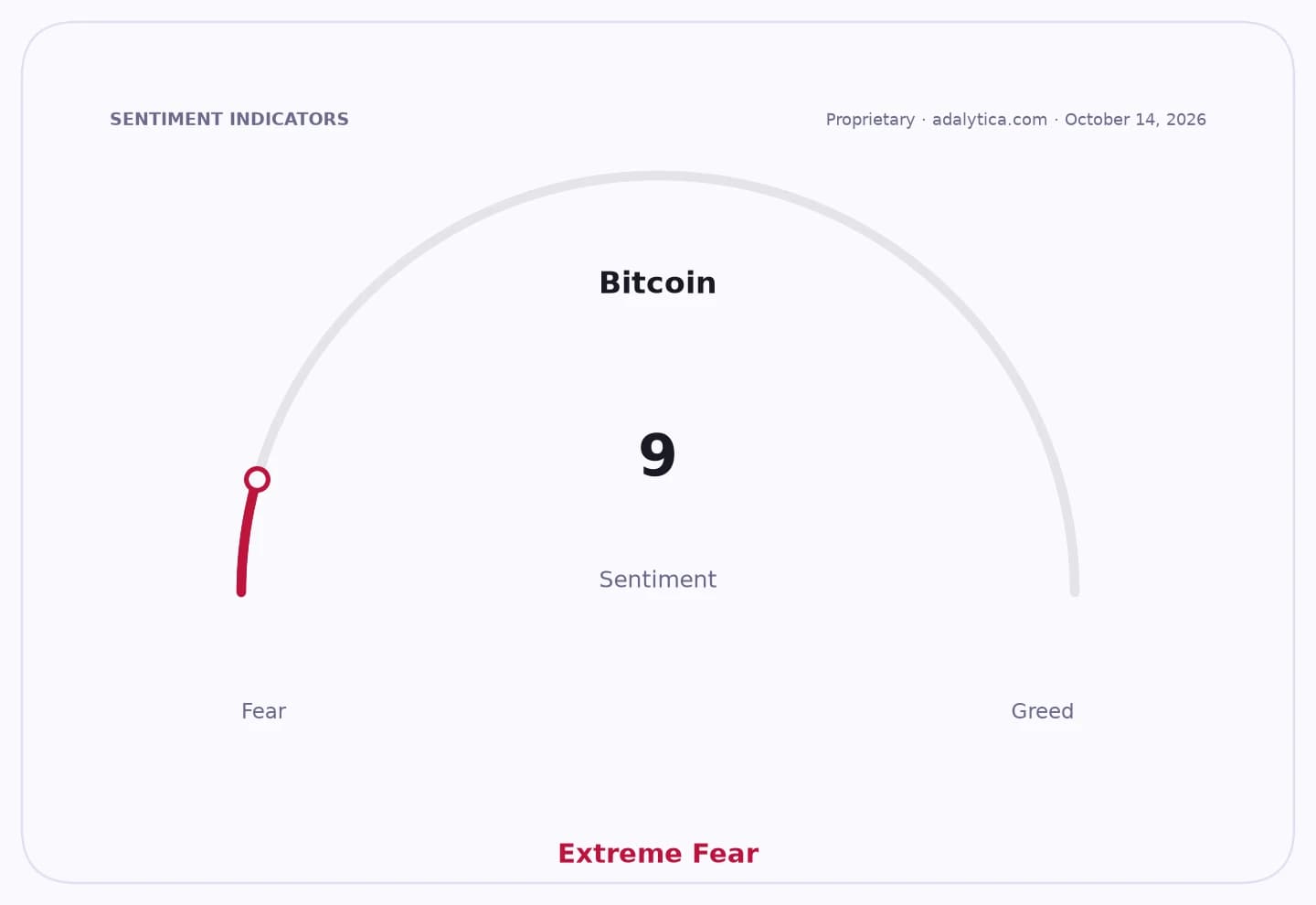
Sentiment IndicatorsⓘProprietary · adalytica.com · October 14, 2026
This is a snapshot — live sentiment, awareness and momentum for 130+ markets update continuously in the dashboard.Open AlphaPulse
For investors, that distinction is everything. A store of value can survive hype cycles. A monetary platform needs durability. Coinbase’s push for quantum-resistant security underscores that Bitcoin’s real investable thesis rests on whether its cryptography can remain intact for decades, not whether the coin can rally for a few weeks. If Bitcoin can evolve to meet that challenge, it strengthens the case for BTC as digital reserve collateral, and potentially for companies built around custody, payments and exchange infrastructure such as Coinbase and MicroStrategy. If it cannot, the whole “digital gold” and future banking narrative gets harder to defend.
The market, meanwhile, is acting as if the debate is already overdue. Bitcoin recently traded around $81,470 after a sharp pullback from above $100,000 earlier in the period, with the 50-day moving average near $81,163 and the 200-day average around $72,205. The move has left the coin well below recent highs and close to the lower end of its Bollinger Band range, while Adalytica’s Bitcoin Fear & Greed Index sits at 9, an “Extreme Fear” reading. That kind of backdrop can shake out weak hands, but it also tends to force the industry to confront the questions that really matter: what gives Bitcoin lasting value, and what could break it?
That is why the current conversation is bigger than a security patch. Satoshi’s criticism of fiat money was rooted in trust, dilution and the fragility of centralized institutions. Bitcoin’s answer was a hard, programmable monetary base that no central bank could debase. But if the network’s cryptographic assumptions are eventually challenged by quantum computing, then the next phase of Bitcoin’s evolution will have to be about preserving that trust in a new technological era.
For long-term investors, the takeaway is straightforward. Bitcoin remains one of the most compelling monetary experiments ever created, but its future depends on continuous adaptation, not nostalgia. The winners are likely to be the networks, custodians and platforms that help Bitcoin remain secure and usable over time. The losers would be investors who assume the protocol is finished simply because it was revolutionary at launch. For anyone with a multi-year horizon, this is a story worth watching closely — and keeping on the watchlist.
| Entity | Gains | Losses |
|---|---|---|
| Bitcoin adopters | ▲Stronger long-term trust | ▼Security complacency |
| Coinbase and custodians | ▲More demand for secure infrastructure | ▼Old cryptography risk |
| Long-term BTC holders | ▲Better preservation of value | ▼Quantum vulnerability |
| Short-term speculators | ▲Volatility-driven opportunities | ▼Thesis uncertainty |