The U.S. government’s transfer of about 12,267 bitcoin — worth roughly $1 billion — has become the latest catalyst for a shakeout in a market already being squeezed by ETF redemptions and rising Treasury yields.
Bitcoin Falls After U.S. Government Wallet Transfer
Bitcoin slipped below $83,000 after the move and briefly touched $81,315, but the bigger message for investors is that the selling pressure is still being driven more by positioning than by any change in bitcoin’s long-term setup. The coin is still trading above its 50-day and 200-day moving averages, and that matters: the trend remains intact even as short-term fear spikes.
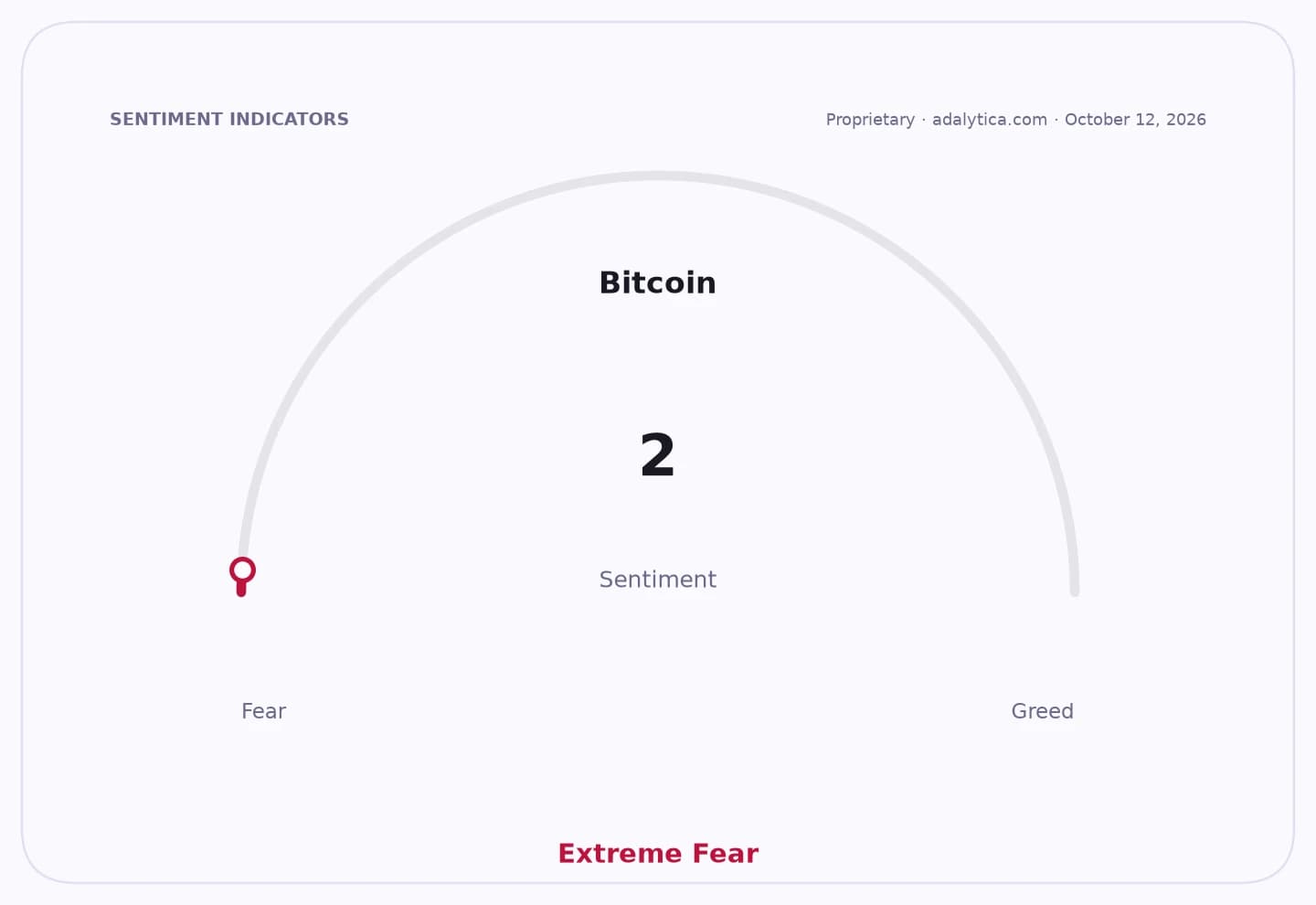
Sentiment IndicatorsⓘProprietary · adalytica.com · October 12, 2026
This is a snapshot — live sentiment, awareness and momentum for 130+ markets update continuously in the dashboard.Open AlphaPulse
The transfer came from a Bitfinex-related seizure wallet, according to reports cited in the market. That is not the same as the government dumping inventory on the open market, but traders treated it as a risk event anyway. In a market where narratives move faster than fundamentals, a billion-dollar wallet transfer is enough to trigger stop-losses, scare momentum buyers and widen spreads across the crypto complex.
That matters economically because bitcoin is no longer a niche asset reacting in isolation. It now sits inside the broader liquidity trade. When ETF outflows hit $244 million in a single day and Treasury yields climb to 5.31%, the pressure does not stop at bitcoin. It spills into miners, exchanges, treasury-heavy crypto balance sheets and risk assets more broadly. The latest move lower also came alongside a 2.5% drop in global crypto market value to $2.86 trillion, underscoring how quickly leverage and sentiment can unwind.
Bitcoin — 30-day sentimentadalytica.com
Explore this data interactively — full history, time series and cross-market comparisons.Open AlphaPulse
For investors, the key is that this is exactly the kind of drawdown that creates second-order opportunity. Bitcoin is still holding well above its 50-day moving average around $81,056 and its 200-day average near $72,053, even after the pullback. Adalytica’s Bitcoin Fear & Greed Index is flashing extreme fear, which usually tells you the market is already pricing in bad news before the tape stabilizes. That is often when the best entries form, not when the headlines look clean.
The more important trade, in our view, is not chasing every intraday bounce in BTC. It is identifying the businesses that monetize the next wave of adoption, infrastructure buildout and trading activity. Coinbase remains the obvious operating leverage name if volumes recover. MicroStrategy stays the most direct proxy for bitcoin beta, for better or worse. And any fresh ETF demand, including from new markets such as Thailand’s opening to bitcoin ETFs on Oct. 16, would reinforce that institutional wrapper remains the real marginal driver.
The government’s wallet move is therefore less a fundamental verdict on bitcoin than a reminder of how fragile positioning remains in a high-rate world. If yields stay elevated and ETF flows stay negative, bitcoin can keep chopping lower in the near term. But if the market digests the transfer without a cascade, this kind of forced fear often marks the early stage of the next accumulation phase. For long-term investors, the actionable takeaway is simple: respect the volatility, but do not confuse a government wallet transfer with a structural top.
| Entity | Gains | Losses |
|---|---|---|
| U.S. government | ▲Operational control | ▼None directly |
| Bitcoin bulls | ▲Accumulation opportunity | ▼Near-term price pressure |
| Coinbase | ▲Trading-volume upside | ▼Lower volumes if fear persists |
| MicroStrategy / BTC proxies | ▲Bargain-entry setup | ▼Mark-to-market volatility |