Flávio Bolsonaro’s pledge to rewrite parts of Brazil’s Constitution has put the country’s runoff election on a collision course with the Supreme Court and Congress, raising questions about how far a hard-right victory could go before hitting legal limits.
Brazil runoff, Bolsonaro reform push and EWZ rally

The most economically important issue is not the list of reforms itself, but whether any future Bolsonaro administration could actually deliver them. Constitutional amendments in Brazil require a three-fifths majority in both chambers, meaning at least 308 deputies and 49 senators in two rounds of voting — a hurdle that would force the Liberal Party to bargain with centrist and regional blocs even with stronger conservative representation after the first round.
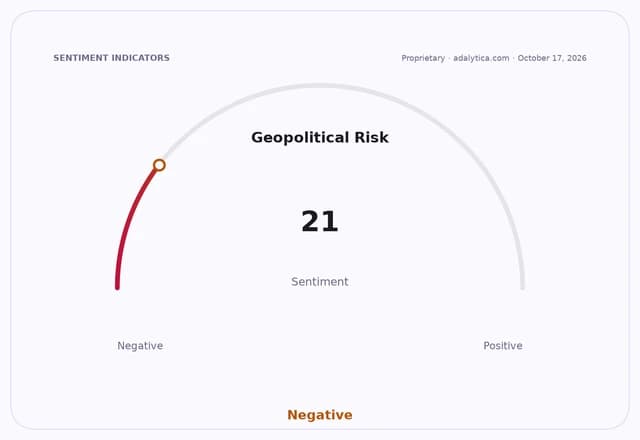
Sentiment IndicatorsⓘProprietary · adalytica.com · October 17, 2026
This is a snapshot — live sentiment, awareness and momentum for 130+ markets update continuously in the dashboard.Open AlphaPulse
That makes the proposal a test of governing capacity as much as ideology. Bolsonaro’s agenda includes lowering the age of criminal responsibility, changing the Supreme Federal Court’s role and ending presidential re-election. One of the most politically sensitive ideas is extending the presidential term from four to five years if re-election is scrapped, a change legal experts say could conflict with the constitutional protection of electoral periodicity if applied to a term starting in 2027.
For investors, the key question is whether the campaign’s reform push would translate into policy certainty or fresh institutional risk. Brazil’s 1988 Constitution places explicit limits on amendments that undermine fundamental rights, the separation of powers or democracy itself. That leaves the Supreme Federal Court positioned as the eventual arbiter of any sweeping overhaul, especially if future reforms target judges, court powers or criminal justice rules.
The market relevance is immediate because Brazil assets trade not just on growth and rates, but on perceptions of institutional stability. The iShares MSCI Brazil ETF, EWZ, has rallied sharply, closing at $41.83 on Oct. 16, up from $35.16 on March 13, but its technical picture also points to a stretched move: the fund is trading well above its 50-day moving average of $37.66 and above its 200-day average of $36.74, while the relative strength index has climbed to 75.5, a level that typically suggests overbought conditions.
That leaves the runoff between Bolsonaro and Luiz Inácio Lula da Silva as more than a political contest. It is a referendum on whether Brazil’s institutions can absorb a conservative policy shift without triggering a constitutional confrontation. Supporters of Bolsonaro’s platform argue that a larger right-leaning Congress would finally open space for security and governance reforms. Critics say the plan risks inviting a protracted legal battle, especially if it tries to alter the timing of elections or weaken judicial checks.
The most likely near-term outcome is negotiation rather than instant overhaul. Even a Bolsonaro victory would still depend on coalition-building, Senate arithmetic and the willingness of the Supreme Court to tolerate changes that move toward a more confrontational constitutional model. For investors, that means the premium on Brazilian assets will hinge as much on institutional execution risk as on the election result itself.
| Entity | Gains | Losses |
|---|---|---|
| Bolsonaro camp | ▲Reform mandate, legislative leverage | ▼Legal challenges, coalition dependence |
| Supreme Federal Court | ▲Institutional centrality | ▼Pressure over judicial powers |
| Brazilian conservatives | ▲Harder line on crime and institutions | ▼Risk of constitutional limits |
| EWZ bulls | ▲Policy-change optimism | ▼Volatility from legal uncertainty |