Brazil’s presidential race is brushing up against one of the biggest investment questions in emerging markets: whether the country’s long-term growth story is being pulled more tightly toward China than the United States. Renan Santos, the Missão candidate, said China is a better commercial partner for Brazil in the near term, arguing that dealing with Beijing is easier than dealing with Washington and calling for a more sovereign foreign policy.
Brazil Brazil-China Trade Links and EWZ Move Higher

That may sound like campaign theater, but it lands in the middle of a real economic shift. Brazil’s trade and investment links with China have deepened sharply, from soybeans and iron ore to cars, energy and data-center infrastructure. China’s economic weight matters because it helps determine demand for Brazil’s biggest export sectors, the direction of foreign capital and, ultimately, the earnings power of some of the market’s most important Brazilian names.
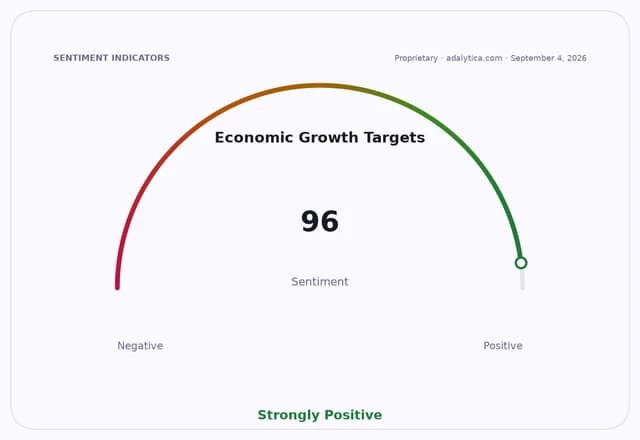
Sentiment IndicatorsⓘProprietary · adalytica.com · September 4, 2026
This is a snapshot — live sentiment, awareness and momentum for 130+ markets update continuously in the dashboard.Open AlphaPulse
For investors, the message is bigger than one candidate’s rhetoric. If Brazil leans further into China, that can be constructive for exporters tied to commodities and industrial supply chains, while also supporting sectors exposed to infrastructure, power and logistics. The latest price action in Brazil-linked assets reflects that appetite: the iShares MSCI Brazil ETF, EWZ, has pushed higher and closed at $38.09 on Sept. 2, well above its 50-day moving average. Vale, the mining giant at the center of Brazil-China trade, finished at $15.73, while poultry exporter BRF ended at $16.80, both showing the kind of resilience investors tend to chase when China demand improves.
The broader backdrop also helps explain why this matters now. Adalytica’s China Economic Growth Target Sentiment is flashing “Extreme Greed,” a sign that investors are increasingly focused on China’s next leg of demand, even as global stability remains fragile. That combination is especially relevant for Brazil, whose fortunes are still closely tied to exports of food, minerals and energy. In other words, this is not just diplomacy. It is about who buys Brazil’s output, who finances its growth and which companies capture the compounding effect of that relationship.
Economic Growth Targets vs EWZadalytica.com
Explore this data interactively — full history, time series and cross-market comparisons.Open AlphaPulse
Santos also pointed to rare earths, renewable energy and data centers as strategic areas where Brazil should renegotiate its external ties. Those are exactly the kinds of sectors that can attract long-duration capital if policy becomes clearer and the country can pair cheap power with industrial ambition. For long-term investors, the opportunity is not to trade every twist in Brazil’s politics, but to watch whether the country keeps building around the trade and resource relationship that is already strongest.
The risk, of course, is that a sharper tilt toward China could invite new friction with the U.S. and add volatility to policy, tariffs and market access. But if Brazil can balance both relationships while leaning into the faster-growing commercial one, the payoff could be durable. For patient investors, Brazil remains worth watching — especially the companies best positioned to benefit from China demand and the country’s push into energy-intensive, strategic industries.
| Entity | Gains | Losses |
|---|---|---|
| Brazil exporters | ▲Stronger China demand | ▼U.S. trade leverage |
| Vale, BRF and EWZ holders | ▲Better China-linked sentiment | ▼Policy uncertainty |
| China | ▲Greater influence in Brazil | ▼Less room for U.S. sway |
| U.S. interests | ▲Strained relationship | ▼Relative influence in Brazil |