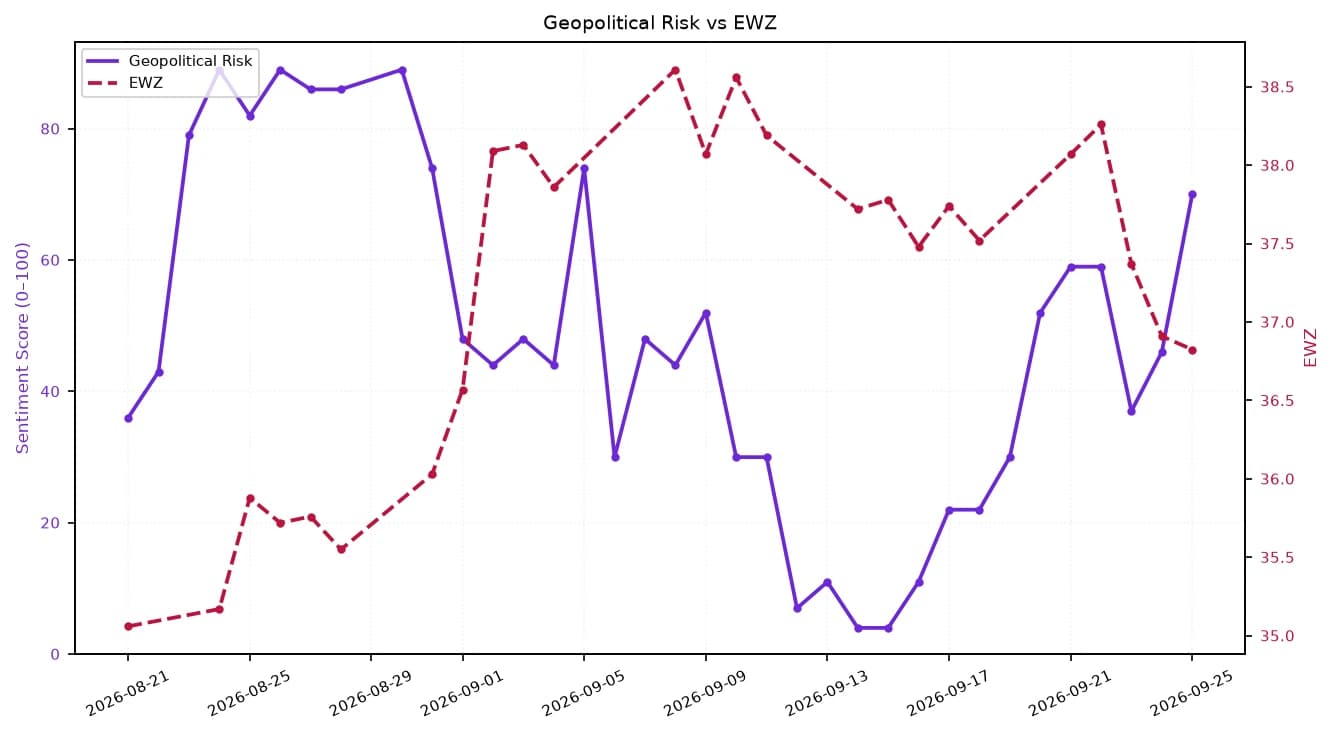
Lula’s government is taking the heaviest political damage in the one area markets watch most closely: control of public spending.
Brazil Lula Spending Control Survey Hurts Fiscal Credibility

An Ipsos/Ipec survey published this week shows the administration is viewed negatively across every major policy field, with spending discipline the worst-rated part of the government’s performance. That matters because perceptions of fiscal credibility feed directly into Brazilian asset pricing, inflation expectations and the central bank’s room to ease policy.
Sentiment IndicatorsⓘProprietary · adalytica.com · September 25, 2026
This is a snapshot — live sentiment, awareness and momentum for 130+ markets update continuously in the dashboard.Open AlphaPulse
The poll found that 43% of respondents rate Lula’s government as bad or very bad overall, versus 33% who call it good or very good. In the individual policy questions, education was the best-scoring area but still drew more criticism than praise, while public spending control lagged all other categories and remained the most problematic for the administration. Inflation fighting was seen positively by only 25% of those surveyed, and the same share applied to public security, underscoring how limited the government’s political cushion has become.
The survey also showed deteriorating views in areas tied to macroeconomic confidence. Negative perceptions rose by five percentage points from the previous Ipsos/Ipec round in employment policy, the environment and foreign policy, suggesting the government is not only failing to consolidate support in social programs but is also losing ground on broader governance questions. The only notable improvement came in spending control, where the share rating the area as good or very good rose by 4 percentage points, though from a low base.
For investors, the fiscal reading is the key takeaway. Brazil’s equity and currency markets are sensitive to any sign that the Lula administration may struggle to restrain spending, especially as fiscal slippage can keep local interest rates elevated and complicate the inflation outlook. The ruling PT’s weak standing on the budget also raises the political cost of any new outlays or tax measures, limiting room for policy surprises that might otherwise support growth.
The timing matters because Brazilian assets have been moving with heightened sensitivity to domestic policy risk. The Brazil-tracking ETFs EWZ, BRZU and EWZS have all shown sharp swings in recent sessions, reflecting how quickly sentiment can shift when fiscal or political narratives change. Even without a direct market shock from the poll, a persistently poor reading on spending control tends to reinforce the discount investors demand on Brazilian risk.
The broader narrative is straightforward: Lula still has support on parts of the social agenda, but the administration’s weakest point is exactly where investors look for macro discipline. Unless the government can restore confidence that it will contain spending while keeping inflation in check, political weakness is likely to remain a market issue as well as a policy one.
| Entity | Gains | Losses |
|---|---|---|
| Fiscal hawks | ▲stronger case for restraint | ▼fewer allies in Brasília |
| Lula government | ▲limited lift from education and anti-poverty scores | ▼broad approval erosion |
| Brazilian bonds and real | ▲little immediate benefit | ▼higher fiscal-risk premium |
| Brazilian equity bulls | ▲some support from policy continuity | ▼weaker sentiment on spending discipline |