The fastest-growing AI trade may no longer be about picking the next model winner, but about owning the companies that keep the whole system running.
Broadcom, KLA and Amphenol in AI infrastructure
That is the case Jensen Investment Management’s Allen Bond is making for Broadcom, KLA and Amphenol, three stocks that sit deeper in the AI infrastructure stack and, in his view, should benefit even if hyperscalers keep designing their own chips or the market’s preferred model changes again. The logic matters because it shifts the conversation from winner-takes-most AI speculation to the broader capital-spending cycle required to support data centers, networking, semiconductor manufacturing and power delivery.
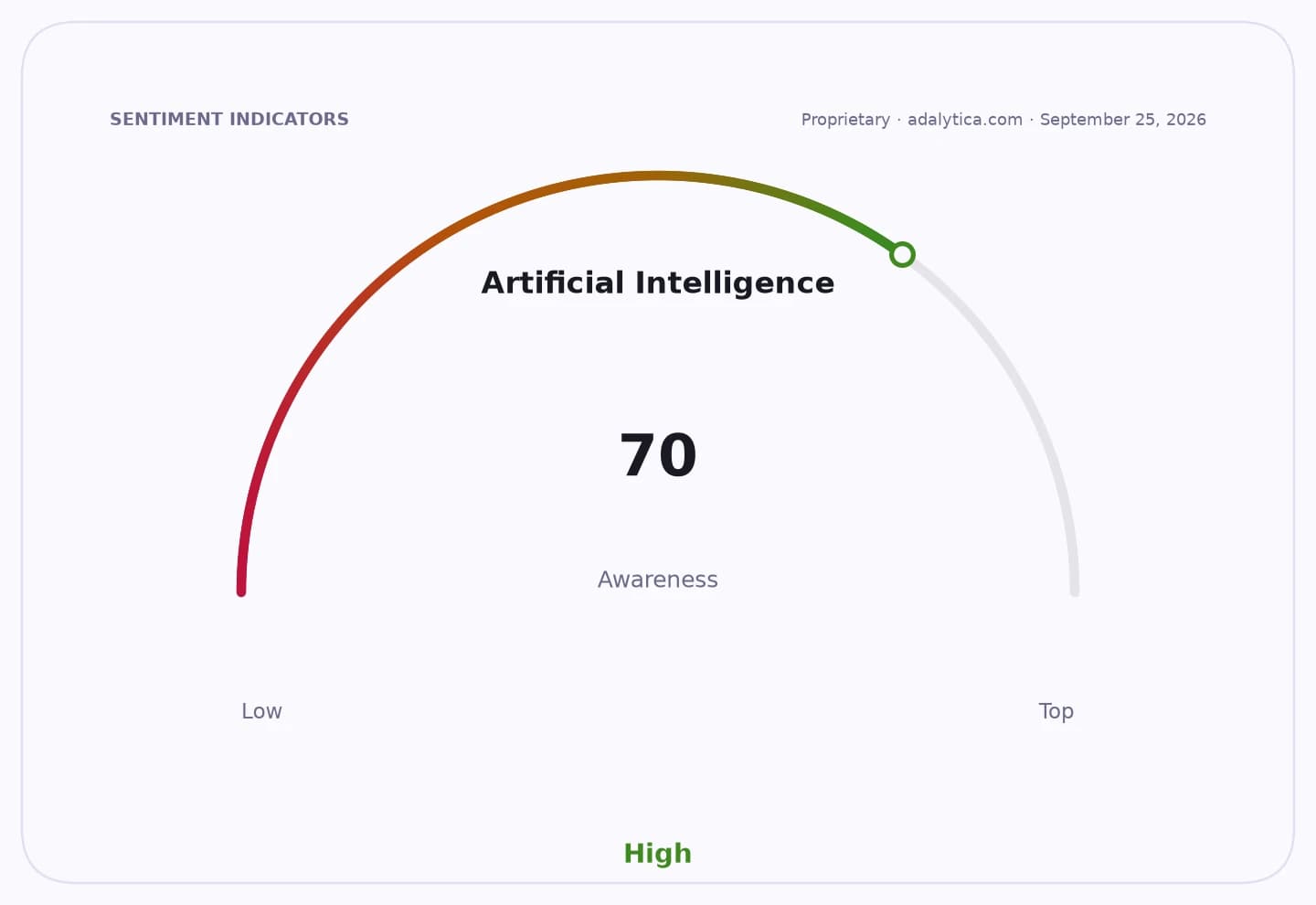
Sentiment IndicatorsⓘProprietary · adalytica.com · September 28, 2026
This is a snapshot — live sentiment, awareness and momentum for 130+ markets update continuously in the dashboard.Open AlphaPulse
Bond’s thesis is straightforward: AI adoption needs more compute, bandwidth and power regardless of which software platform dominates. Broadcom sits closest to the compute layer with custom accelerators and networking gear; KLA supplies process-control equipment that helps chipmakers improve yields as devices become more complex; Amphenol supplies connectors and interconnect systems that move power and data through dense data-center environments.
For investors, the appeal is diversification within the same secular theme. Nvidia has become the market’s shorthand for AI, but that also concentrates risk in a single name and a single architecture. Broadcom, KLA and Amphenol offer different ways to profit from the same physical buildout without having to forecast which model developer, accelerator design or application layer ultimately captures the economics. That is especially relevant as customers increasingly pursue custom silicon and alternative architectures, a dynamic that can broaden the winners even as it complicates the trade in pure-play AI software names.
The market backdrop also shows why the infrastructure trade is becoming more selective. Broadcom’s shares have been volatile and are still trading well below their recent highs; at $348.98 on Sept. 28, the stock was below its 50-day moving average of $375.58 and just under its 200-day average of $366.77, with RSI readings near 37.9, a sign of weaker momentum. KLA has also cooled after a sharp run, closing at $183.92 versus a 50-day average of $188.22 and a 200-day average of $175.93. Amphenol has held up better, trading at $82.90, above both its 50-day and 200-day averages, suggesting investors still see value in the connectors and interconnect theme.
That dispersion reflects both opportunity and risk. Broadcom is tied to hyperscaler spending and custom AI deployments, but its latest filing also underscores customer concentration and the possibility that orders could be delayed if AI infrastructure buildouts slow. KLA benefits from more advanced chip production, yet semiconductor equipment is still exposed to capital-spending cycles and the possibility that customers defer purchases. Amphenol’s exposure is broader and, in some ways, less cyclical, but it is still dependent on continued data-center expansion and industrial demand for high-performance connectivity.
Bond’s broader point is that the AI trade is no longer just about GPUs. The infrastructure layer — compute, testing, connectivity and power delivery — is where the physical demands of the boom show up first, and where revenues can be more durable if the industry’s architecture keeps evolving. That makes Broadcom, KLA and Amphenol useful barometers of the next phase of AI spending: less dependent on a single winner, but still highly sensitive to whether capital expenditure keeps flowing into the ecosystem.
For investors, the key question now is not whether AI spending continues, but where the returns are most insulated from model-level disruption. If the buildout stays broad, these names should keep drawing allocation from investors who want AI exposure without owning the most crowded part of the trade.
| Entity | Gains | Losses |
|---|---|---|
| Broadcom | ▲Custom AI and networking demand | ▼Single-architecture risk |
| KLA | ▲Semiconductor process-control spending | ▼Chip-cycle slowdown |
| Amphenol | ▲Data-center interconnect growth | ▼Delayed infrastructure rollout |
| Nvidia-only trade | ▲Simplicity and momentum | ▼Concentration risk |