Bullish has widened its push into tokenized equities by adding Aptos alongside Solana and Ethereum, a move that underscores how digital-asset infrastructure is beginning to compete for a piece of Wall Street’s post-trade plumbing.
Bullish Adds Aptos to Tokenized Equity Push
The New York Stock Exchange-listed crypto company said on Nov. 3 that the three blockchains are the first networks it will use for equity tokenization services, with Aptos now in the mix as a potential home for shares represented as blockchain-based tokens. Bullish has not given a launch date, but the decision matters because tokenization is moving from a concept discussion to a fight over which blockchains can host regulated financial assets at scale.
Sentiment Indicators
For issuers and investors, the appeal is straightforward: tokenized shares could trade around the clock, settle faster and move on infrastructure that is cheaper than legacy market rails. That is a direct challenge to the back-office systems that still govern most equity trading, where settlement can take a business day and markets shut every evening and weekend.
Aptos is using the announcement to argue that it can compete for institutional financial flows, not just retail crypto activity. The network says transactions finalize in under a second for a fraction of a cent, and it already hosts tokenized funds from asset managers including Franklin Templeton and Apollo. Those products matter because they show regulated institutions are willing to place real-world assets on-chain, not merely experiment with them.
Outside research supports the cost case. Blockworks Research estimated Aptos’ median transaction fee at about $0.0003 in October, even after the network increased fees tenfold in March. The same report counted roughly $1.6 billion in stablecoins on Aptos, providing the liquidity backbone tokenized securities would typically need to trade against.
Aptos is also trying to address the institutional objections that have slowed tokenization elsewhere. Confidential APT, launched on mainnet in September, allows users to hide balances and transfer amounts if they choose, while an encrypted mempool introduced in October is designed to reduce front-running by keeping pending trades out of sight. Those features matter to asset managers and brokerages that will not move meaningful products onto public chains unless privacy and execution quality are adequate.
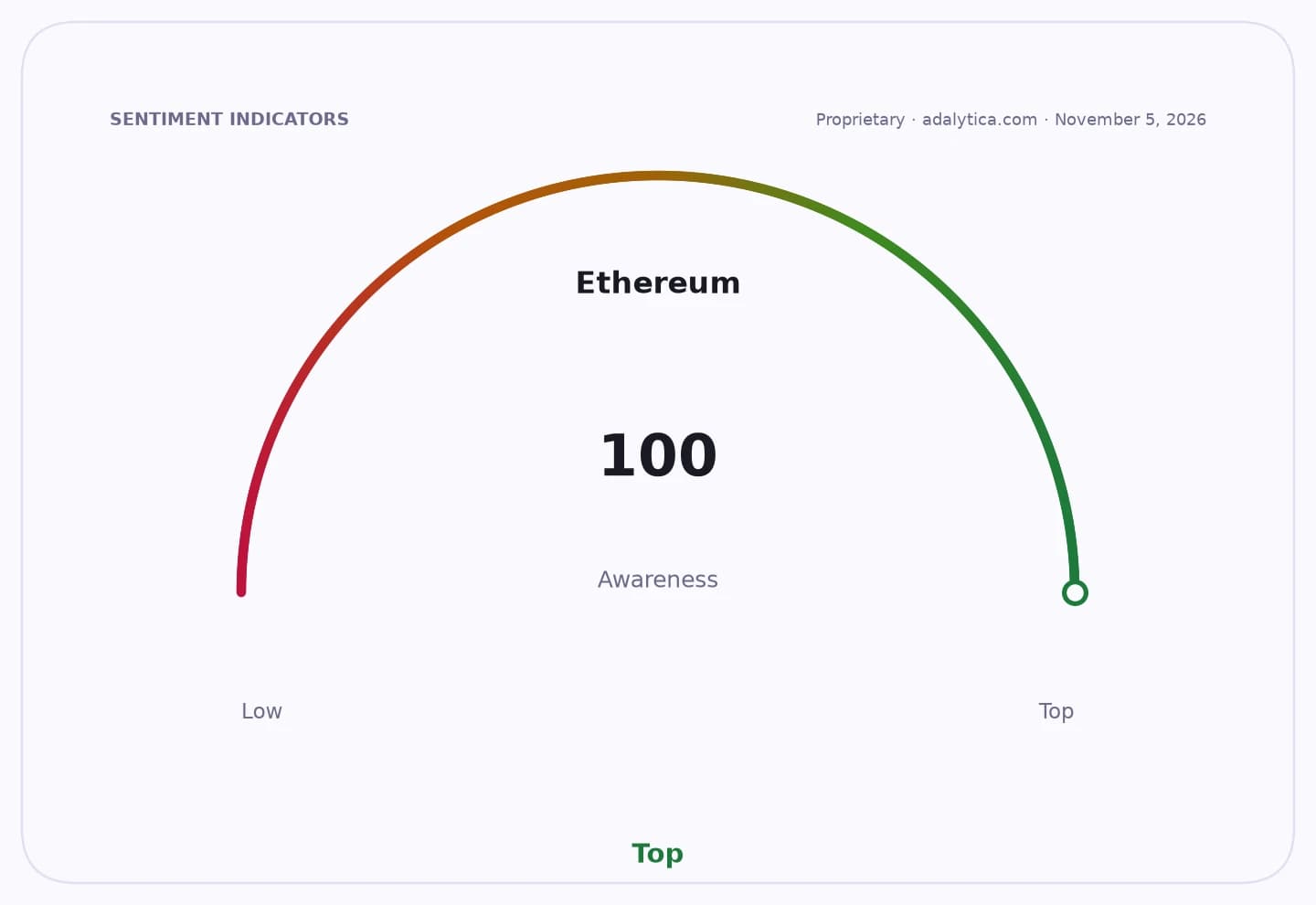
The timing is notable for a broader market still wrestling with extreme caution toward digital assets. Adalytica’s Bitcoin and Ethereum fear-and-greed snapshots both sit in extreme fear even as awareness remains elevated, a sign that investor attention is high but conviction remains fragile. Against that backdrop, infrastructure deals like Bullish’s can matter more than price action because they point to where the next phase of crypto adoption may come from: regulated finance using blockchain rails, not speculative trading alone.
For Bullish, the expansion also helps position the company as more than a venue for crypto liquidity. If tokenized stocks gain traction, the firms supplying the rails could benefit from sticky transaction flow, custody relationships and servicing revenue. The main risk is execution: without a launch date, regulatory clarity and obvious demand from major issuers, the announcement remains strategic rather than immediately monetizable.
Still, the direction is clear. The battle is shifting from whether equities can be tokenized to which blockchain will host them, and Aptos is now in that contest with Solana and Ethereum. For investors, that raises the stakes for networks that can combine speed, low fees, institutional credibility and compliance-friendly features.
| Entity | Gains | Losses |
|---|---|---|
| Aptos | ▲Institutional credibility | ▼Less room for rivals |
| Bullish | ▲Broader product reach | ▼Execution and launch risk |
| Solana | ▲Early network exposure | ▼Shares spotlight with rivals |
| Ethereum | ▲Brand leverage in tokenization | ▼Higher-fee rival pressure |