Burlington’s slide into $65 million of debt highlights how a once-expansionary fashion retail model can unravel when boardroom turmoil and rising operating costs outpace cash generation.
Burlington debt, shares, and off-price retail peers
The distress matters because off-price retail depends on disciplined inventory buying, tight expense control and constant liquidity management. When those pillars weaken, debt becomes more than a balance-sheet line item: it constrains merchandise purchases, squeezes margins and can force management to choose between survival and growth. For investors, the question is whether the company can stabilize operations fast enough to stop funding costs from eating into already thin retail economics.
Sentiment IndicatorsⓘProprietary · adalytica.com · October 22, 2026
This is a snapshot — live sentiment, awareness and momentum for 130+ markets update continuously in the dashboard.Open AlphaPulse
The market has already priced in the strain. Burlington shares fell to $252.62 on Oct. 22 from $296.51 on Nov. 21, a drop of roughly 15% over that stretch and well below the stock’s 50-day moving average of $273.80. The shares are also trading under the 200-day moving average of $309.52, a sign that the longer-term trend has deteriorated. The relative strength index near 31 suggests the stock is approaching oversold territory, but that alone does not restore confidence in the underlying business.
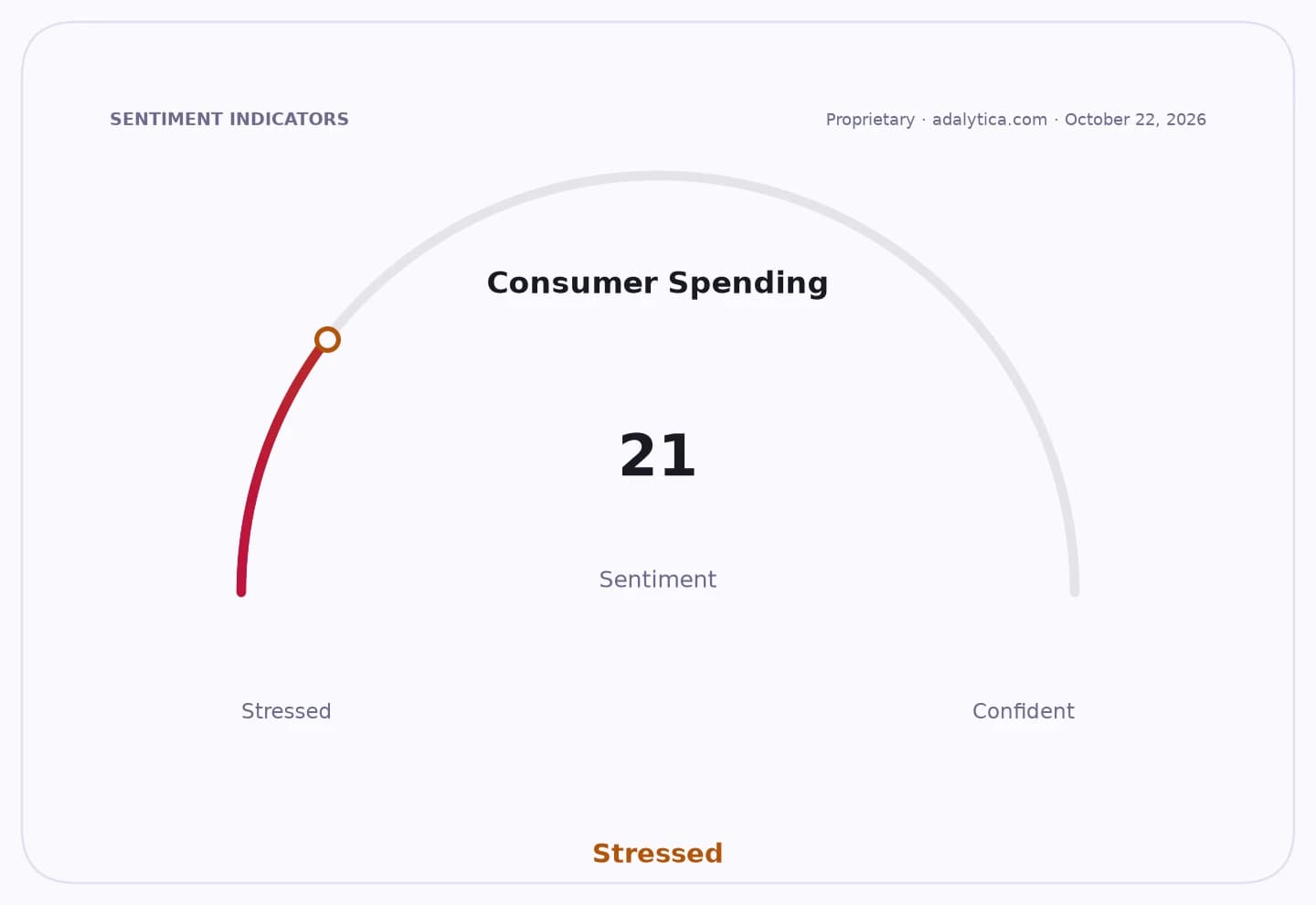
The broader retail backdrop is not helping. Adalytica’s consumer spending sentiment gauge sits in fear, while its S&P 500 trade-signal snapshot shows extreme fear, a reminder that discretionary demand remains fragile. That raises the stakes for retailers tied to fashion and apparel, where shoppers can trade down, delay purchases or simply spend less if confidence weakens further. In that environment, a business already burdened by debt has less room to absorb missteps.
The contrast with peers is telling. Ross Stores and TJX have held up far better in the same period, reflecting the market’s preference for off-price chains that can keep traffic and margins steadier. Ross ended Oct. 22 at $236.67, above both its 50-day and 200-day moving averages, while TJX closed at $147.38 and remained well above its 200-day average. Those stocks are not immune to consumer pressure, but they are being treated as sturdier operators, not balance-sheet stories.
For Burlington, the bear case is that governance disruption and higher costs reduce flexibility just as competition for value-conscious shoppers intensifies. The bull case is that an oversold stock, coupled with any improvement in execution, could trigger a sharp rebound. But until management proves it can control spending, rebuild trust and generate enough cash to service debt comfortably, investors are likely to view any rally as a trading opportunity rather than a durable recovery.
| Entity | Gains | Losses |
|---|---|---|
| Burlington | ▲Potential value if execution stabilizes | ▼Liquidity, margins, investor confidence |
| Debt holders | ▲Higher claim priority | ▼Greater default risk if cash flow weakens |
| Ross Stores | ▲Relative quality premium | ▼None material from Burlington’s distress |
| TJX | ▲Competitive positioning in off-price retail | ▼None material from Burlington’s distress |