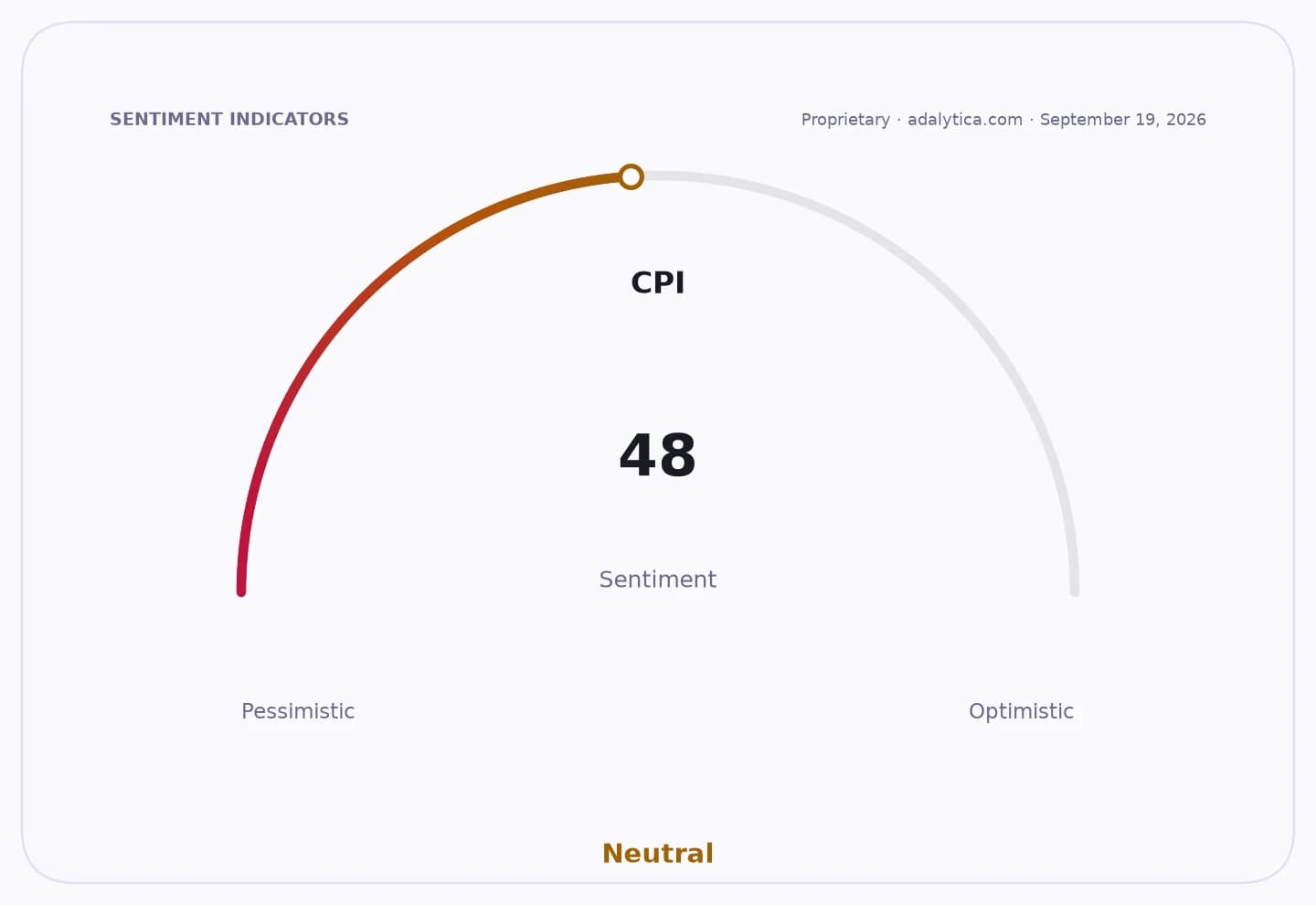
Economists have turned more cautious on Canada’s inflation outlook, pushing the return to the Bank of Canada’s 2% target out to the third quarter of next year as higher oil prices and firmer gasoline costs threaten to keep price pressures elevated.
Canada inflation outlook delayed by higher oil prices
That shift matters because it lengthens the period in which policymakers must balance weak growth against stubborn inflation, narrowing the odds of near-term rate cuts and keeping markets exposed to a more hawkish policy path than many had expected. The median forecast in a Bloomberg survey now has consumer prices averaging 3% over the next six months, 0.6 percentage point higher than in last month’s poll, underscoring how quickly energy shocks can feed into broader pricing expectations.
Sentiment IndicatorsⓘProprietary · adalytica.com · October 1, 2026
This is a snapshot — live sentiment, awareness and momentum for 130+ markets update continuously in the dashboard.Open AlphaPulse
Bank of Canada Governor Tiff Macklem has already warned that sustained gasoline inflation could keep headline CPI above target and raise the risk that price pressures spread through the economy. The survey suggests economists are taking that warning more seriously. Still, they do not expect the central bank to raise its policy rate from 2.25% until its June meeting next year, a view that leaves them at odds with markets, where overnight swaps imply about a 50-50 chance of a hike as soon as the October meeting.
The divergence matters for bonds, the currency and rate-sensitive sectors. Canadian bond yields have risen as investors reassess the path of inflation and policy, while the Canadian dollar has weakened to a two-and-a-half-month low, reflecting both the inflation backdrop and a more uncertain global risk environment tied to Middle East tensions. If oil stays elevated, the BoC may find it harder to justify easing, even as economists trimmed their growth view to 1.5% annualized in both the fourth and first quarters and put recession odds at 30%.
For investors, the message is that Canada is moving into a longer stretch of policy uncertainty rather than a clean disinflation story. That favors a steeper premium in short-dated rates, keeps pressure on domestically exposed borrowers and leaves the loonie vulnerable if energy gains are not enough to offset slower growth. The next key test comes with Statistics Canada’s inflation release on Oct. 19, which could either validate the hotter forecast or force another round of repricing across bonds and currency markets.
| Entity | Gains | Losses |
|---|---|---|
| Energy producers | ▲Higher crude-linked revenues | ▼Demand risks from slower growth |
| Canadian bondholders | ▲None | ▼Higher yields, lower prices |
| Bank of Canada | ▲Policy flexibility if inflation cools | ▼Pressure to stay hawkish |
| Canadian dollar bulls | ▲Potential support from oil | ▼Weak growth and policy uncertainty |