The Canadian dollar fell to an 18-month low on Monday as a surge in the U.S. dollar, driven by renewed worries over France’s fiscal outlook, collided with weak domestic services data and softer oil prices.
Canadian dollar falls to 18-month low on dollar strength

The loonie traded at 1.4257 per U.S. dollar, or 70.14 U.S. cents, after briefly touching 1.4293, its weakest level since April 2025. That move matters because Canada’s currency is highly sensitive to both global risk appetite and commodity prices, and this time both turned against it at once.
Sentiment IndicatorsⓘProprietary · adalytica.com · October 6, 2026
This is a snapshot — live sentiment, awareness and momentum for 130+ markets update continuously in the dashboard.Open AlphaPulse
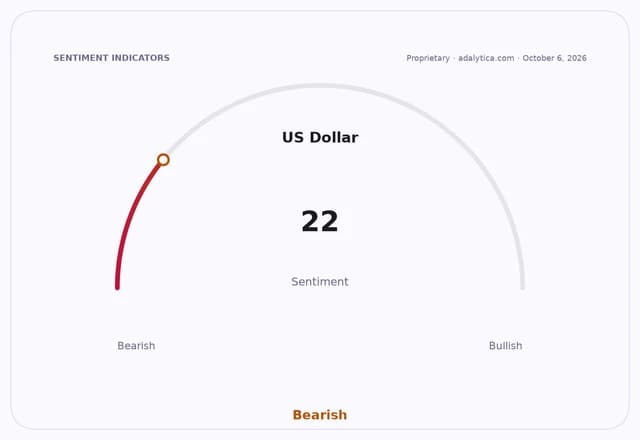
The cleanest explanation is that the market is punishing Canada through the external channel before it is fully pricing the domestic one. RBC Capital Markets’ George Davis said CAD moves were “largely dictated by developments in Europe as opposed to domestic developments here in Canada,” with broad U.S. dollar strength doing the heavy lifting. When the world’s reserve currency catches a bid, high-beta currencies like the loonie usually absorb the damage first.
France’s budget worries are the spark. Concerns that Paris will struggle to rein in its deficit pushed investors toward the dollar and away from the euro, a reminder that currency markets are still being driven by sovereign risk and policy credibility, not just growth differentials. For investors, that reinforces the case for owning U.S. dollar liquidity in periods when Europe’s fiscal politics flare up.
Canada’s own data only added pressure. S&P Global’s services PMI showed the sector contracting for a fourth straight month, with the headline index at 48.3 in September, still below the 50 level that separates expansion from contraction. That suggests the economy is losing momentum just as traders are already leaning bearish on the currency. CFTC data showed speculative net short positions on the loonie rose to 78,671 contracts in the week ended Sept. 29 from 53,210 a week earlier.
Oil, the other key pillar for the Canadian dollar, also slipped, with U.S. crude futures settling 1.8% lower at $89.43 a barrel as Middle East exports increased and the Group of Seven pledged to boost supplies. Lower crude typically means less support for the loonie, especially when growth data are soft and bond yields are rising.
Canadian yields moved higher across the curve, with the 10-year up 4.4 basis points to 3.989%, pulling back toward last week’s nearly three-year high of 4.042%. That combination of weaker currency, firmer yields and soft services activity points to tighter financial conditions ahead, not easier ones.
The broader investment message is straightforward: the market is treating Canada as a secondary beneficiary of a stronger global dollar, not a destination for capital. Unless France’s fiscal anxiety fades, oil stabilizes and domestic activity improves, the path of least resistance for the loonie remains lower. For investors, that keeps the trade tilted toward U.S. dollar strength and against Canadian assets that depend on a rebound in growth and commodities.
| Entity | Gains | Losses |
|---|---|---|
| U.S. dollar | ▲Safe-haven inflows | ▼None |
| Canadian dollar | ▲None | ▼18-month low |
| Canadian exporters | ▲More local-currency revenue | ▼Import costs rise |
| Oil producers | ▲None | ▼Weaker crude support |