Crédit Agricole sees the Canadian dollar recovering over the next two years, but the path is likely to be choppy because US yields are still rising, Canadian labour data remain weak and the pair is starting from a high base near 1.43.
Crédit Agricole sees USD/CAD falling to 1.32 by 2027
The bank expects USD/CAD to ease to 1.38 in December 2026, 1.34 by June 2027 and 1.32 by December 2027, implying a roughly 7.4% drop from Tuesday’s level of 1.4249. A falling USD/CAD rate means a stronger Canadian dollar.
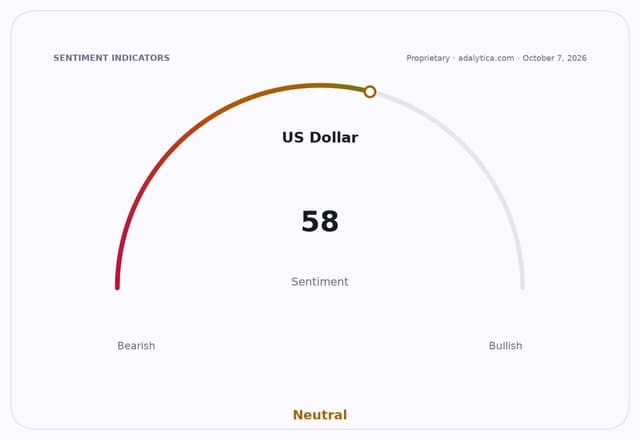
Sentiment IndicatorsⓘProprietary · adalytica.com · October 7, 2026
This is a snapshot — live sentiment, awareness and momentum for 130+ markets update continuously in the dashboard.Open AlphaPulse
That call matters because it hinges on a two-stage story for FX markets: first, persistent US rate support keeps the greenback firm into early 2027; then, softer Treasury yields and Federal Reserve easing weaken the dollar enough for the loonie to recover. Crédit Agricole said Treasury yields are likely to keep rising into early 2027 as inflation stays sticky and energy prices add pressure, while front-end yields remain sensitive to incoming data and Fed guidance.
For investors, that means the Canadian dollar rally is not a straight-line trade. The bank’s outlook depends on a late-cycle turn in US fiscal and monetary policy, including its view that the Fed could cut rates in the fourth quarter of 2027, reducing the dollar’s rate advantage. Until then, the US yield backdrop remains a headwind for any sustained CAD rebound.
The timing is awkward for Canada. Statistics Canada said employment fell by 42,000 in August and the unemployment rate held at 6.4%, leaving the labour market vulnerable just as the currency needs domestic support. Friday’s September jobs report will be watched closely for signs that hiring is stabilizing.
There are some offsets. Canada’s merchandise surplus widened to C$4.2 billion in August from a revised C$787 million in July, helped in part by tariff-related front-loading of imports, and Crédit Agricole expects growth to improve to 1.8% in 2027 from 1.5% in 2026. Inflation is seen averaging 2.1% and 2.0% over those two years, giving the Bank of Canada room to stay on hold unless growth weakens further.
Technically, USD/CAD has been trading around 1.43, above its 50-day moving average near 1.40 and its 200-day average around 1.39, with conventional RSI readings in deeply overbought territory. That suggests the pair can stay elevated near term even if the medium-term forecast points lower.
For now, investors are left balancing a still-firm US rate story against a later Canadian recovery. The next domestic payrolls print and the next read on US inflation will help determine whether Crédit Agricole’s 2027 loonie rebound starts to look credible sooner rather than later.
| Entity | Gains | Losses |
|---|---|---|
| US dollar bulls | ▲Higher yields, late-Fed easing trade | ▼A later USD downtrend |
| Canadian dollar bulls | ▲2027 policy normalization, stronger growth | ▼Weak jobs data, near-term USD support |
| Canadian exporters | ▲Stronger demand backdrop if growth improves | ▼A stronger loonie later |
| Importers into Canada | ▲A firmer currency would lower costs | ▼Near-term FX volatility |