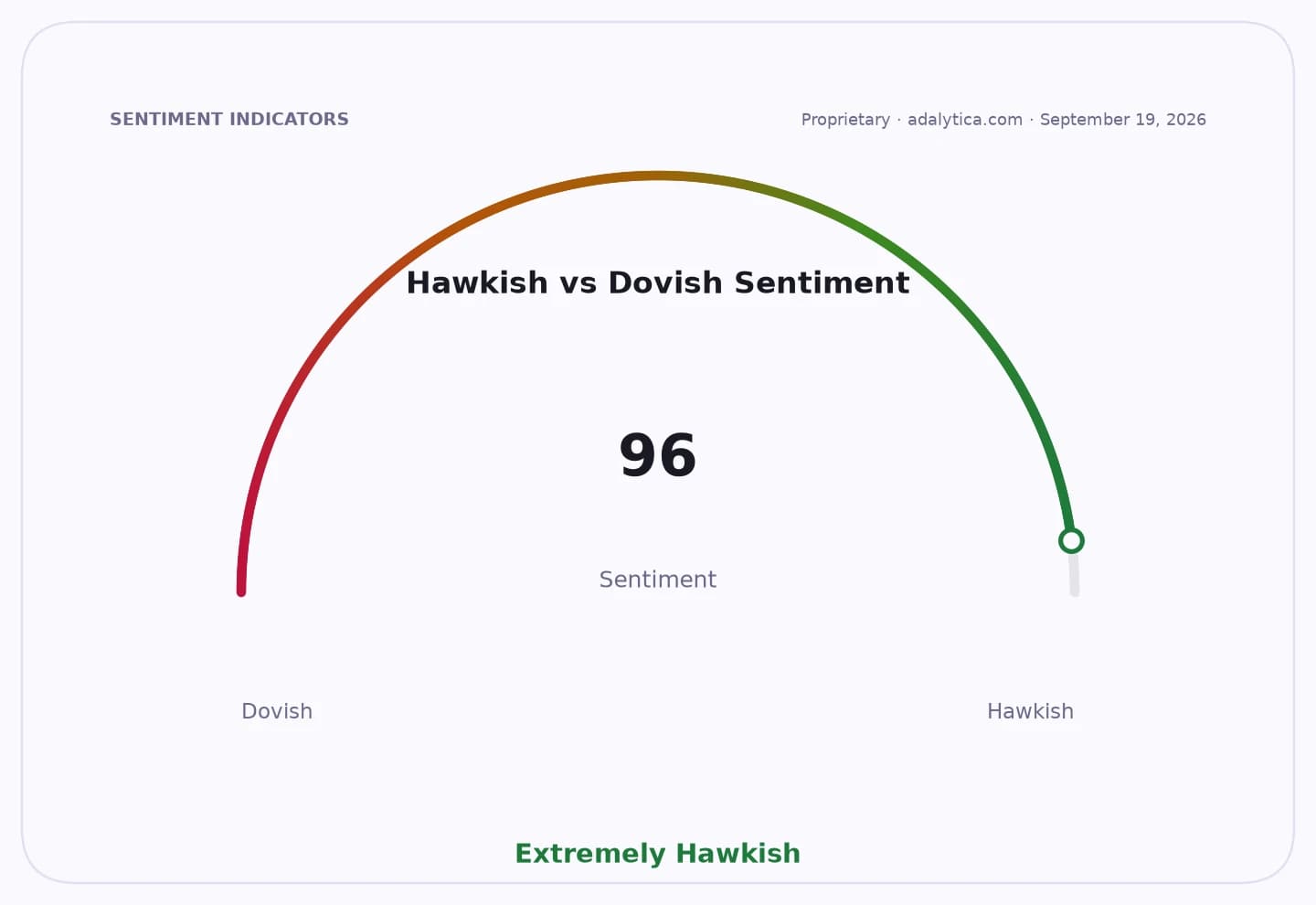
Chile’s central bank kept its policy rate unchanged at 4.5%, a widely expected move that leaves policymakers in wait-and-see mode as domestic activity disappoints and geopolitical tensions threaten to complicate the inflation outlook.
Chile central bank keeps rate at 4.5%

The unanimous decision underscores a balancing act familiar to investors across emerging markets: preserve enough restraint to keep prices in check, but avoid choking off an economy that is already running below the central bank’s own June forecast. Officials said the macro backdrop remains “subject to a greater degree of uncertainty than usual,” citing risks from the war between the United States and Iran, the potential spillover into oil prices, and weaker-than-expected local performance.
Sentiment IndicatorsⓘProprietary · adalytica.com · September 9, 2026
This is a snapshot — live sentiment, awareness and momentum for 130+ markets update continuously in the dashboard.Open AlphaPulse
That combination matters because Chile is trying to steer between slower growth and sticky external shocks. Higher oil prices would feed through to transport, fuel and imported goods, tightening financial conditions just as the economy is showing signs of fragility. The bank’s warning that weakness could prove more persistent than expected suggests policymakers are not ready to commit to a faster easing cycle, even if inflation eventually allows room for cuts.
For investors, the decision confirms that the near-term rates story is about patience rather than action. A hold was already priced in, so the immediate market reaction is likely to be limited, but the guidance is more important than the headline. The central bank is signaling that any future moves will depend on whether growth stabilizes and whether the oil shock remains contained. That keeps the peso, local bonds and rate-sensitive stocks tied to incoming data and global energy prices rather than to a predetermined policy path.
The broader narrative is one of central banks being forced to defend credibility in a world of uneven growth and imported uncertainty. In Chile’s case, the main question is whether the economy’s current softness is temporary or the start of a more durable slowdown. If activity fails to recover and oil stays volatile, pressure will build for policy support later in the year. If inflation risks reaccelerate, the bank may be stuck on hold for longer than markets would like.
| Entity | Gains | Losses |
|---|---|---|
| Chile Central Bank | ▲Inflation credibility | ▼Policy flexibility |
| Chilean bondholders | ▲Rate stability | ▼Faster cuts |
| Borrowers and growth sectors | ▲Lower financing risk | ▼No immediate easing |
| Peso-sensitive exporters | ▲Some FX stability | ▼Stronger oil-linked import costs |