China’s AI buildout is no longer just a story about chips and software — it is becoming a capital cycle for electricity, storage and industrial automation, and that makes the energy sector one of the clearest second-order winners of the country’s push to scale artificial intelligence.
China AI buildout lifts power and storage demand
The most important development is the deepening integration of AI with power generation, storage and trading, backed by a fresh policy push in Beijing to coordinate computing capacity with electricity supply. That matters because AI workloads are among the most power-hungry industrial uses in the economy, and China’s data-center electricity demand is set to jump from 170 billion kWh in 2025 to more than 700 billion kWh by 2030, according to a China Galaxy Securities estimate cited in the report.
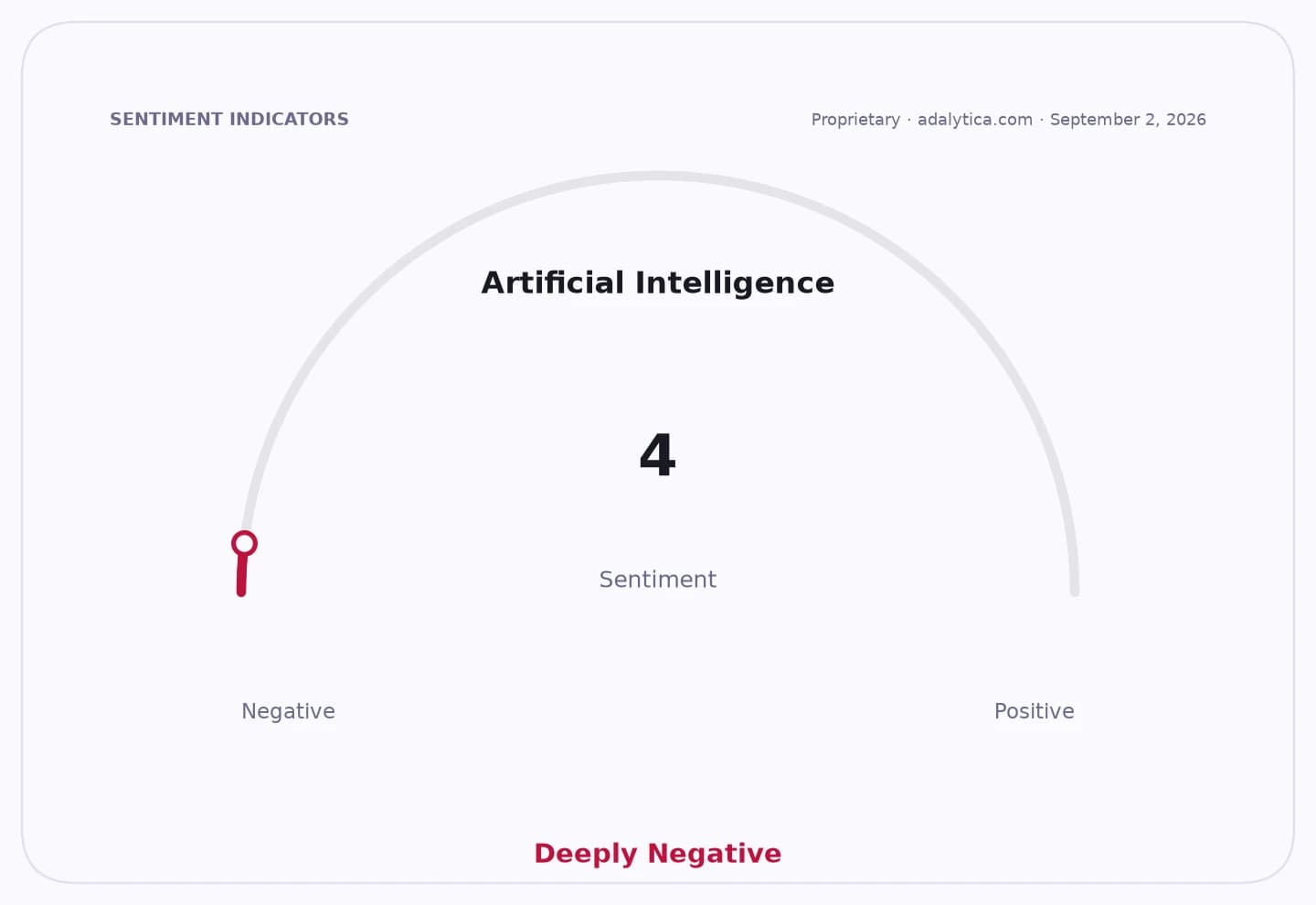
Sentiment IndicatorsⓘProprietary · adalytica.com · September 5, 2026
This is a snapshot — live sentiment, awareness and momentum for 130+ markets update continuously in the dashboard.Open AlphaPulse
This is the kind of shift investors often miss at first. The market tends to focus on model training, semiconductors and internet platforms. But if China’s AI rollout is constrained or accelerated by power availability, the real beneficiaries are likely to be the companies that can manage, store, optimize and trade electricity at scale. That includes battery makers, grid software providers, energy-storage specialists and renewable developers positioned near major computing hubs.
The policy backdrop is getting more explicit. China’s government work report this year called for new infrastructure projects on hyper-scale intelligent computing clusters and coordinated development of computing capacity and electricity supply, the first time that language has appeared in the document. A separate action plan released in May said clean-energy supply capacity for AI infrastructure should be significantly increased by 2030, while the application of AI in the energy sector should also improve materially.
That creates a powerful loop: AI boosts the efficiency of the power system, and a cleaner, more flexible power system lets China run more AI. Weheng Intelligent Technology’s WHES OS can generate battery scheduling strategies from natural-language prompts. HyperStrong says AI is shortening energy-storage R&D cycles from years to months. Contemporary Amperex Technology’s TENER Smart Storage platform can warn of faults up to seven days in advance, while Envision Group says an AI trading agent at a storage site in Shandong has reached 95% accuracy in predicting peak-valley price spreads.
The economic significance is hard to overstate. AI data centers need steady electricity, but renewables are inherently variable. That means the bottleneck is not only generation, but orchestration — who can match intermittent solar and wind with storage, dispatch, backup supply and market trading. In that environment, batteries become the toll roads of the AI era: they monetize volatility rather than just generation capacity.
China is also building from a position of strength. The National Energy Administration said this week installed photovoltaic capacity has overtaken coal-fired capacity for the first time, making solar the country’s largest power source by installed capacity. That gives China a structural advantage in powering compute with cleaner electricity, especially if computing clusters continue migrating toward energy-rich regions such as Inner Mongolia, where a pilot data center integrating renewable generation, storage and computing load began operating in July 2025.
For investors, the message is that AI in China should not be valued only through the lens of software monetization or internet advertising. The more durable opportunity may sit in the infrastructure layer: batteries, grid intelligence, renewable bases, storage controllers and the industrial software that turns electricity into a flexible digital input. That is where the capex is likely to flow, and where margins can widen as utilization rises.
There are still real constraints, including a shortage of industry-specific large AI models, patchy high-quality data and weak cross-enterprise data sharing. But those are execution problems, not thesis killers. The direction of travel is clear: China is turning power into a strategic input for AI, and AI into a tool for squeezing more value out of power assets.
If that loop strengthens over the next few years, the biggest winners will not just be the most visible AI names. They will be the companies that own the underlying energy infrastructure, the storage intelligence and the software that makes China’s compute economy work.
| Entity | Gains | Losses |
|---|---|---|
| Battery/storage firms | ▲Higher utilization, software revenue | ▼Commodity pricing pressure |
| Renewable developers | ▲More demand near compute hubs | ▼Grid bottlenecks, curtailment risk |
| AI/data-center operators | ▲Cheaper, cleaner power access | ▼Higher power costs if uncoordinated |
| Coal-heavy generators | ▲Transitional backup role | ▼Share loss to solar and storage |