China’s Communist Party is doubling down on tighter internal discipline and centralized leadership as it tries to keep the world’s second-largest economy growing, maintain social stability and project more confidence abroad.
China Communist Party Policy Direction and Growth
That is the economic heart of the message from the party’s Fifth Plenary Session, which framed full and rigorous self-governance as the foundation for what Beijing sees as its next stage of modernization. For investors, the significance is straightforward: in China, political governance is economic governance, and the party is signaling it wants to preserve policy coherence at a time when growth is under pressure, global trade tensions remain elevated and the country is still navigating a difficult property slowdown.
Sentiment Indicators
The pitch matters because Beijing is not describing governance as an abstract political ideal. It is tying the party’s authority directly to economic performance, innovation and long-term resilience. China says its GDP has surpassed 140 trillion yuan, while it remains the world’s second-largest economy. It also says it leads the world in invention patent applications and innovation clusters, and is making gains in artificial intelligence, robotics and biomedicine. Those claims are meant to support a larger investment narrative: that China’s next leg of growth will come less from heavy infrastructure and more from state-directed industrial upgrading, strategic technology and a more disciplined policy machine.
For markets, the immediate takeaway is not a new stimulus wave. It is continuity. The party is signaling that reform will be pursued through tighter governance rather than through a sudden change in model. That tends to favor sectors aligned with national priorities — advanced manufacturing, clean energy, semiconductors, artificial intelligence and selected consumer and industrial upgrades — while leaving little room for the kind of broad-based market liberalization foreign investors sometimes hope for.
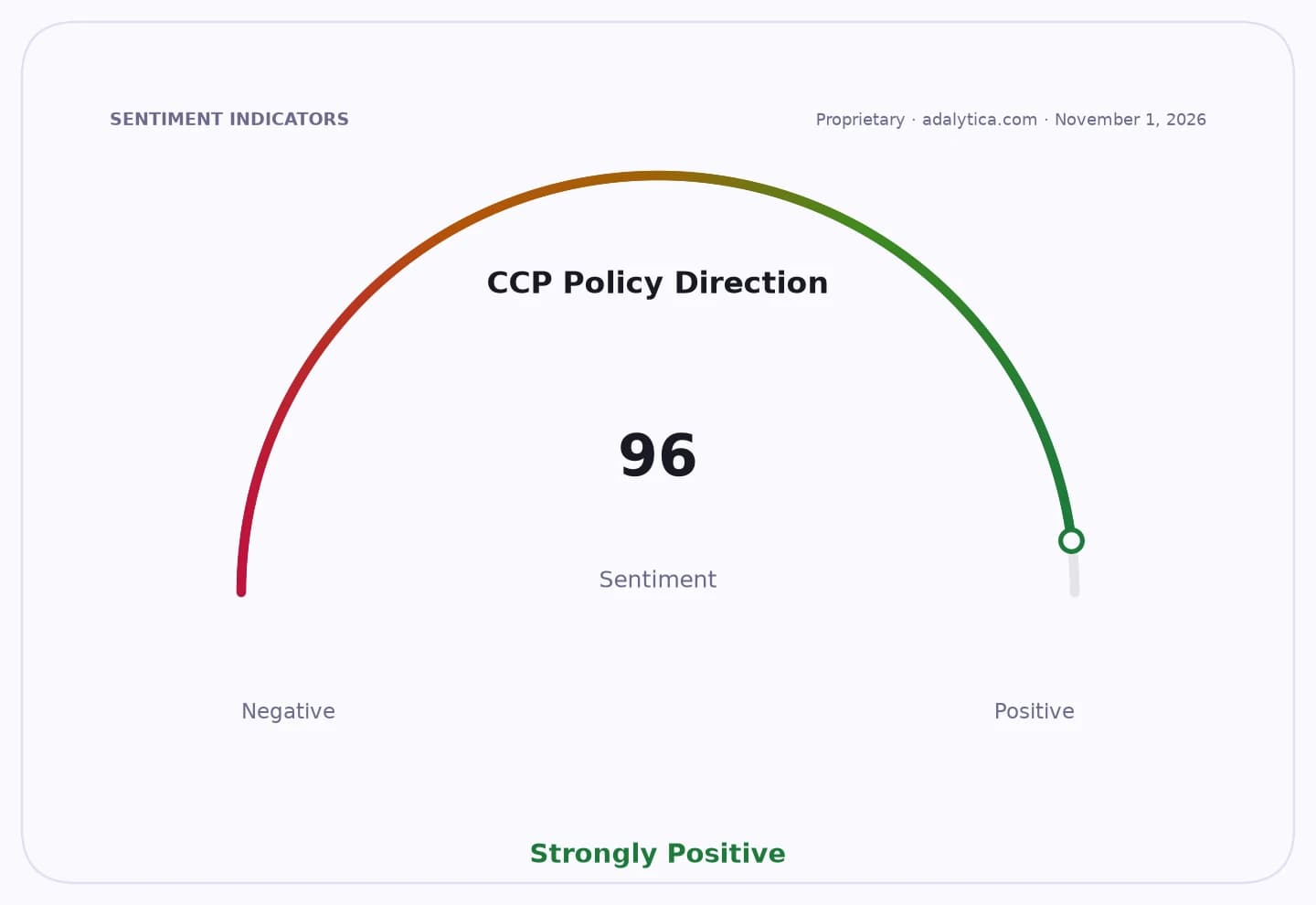
CCP Policy Direction — 30-day sentimentadalytica.com
Explore this data interactively — full history, time series and cross-market comparisons.
CCP Policy Direction
The emphasis on self-governance also serves a political purpose. Beijing wants to reassure domestic and overseas audiences that the party can police itself, avoid the “historical cycle” of rise and fall, and preserve legitimacy through performance. That message is especially relevant in a year when China is trying to defend growth, manage deflationary pressures in parts of the economy and maintain investor confidence despite weaker sentiment around the property sector and external demand.
The government is also folding foreign policy into the same framework. By casting the party’s governance model as a contributor to global governance, Beijing is making a broader claim for influence at a time of deep strategic rivalry with the U.S. and uncertainty over trade, technology and security. The text highlights China’s global development, security, civilization and governance initiatives and says they have won international support, including in Mongolia. That is part of a longer-term effort to present China as a stabilizing force and a rule-shaper, not just a trade power.
For investors, the question is what this means in practice. The answer is that Beijing is likely to keep prioritizing policy consistency, industrial self-reliance and political control over a market-friendly liberalization narrative. That may help state-backed sectors and domestically favored champions, but it also means foreign capital will probably continue to face a system where politics, regulation and industrial policy matter as much as earnings.
| Entity | Gains | Losses |
|---|---|---|
| CPC leadership | ▲Greater policy control | ▼Reform flexibility |
| China’s state-backed sectors | ▲Policy support and capital access | ▼Private-sector autonomy |
| Long-term investors | ▲Stability and strategic clarity | ▼Faster liberalization |
| Global rivals and skeptics | ▲Little gain | ▼China’s governance narrative |