China is becoming the most important swing factor in global energy markets, and the implication for traders and investors is that OPEC’s ability to set the floor under oil may be weaker than the market assumes.
China and OPEC Oil Market Power Shift

That was the message from Igor Sechin, the longtime Rosneft chief and one of Vladimir Putin’s closest energy allies, who said at a Russia-China business forum in Vladivostok that China has effectively taken the initiative from OPEC by cutting crude imports by 5.5 million barrels a day this year. Sechin argued that Beijing, despite not belonging to any cartel, has stabilized the oil market through its own demand management and stockpiling decisions.
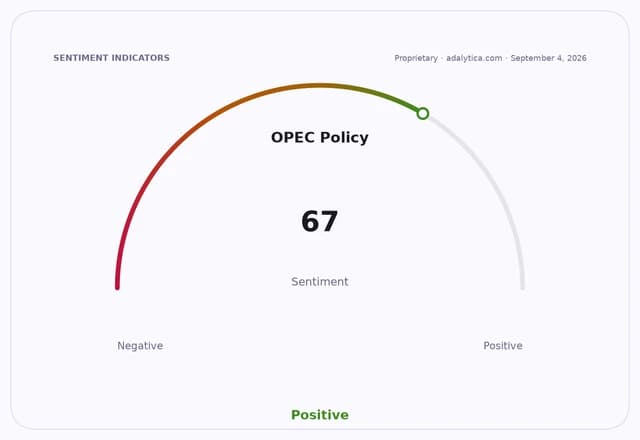
Sentiment IndicatorsⓘProprietary · adalytica.com · September 4, 2026
This is a snapshot — live sentiment, awareness and momentum for 130+ markets update continuously in the dashboard.Open AlphaPulse

The economic significance is hard to miss. If China is now the marginal force shaping crude balances, then the market’s center of gravity has shifted from producer coordination to consumer behavior. That matters because Chinese refiners, state stockpilers and policymakers can absorb barrels, delay purchases or accelerate buying in ways that ripple through prices, freight and refining margins worldwide. The oil market increasingly looks less like a simple OPEC-versus-shale contest and more like a three-way struggle among Middle East producers, U.S. supply and China’s demand machine.
The backdrop strengthens Sechin’s point. China has been rapidly expanding energy infrastructure and is still reworking its fuel mix even as solar capacity has surpassed coal for the first time, according to separate data cited in the market context. That underscores a broader point: China is not just a passive buyer of oil, it is actively reshaping the composition of its energy system. At the same time, Russian officials are openly telling investors that China will take more than 60% of Russia’s natural gas exports by 2030, a reminder that Moscow is increasingly tied to Beijing’s long-term energy appetite.
For investors, that means the old OPEC trade is not enough. If China’s imports stay volatile, crude prices can stay range-bound even when producers talk up discipline. That is a headwind for upstream names that rely on a sustained price rebound, but it also creates opportunity in the infrastructure and services tied to China’s energy transition: gas pipelines, LNG logistics, grid buildout, power equipment and the industrial firms that move molecules and electrons rather than speculate on them.
The market is also being forced to rethink who has pricing power. Adalytica’s OPEC Policy Sentiment is only neutral, while oil trade signals show extreme fear around WTI even as awareness remains elevated, a combination that usually points to a market that is watching headlines closely but lacks conviction in a durable trend. BP’s shares, meanwhile, have recovered from summer lows, but the stock is still trading well below the kind of euphoric oil-price backdrop that would normally justify a full rerating.
The bigger narrative is that China is turning itself into the key arbiter of energy flows just as OPEC’s cohesion looks more fragile and Russian exports become more China-dependent. That is a structural shift, not a one-day headline, and it argues for positioning around the beneficiaries of Chinese energy reordering rather than assuming the next crude breakout will be driven by producer cuts alone. The best opportunity may not be in chasing oil higher, but in owning the toll roads of the new energy map.
| Entity | Gains | Losses |
|---|---|---|
| China | ▲More pricing power | ▼Reliance on imported crude |
| OPEC | ▲Shorter-term relevance erosion | ▼Ability to steer prices |
| Russia/Rosneft | ▲Deeper China demand link | ▼Less leverage versus Beijing |
| Oil bulls | ▲Demand-driven catalysts | ▼Cartel-driven upside thesis |