China’s central bank kept its benchmark lending rates unchanged for a 14th straight month on Monday, a sign policymakers still view currency stability as more urgent than delivering another immediate shot of stimulus to a slowing economy.
China Keeps Rates Steady as Yuan Stability Takes Priority

The one-year Loan Prime Rate remained at 3.0% and the five-year tenor stayed at 3.5%, matching market expectations but reinforcing a policy stance that has become increasingly cautious as growth momentum softens and the yuan has stabilized after recent pressure. For investors, the decision suggests Beijing is still trying to avoid the kind of aggressive easing that could widen interest-rate differentials with the US, revive depreciation risks and unsettle capital flows.
Sentiment IndicatorsⓘProprietary · adalytica.com · July 20, 2026
This is a snapshot — live sentiment, awareness and momentum for 130+ markets update continuously in the dashboard.Open AlphaPulse

The trade-off is economically significant. China’s domestic demand remains fragile, property-sector conditions are weak and credit demand has yet to show a convincing rebound, which argues for lower borrowing costs. But the case for patience has strengthened as the currency firms: a weaker yuan would complicate financial conditions, raise imported inflation risks and potentially force officials to lean more heavily on administrative tools instead of rate cuts. The central bank is effectively signalling that it would rather preserve room to maneuver than spend policy firepower too early.
That balancing act matters for Chinese lenders, developers and equity investors alike. Banks may continue to face compressed lending margins if policymakers eventually have to cut rates or push more credit support through other channels, while property-linked borrowers remain constrained by the absence of a stronger policy impulse. By contrast, the steadier yuan offers some relief to offshore investors worried about currency losses, especially after periods of elevated foreign-exchange volatility that have weighed on China assets.
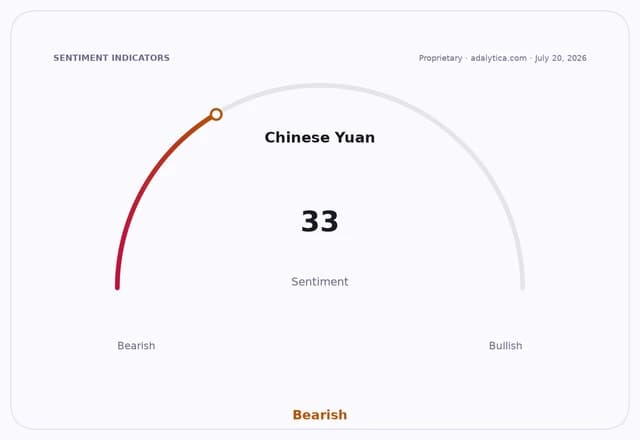
Markets were already pricing in restraint. Chinese equities have struggled to build sustained momentum even as technical readings on the FXI China ETF show a rebound from earlier weakness, with the fund still trading below its 200-day moving average despite recent gains. Adalytica’s Chinese yuan trade signals show sentiment has improved from prior stress, but awareness of the currency remains depressed, highlighting how fragile confidence still is. That combination helps explain why the central bank may be opting to wait for clearer evidence of disinflation or a sharper growth slowdown before moving again.
The broader message is that China’s policy cycle remains constrained by external and internal limits at the same time. Domestic growth needs support, but the currency and global rate backdrop are making it harder to deliver that support through benchmark cuts. Unless activity deteriorates more sharply, Beijing appears likely to keep leaning on selective credit measures, fiscal backing and targeted liquidity rather than broad rate reductions.
For investors, the next catalyst will be whether economic weakness deepens enough to force a change in that calculus. Until then, stable LPRs point to a policy stance that protects the yuan first and growth second — a combination that may cap upside for Chinese banks, developers and cyclical stocks even as it reduces near-term currency risk.
| Entity | Gains | Losses |
|---|---|---|
| Yuan holders | ▲Less depreciation risk | ▼Slower policy easing |
| Chinese banks | ▲Margin stability | ▼Weak loan demand |
| Property borrowers | ▲Avoid sharper rate shock | ▼No meaningful relief |
| China equity bulls | ▲Currency support | ▼Limited growth stimulus |