China’s consumer and investment slowdown deepened in August, reinforcing a split economy that is leaning harder on exports and industrial production while household demand and fixed-asset spending lose momentum.
China Retail Sales and Investment Slow in August

Retail sales rose just 0.4% from a year earlier, down from 0.6% in July and below the 0.8% expected by economists, while urban fixed-asset investment contracted 7.2% in the first eight months of the year, a sharper decline than the 6.7% fall recorded through July. The data suggest Beijing’s campaign to stabilize growth is not yet feeding through to the parts of the economy that matter most for balanced expansion: consumption, property-linked investment and infrastructure spending.
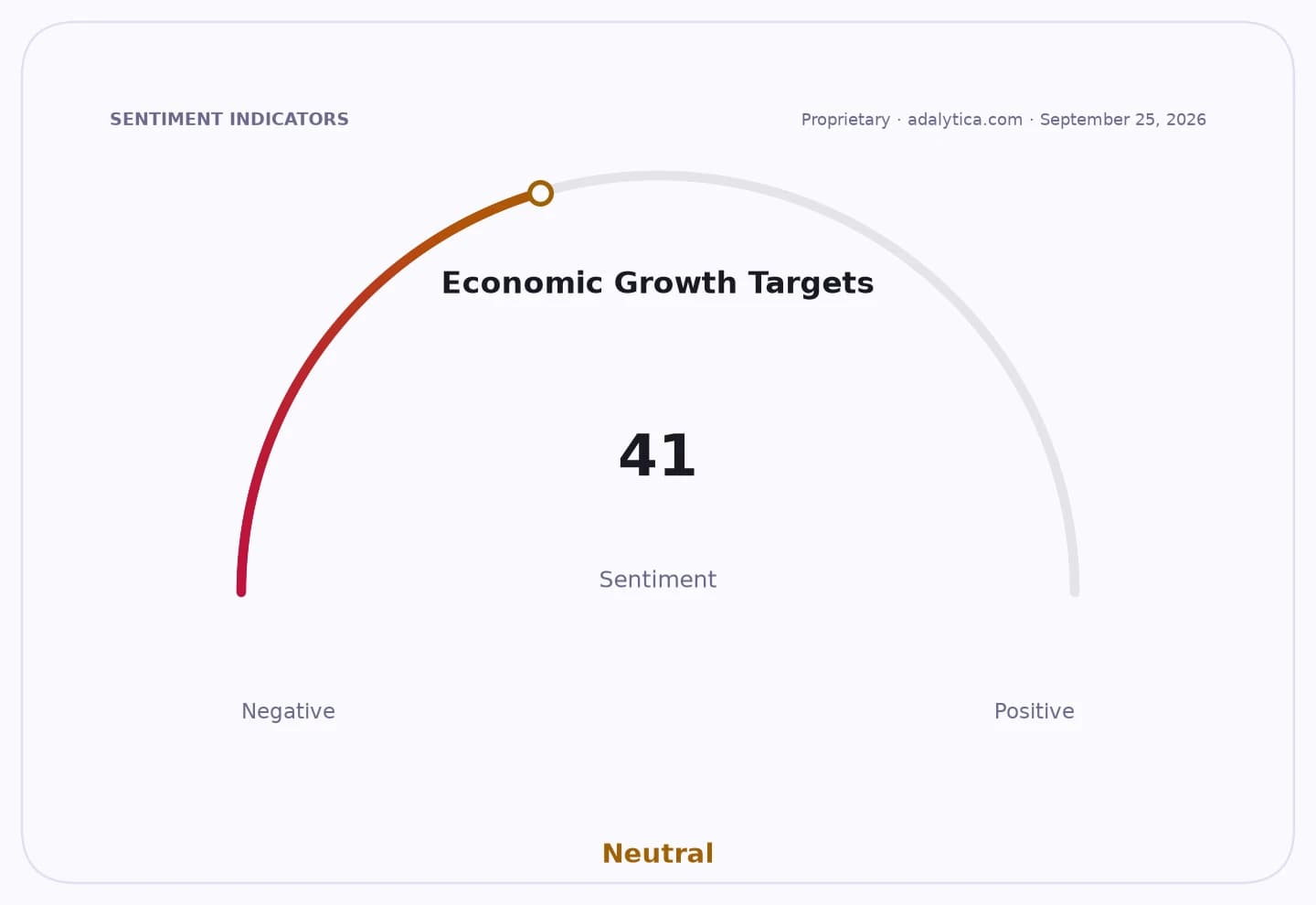
Sentiment IndicatorsⓘProprietary · adalytica.com · September 24, 2026
This is a snapshot — live sentiment, awareness and momentum for 130+ markets update continuously in the dashboard.Open AlphaPulse
The mismatch matters because domestic demand remains the weakest leg of China’s growth model. A consumer spending slowdown reduces pricing power for retailers, restaurants and discretionary brands, while a deeper slide in investment points to continuing stress in real estate and a cautious stance from local governments and private firms. For policymakers, that raises the odds of additional easing measures or targeted fiscal support, especially if growth remains near the lower end of Beijing’s target range in the third quarter.
Industrial production offered some relief, rising 5.2% year on year versus 4.5% in July and beating forecasts of 4.8%. But that strength is increasingly being driven by external demand and industrial upgrading rather than a broad-based domestic recovery. China’s statistics bureau warned that the external environment has become more adverse and that there remains an “acute” imbalance between strong supply and weak demand at home.
That divergence is exactly what investors are watching. Strong factory output can support earnings for exporters, equipment makers and technology manufacturers, but it does little for consumer-facing sectors that depend on healthier household balance sheets and sentiment. ING said the latest figures show consumption and investment remained weak because of soft internal demand, while external demand continued to support activity, adding that third-quarter GDP is likely to land near or below the bottom of China’s official range.
The market implication is a continued preference for exposure to China’s industrial and high-tech winners over domestically focused sectors. Shares linked to Chinese growth have already reflected the uneven picture: the FXI China ETF is trading below its 50-day and 200-day moving averages, while the broader MCHI fund remains under pressure even after recent rebounds. For global investors, that keeps China more of a trade in policy headlines and sector selection than a straightforward macro recovery story.
The bigger narrative is that China is no longer slowing everywhere at once. It is becoming more polarized, with technology-intensive and export-linked industries holding up while the consumer economy and investment cycle lag behind. Unless September data show a meaningful turn in spending and capital formation, the case for a durable rebound in Chinese domestic demand will remain weak.
| Entity | Gains | Losses |
|---|---|---|
| Exporters / industrial firms | ▲Stronger external demand | ▼— |
| China’s policymakers | ▲Industrial resilience | ▼Weak consumer demand |
| Consumers / retailers | ▲— | ▼Soft spending growth |
| FXI / MCHI bulls | ▲Policy stimulus hopes | ▼Domestic-demand slowdown |