China’s services trade expanded at a brisk 8.5% pace in the first nine months of 2026, underscoring Beijing’s effort to rebalance growth toward consumption, technology and higher-value cross-border activity as the country leans less on goods exports and factory-led expansion.
China services trade grows 8.5% in first nine months
Services imports and exports reached 5.77 trillion yuan, or about $859 billion, from January through September, with exports rising 14.8% and imports up 4.8%, according to the Ministry of Commerce. The faster growth in exports left a services trade deficit of 1.23 trillion yuan, but the more important story for policymakers is that the sector is still expanding strongly even as China tries to build new competitive advantages in an economy under pressure from property weakness, soft domestic demand and trade friction abroad.
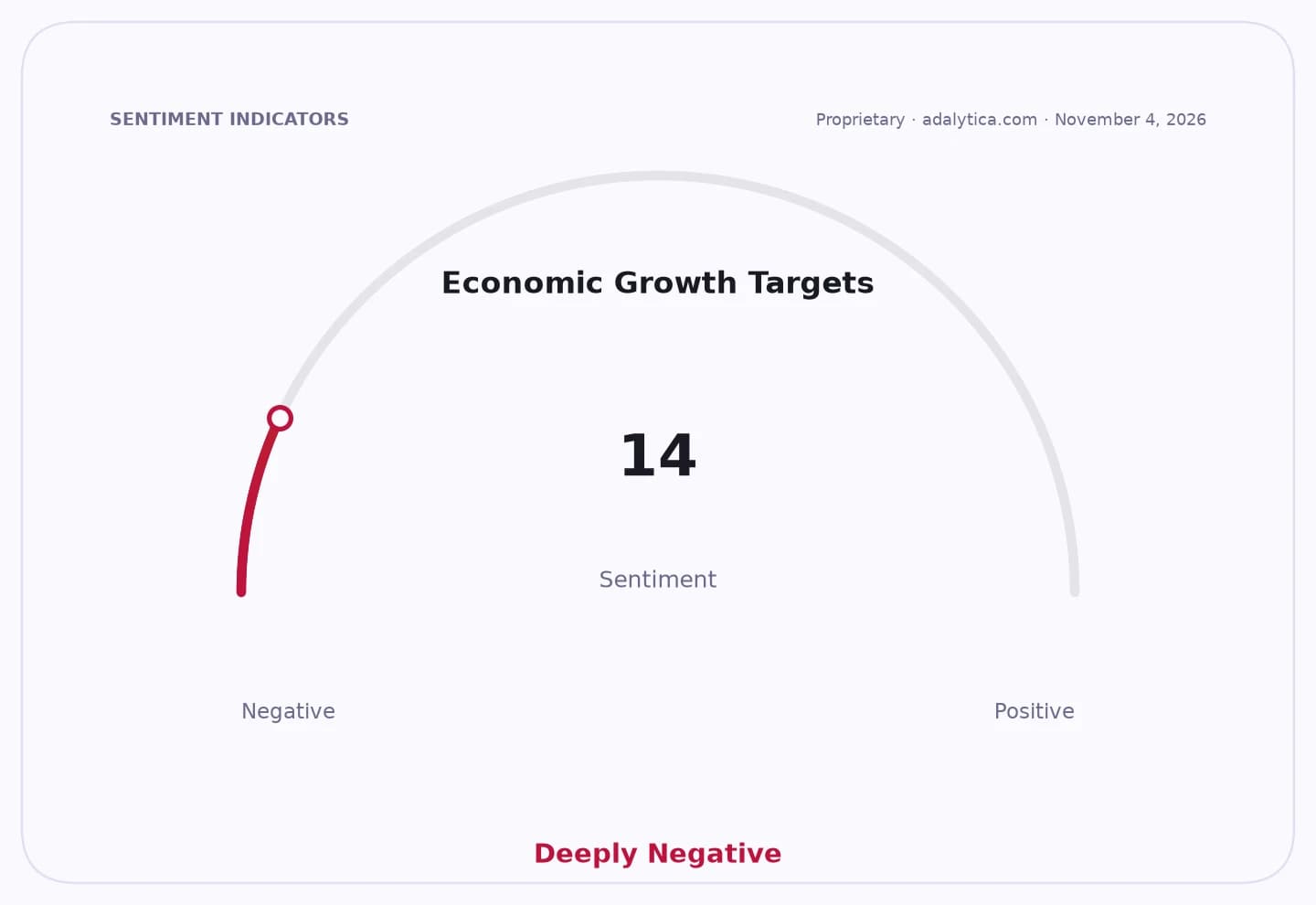
Sentiment Indicators
Transport services were the standout, surging 33.9% in the period, while knowledge-intensive services — which now account for 43.9% of all services trade — increased 7.4%. That mix matters because it shows China is not just exporting more logistics and travel-related activity, but also building scale in areas such as intellectual property, business services and digital offerings that tend to generate higher margins and deeper integration into global supply chains.
For Beijing, the strategic value is clear. Services trade is becoming a lever for “high-standard opening up,” a policy phrase that means broader access for foreign firms, better domestic standards and a larger role for the services sector in international commerce. The 15th Five-Year Plan for 2026-2030 calls for vigorously developing services trade, while the 2026 government work report promised to improve national standards and cultivate a “China Services” brand.
The policy push is already being operationalized. In April, the commerce ministry launched a plan to develop national demonstration zones for services trade in 16 cities including Beijing, Tianjin and Shanghai, plus Hainan province, aiming to build industry clusters and significantly raise liberalization by 2035. That suggests the government sees services not as a peripheral add-on to manufacturing, but as a core growth engine and a way to absorb external shocks from tariff disputes and slowing global demand for goods.
Investors are likely to read the data as a mixed but constructive signal for China-related assets. On one hand, the expansion supports the case that China’s external sector is broadening beyond traditional exports. On the other, the sizeable deficit in services trade highlights the country’s continued reliance on imported travel, transport, business and intellectual-property services, which keeps outflows elevated and means the structural shift is still incomplete.
The global implications are also material. Li Bin, deputy head of the State Administration of Foreign Exchange, said China’s services imports exceeded $620 billion in 2025, making it the world’s second-largest importer of services. For multinational airlines, logistics groups, tourism operators, software firms and professional-services providers, that scale makes China an increasingly important source of demand even when broader trade conditions are uneven.
For equity investors, the near-term read-through is more about policy direction than immediate earnings upside. Chinese internet, education, travel, logistics and selected industrial service names could benefit if liberalization deepens and domestic demand stabilizes. But the longer-term test will be whether Beijing can convert policy support into sustained productivity gains and higher-margin services exports rather than simply expanding a deficit-funded consumption channel.
The key catalyst now is execution. If the demonstration zones succeed and standards improve, China could strengthen its position in global services trade and reduce dependence on cyclical goods exports. If not, the headline growth rate may prove less important than the fact that the country is still searching for a durable engine of balanced, services-led expansion.
| Entity | Gains | Losses |
|---|---|---|
| Chinese services exporters | ▲Higher demand, policy support | ▼Execution risk |
| Foreign services providers | ▲Access to a larger market | ▼Pricing pressure |
| Chinese consumers/travel users | ▲More choice, better services | ▼Persistent import-led deficit |
| Goods exporters | ▲Less policy focus on surplus | ▼Slower relative attention |