China’s plan to repurpose thousands of abandoned coal mines as underground farms is less a quirky science project than a practical response to two of the biggest long-term risks in the global economy: climate stress on food production and the need to find productive uses for a massive industrial legacy.
China Plans Underground Farms in Abandoned Coal Mines
That is why investors should pay attention. If researchers can turn disused mines into controlled environments for crops, China could create a new model for climate-resilient agriculture that uses existing infrastructure, steadier underground temperatures and geothermal energy instead of depending entirely on increasingly erratic weather. For a country expected to have about 15,000 abandoned coal mines by 2030, with roughly 7.2 billion cubic meters of underground space, the opportunity is not trivial.
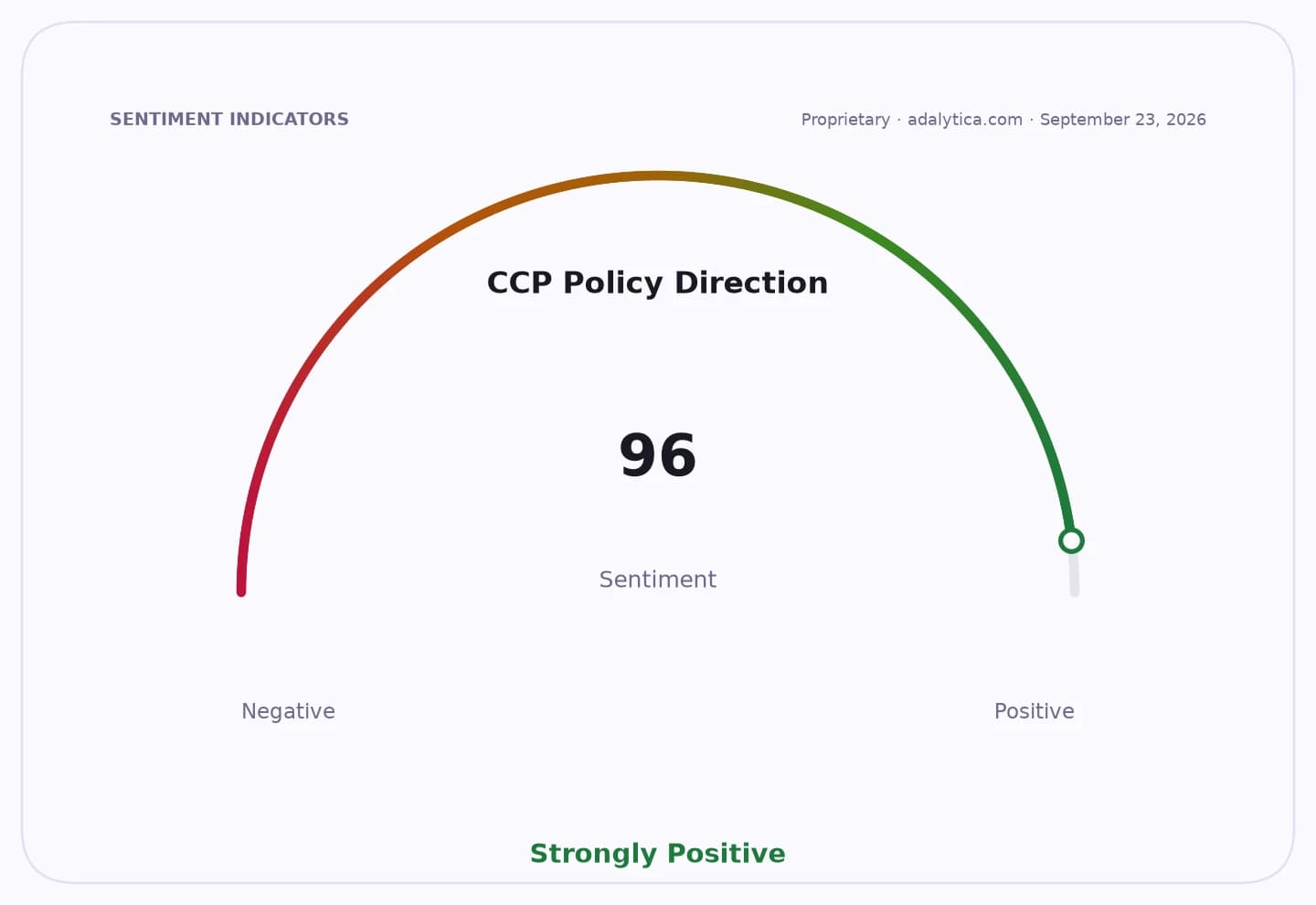
Sentiment IndicatorsⓘProprietary · adalytica.com · September 11, 2026
This is a snapshot — live sentiment, awareness and momentum for 130+ markets update continuously in the dashboard.Open AlphaPulse
The basic idea is simple: move parts of agriculture underground, where temperature swings are far smaller than on the surface and lighting, water and air can be controlled. Scientists in Shanxi have already outlined the concept in China Mining Magazine, arguing that old mines could become large-scale test beds for crops and technologies designed to perform in fully regulated conditions. That makes sense in a world where droughts, floods and heat extremes are making traditional farming less reliable.
Economically, the appeal is broader than food production alone. China has spent decades extracting value from coal; now it is looking for a second life for the holes left behind. If underground farms work, they could reduce the cost of land use, support local research ecosystems and lower energy intensity by tapping geothermal heat in some sites. They could also create demand for lighting systems, water treatment, membranes, sensors and automation — all the plumbing of the next generation of agriculture.
The work is still experimental, and that is important. Chinese researchers are not talking about replacing open-field farming tomorrow. They want to use abandoned mines as giant laboratories, testing how plants respond when temperature, water, light and air are tightly managed. They are also studying how to treat contaminated mine water through methods such as adsorption and membrane separation, since abandoned mines often hold pollutants from lubricants, hydraulic fluids and old workings.
There are already small proof points. In Daye, in Hubei province, scientists are growing butterhead lettuce about 245 meters underground in a former copper mine using artificial lighting, smart cultivation systems and low-emissions power sources. Britain has its own underground farming experiments in North Yorkshire, and the concept has been circulating for years. The difference now is scale: China’s mine inventory is so large that even a modest success could be replicated across a vast industrial footprint.
For long-term investors, the bigger takeaway is that climate adaptation is becoming a real investable theme, not just a policy slogan. Companies tied to controlled-environment agriculture, water recycling, energy-efficient lighting and industrial automation could benefit as governments and researchers search for ways to make food systems more resilient. At the same time, miners and coal-heavy regions face a new question: what happens after extraction ends?
That’s why this story matters beyond China. It is really about the future of land use, food security and industrial reuse in a hotter world. The companies and countries that figure out how to turn old assets into productive new ones will be better positioned than those that keep treating climate disruption as a temporary problem. For investors, it is worth watching the suppliers and technologies that can help agriculture move underground — and, more broadly, the businesses built for a less predictable climate.
| Entity | Gains | Losses |
|---|---|---|
| China’s researchers | ▲New test beds for climate-proof farming | ▼Higher technical complexity |
| Controlled-environment agriculture suppliers | ▲More demand for systems and sensors | ▼Slow adoption risk |
| Coal-region communities | ▲Second life for abandoned mines | ▼Cleanup and retrofit costs |
| Traditional open-field farming | ▲— | ▼More pressure from climate volatility |