The European Banking Authority’s classification of Circle’s USDC as the first significant e-money token in the European Union gives the world’s largest regulated dollar stablecoin a clearer path into mainstream payments, while tightening scrutiny on an asset class that is moving deeper into the financial system.
Circle USDC Gets EU Significant E-Money Designation
The designation matters because it moves USDC from being a fast-growing crypto settlement tool to a token that European regulators now view as systemically relevant. Under the EU’s Markets in Crypto-Assets regime, “significant” stablecoins face heavier oversight on reserves, governance and reporting, reflecting the risk that a widely used token can become infrastructure rather than a niche trading instrument.
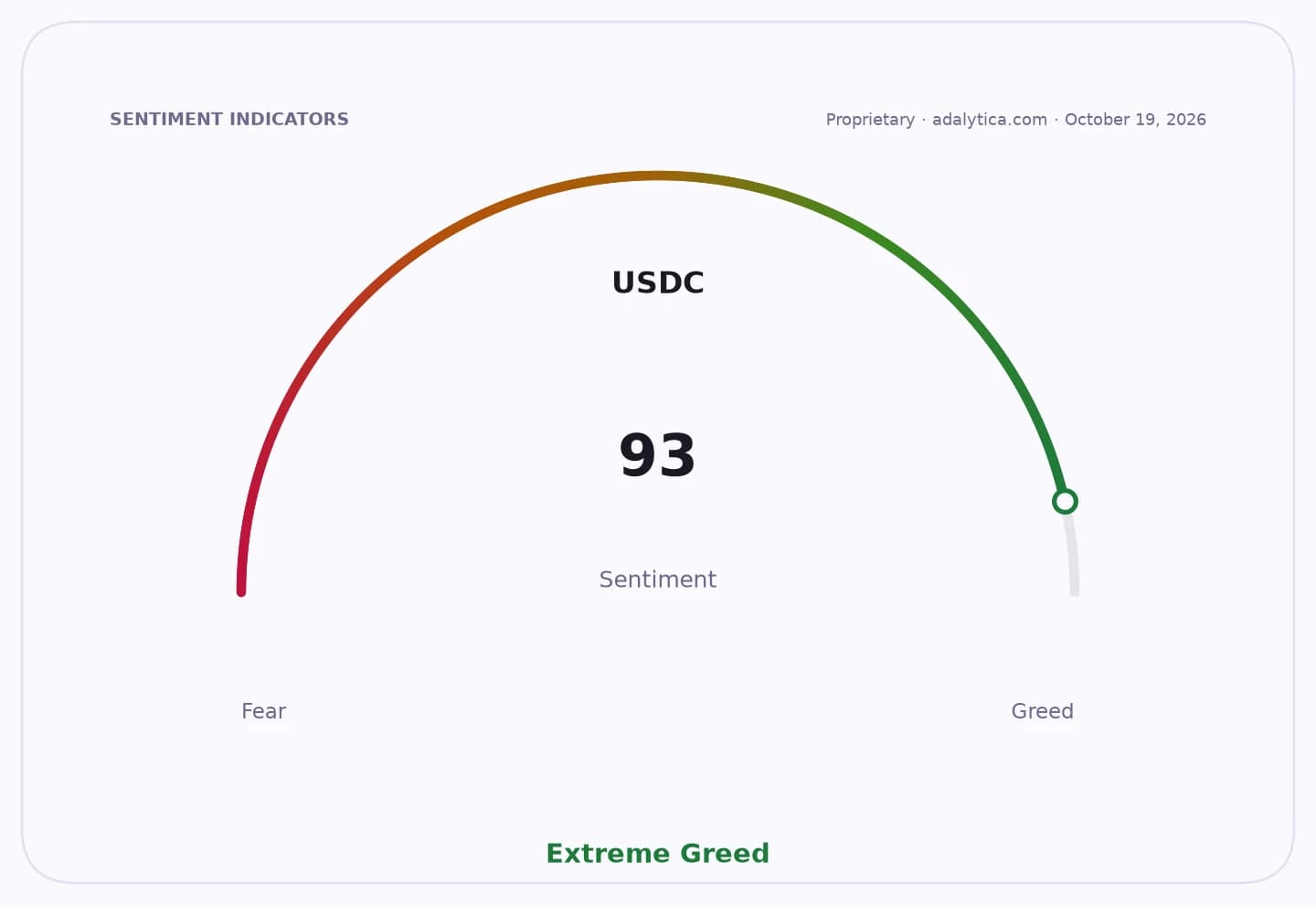
Sentiment IndicatorsⓘProprietary · adalytica.com · October 19, 2026
This is a snapshot — live sentiment, awareness and momentum for 130+ markets update continuously in the dashboard.Open AlphaPulse
For Circle, that is both validation and pressure. The company has spent heavily to build distribution, paying more than half its first-half 2026 revenue on distribution and transaction costs even as USDC volumes expand. The token settled $36 trillion in transactions in the first half of 2026, according to company disclosures cited in the market context, and is now being embedded into payment rails through partnerships such as Visa’s USDC prefunding tool and Samsung’s integration across 82 million phones.
Investors have been treating that growth as evidence that stablecoins can become a core layer of payments, not just a crypto market plumbing asset. Circle’s stock has been volatile, but the broader trend in its price action has been strong relative to earlier lows, reflecting expectations that regulatory clarity and enterprise adoption will eventually support higher recurring usage. USDC-related trade signals in Adalytica’s proprietary gauge also point to unusually elevated interest, with sentiment at “Extreme Greed” even as awareness remains low, underscoring how much of the market is still trying to price in the regulatory opportunity.
The EBA ruling also has competitive implications. It strengthens Circle’s position against rival tokens and payment providers by giving European institutions a clearer compliance framework for using USDC. But it may also raise the cost of scaling in the region, because the more important USDC becomes, the more capital, operational discipline and regulatory reporting Circle will need to maintain.
For investors, the key question is whether European recognition accelerates adoption fast enough to offset rising compliance and distribution costs. If it does, USDC stands to benefit from a larger share of institutional payment flows and treasury use. If it does not, the designation could reinforce the idea that stablecoins are becoming more regulated just as they are becoming more expensive to run.
What to watch next is whether EU banks, fintechs and payment companies start treating USDC as approved infrastructure for cross-border settlement and prefunding, and whether Circle can convert that status into revenue growth without further compressing margins.
| Entity | Gains | Losses |
|---|---|---|
| Circle / USDC | ▲Regulatory legitimacy | ▼Higher compliance burden |
| EU banks and fintechs | ▲Clearer stablecoin access | ▼More oversight costs |
| Competitor stablecoins | ▲Market pressure | ▼Relative disadvantage |
| Investors in CRCL | ▲Adoption upside | ▼Margin compression risk |