AI projects are increasingly stalling before a single line of code is written because companies are trying to automate broken processes without first understanding how those processes really work. That is the core problem behind the adoption paradox now visible in Colombia, where 42% of companies have taken up AI — roughly one every five minutes — but only 12% are achieving a meaningful transformation.
Colombia AI Adoption Study Flags Process Discovery Gap
The implication matters well beyond one market. For businesses, the failure mode is economic: if the business case is built on assumptions rather than operational evidence, AI spending can be diverted into cosmetic upgrades, duplicate workflows and pilots that never scale. For investors, that raises a familiar question in the AI trade: which vendors are capturing durable enterprise budgets, and which are benefiting from experimentation that will not survive procurement scrutiny?
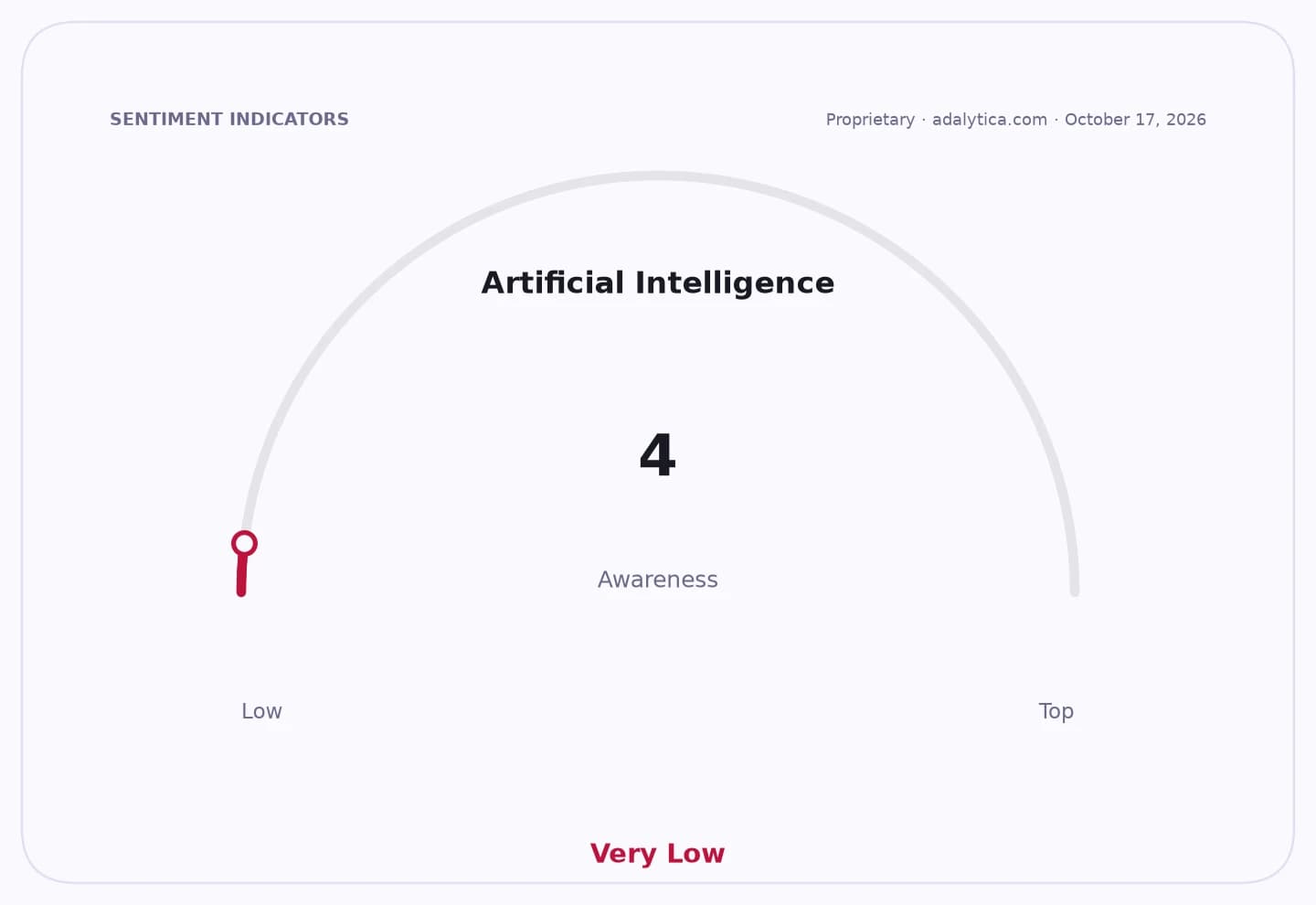
Sentiment IndicatorsⓘProprietary · adalytica.com · October 17, 2026
This is a snapshot — live sentiment, awareness and momentum for 130+ markets update continuously in the dashboard.Open AlphaPulse
According to the study cited in the source material, the biggest bottleneck is the discovery phase, where companies are supposed to identify friction points, measure process variability and decide where AI can deliver quantifiable value. Instead, many still rely on workshops, manual process maps and executive intuition. EPAM Colombia managing director Fernando Silvestre said those methods are “insufficient” for modern corporate systems and lead firms to build cases on “assumptions and not on real data,” leaving development teams to inherit operational gaps that should have been fixed first.
That distinction is critical because AI economics depend on baseline efficiency. In regulated sectors such as insurance and financial services, management may believe a claims workflow takes three or four days, while event data can expose hidden rework loops that make the true cycle far longer. If the process is poorly understood, AI can end up optimizing the wrong step, or worse, automating inefficiency at scale. That is why the article argues that discovery is not an academic preface to deployment but the main determinant of return on investment.
The market consequence is a shift in demand from broad AI enthusiasm toward evidence-based implementation tools. Process mining, task mining, natural-language processing and knowledge graphs are being positioned as the infrastructure layer that can reconstruct real workflows from system logs, manual workarounds, policies and relationships across roles and data. In practical terms, this favors software and services firms that can prove operational visibility before deployment, rather than those selling the fastest route to a demo.
For Microsoft, Nvidia and Salesforce, the broader theme is mixed. These companies remain central beneficiaries of enterprise AI spending, but their filings show the same tension: customers can delay or reduce AI workloads, regulators can impose constraints, and inadequate governance can reduce acceptance of AI products. That means the next phase of AI monetization is less about model novelty and more about trust, control, compliance and measurable process gains.
The bull case is that once enterprises move past hype, spending becomes more durable because it is tied to core workflows rather than discretionary experimentation. The bear case is that a meaningful share of current AI adoption will be exposed as superficial, with budgets reprioritized toward process redesign, governance and systems integration instead of new tools. Either way, the message for investors is clear: the winners are likely to be the firms that help companies understand their own operations before trying to automate them.
| Entity | Gains | Losses |
|---|---|---|
| Process mining vendors | ▲More demand for discovery tools | ▼Manual workshops |
| Enterprise AI providers | ▲Durable, workflow-based budgets | ▼Demo-driven pilots |
| CFOs and operators | ▲Better ROI visibility | ▼Misallocated AI spend |
| Microsoft, Nvidia, Salesforce | ▲Larger long-term enterprise markets | ▼Faster revenue conversion from hype |