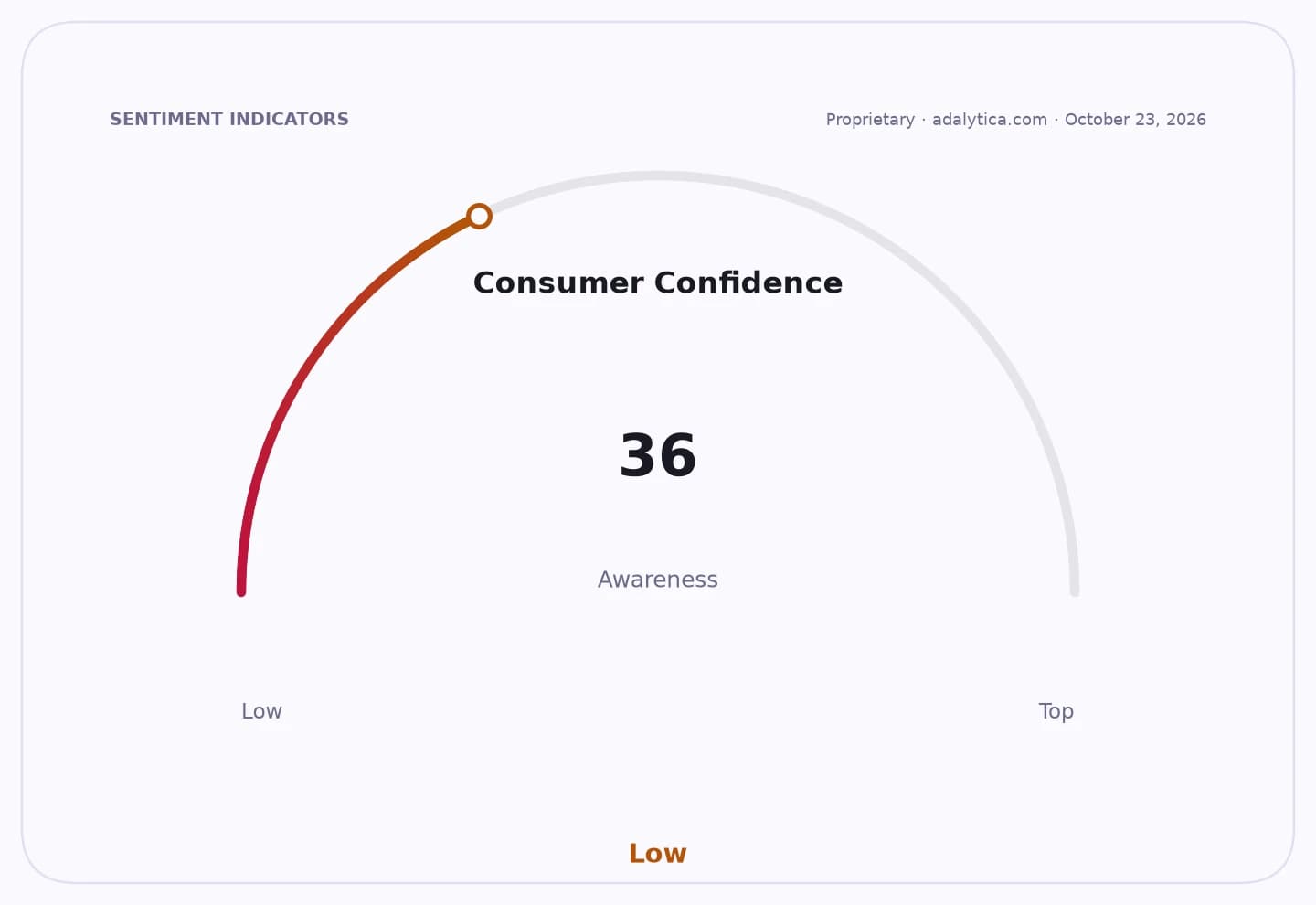
Consumer confidence in Colombia climbed sharply from a year earlier in September, but the latest reading still shows households are upbeat about the economy’s direction while turning more guarded about their own finances and big-ticket purchases.
Colombia Consumer Confidence Rises in September
Fedesarrollo said its consumer confidence index rose to 15.7% from 1.6% in September 2025, a gain of 14.1 percentage points that points to a stronger outlook for income, jobs and consumption over the coming months. For an economy that depends on household spending to support growth, that matters because firmer confidence can translate into demand for housing, cars and durable goods.
Sentiment IndicatorsⓘProprietary · adalytica.com · October 16, 2026
This is a snapshot — live sentiment, awareness and momentum for 130+ markets update continuously in the dashboard.Open AlphaPulse
The monthly picture was less convincing. The index rose just 0.2 points from August, as the improvement in expectations was offset by weaker views of current household conditions. Fedesarrollo’s expectations gauge climbed to 25.1% from 22.6% in August, but the conditions index fell to 1.7% from 4.8%, driven by a swing in the share of respondents saying their family finances were better than a year earlier from 5.4% to -4.8%.
That split matters for investors because confidence is often an early read on whether consumers will sustain spending or pull back. Colombian households said they were more optimistic about the country’s outlook over the next 12 months, with the balance expecting better national conditions rising to 19.9% from 14.8% in August. The balance expecting favorable economic conditions in the coming months also improved to 21.3% from 16.7%.
But the willingness to spend is still uneven. The balance for buying housing improved to -24% from -25.7%, and appetite for durables such as furniture and appliances rose to 8.1% from 4.2%. At the same time, intentions to buy vehicles weakened to -23.4% from -18.6%, suggesting consumers remain selective even as broader sentiment improves.
The gains were not evenly distributed across the country or income groups. Bucaramanga posted the strongest confidence reading at 26.4%, followed by Barranquilla at 20% and Medellín at 18.4%, while Cali lagged at 7.2%. Confidence rose month on month in Bucaramanga, Bogotá and Medellín, but fell in Barranquilla and Cali.
The same pattern showed up by income. Confidence increased only among lower-income households, while it fell among middle- and upper-income consumers. That uneven recovery suggests Colombia’s domestic demand may improve, but not in a straight line.
For markets, the report reinforces the idea that consumption support is still there, but fragile. Retailers, automakers and housing-linked sectors will watch whether the better year-on-year mood starts to feed into actual purchases in the final quarter. The next test is whether the stronger expectations index finally turns into firmer household spending data.
| Entity | Gains | Losses |
|---|---|---|
| Colombian retailers | ▲Better demand outlook | ▼Cautious high-income shoppers |
| Housing sector | ▲Slightly improved buying intent | ▼Still-negative housing balance |
| Auto dealers | ▲Long-term optimism about economy | ▼Weaker vehicle purchase intent |
| Lower-income households | ▲Rising confidence | ▼Middle- and high-income households |